
Innovation is not just about changing an economic model, but first of all, about "liberating" deep and courageous thinking.
From eliminating subsidies, liberalizing prices, reforming monetary and financial systems, to building a legal corridor for the private economy and opening up integration, breakthrough policies have unlocked social resources, bringing Vietnam out of crisis.
More importantly, from policies, the trust of people and businesses has been gradually restored, becoming the foundation for sustainable development.
Reform sprouts sprout in hardship
In the mid-1980s, the Vietnamese economy fell into a comprehensive crisis. Inflation in 1986 reached 774.7%, currency depreciation, wages often had to be paid in kind. The subsidy distribution system could not meet the minimum demand, the black market overwhelmed the formal market. Social negativity increased, life fell into a feeling of deadlock, trust in policies and the future was eroded.
In that context, Doi Moi initiated by the Party at the 6th Congress (1986) was the only way out. However, the road to a market economy was not smooth when centralized planning thinking and bureaucratic subsidies were deeply ingrained in awareness. The market economy was still seen as a counterproduct to the socialist bloc, causing the transition process to take place in a fierce ideological tug-of-war.
However, initial "opening" signals soon appeared. In 1977, Decree 115-CP on foreign investment, then the Foreign Investment Law passed by the National Assembly immediately after the 6th Congress, sent a clear reform message. This is a pioneering step, laying the foundation for the policy of attracting foreign direct investment (FDI) and international integration, even though the country was still encircled and embargoed at that time.
But the real boost to build trust came from agriculture. Resolution 10-NQ/TW in 1988 of the Politburo, also known as Agreement 10, granted long-term land use rights to farmers, establishing them as producers. When liberated, agricultural production exploded, food production skyrocketed, bringing Vietnam from hunger to surplus and rising to the group of leading rice exporting countries.
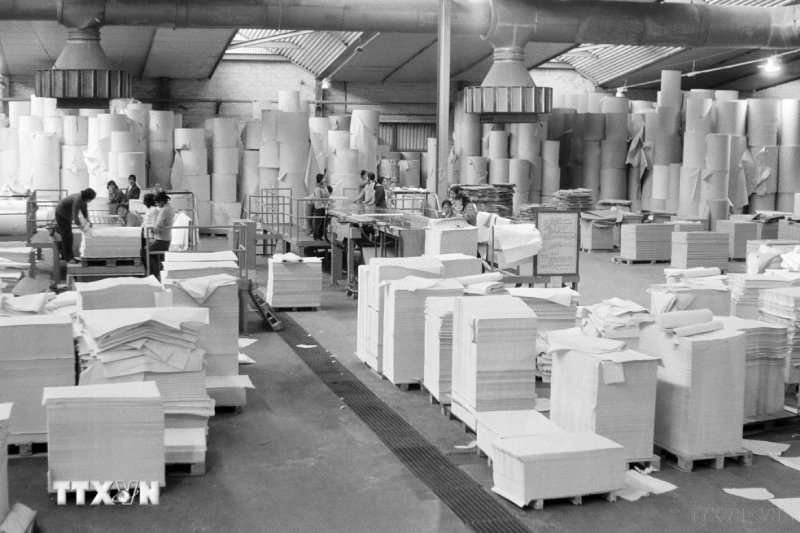
This foundation paved the way for the most comprehensive and drastic reform in the period 1990-1992. In a short time, a series of key policies were promulgated: the Law on Enterprises and the Law on Private Enterprises in 1990 for the first time "legalized" the private economic sector; the Law on Foreign Investment was amended in a more open direction.
In particular, the 1992 Constitution officially recognized the multi-sectoral economy, operating under a market mechanism with state management, marking a strong shift to a socialist-oriented market economy.
In parallel with institutional reform, the State is gradually liberalizing prices, eliminating the two-billion exchange rate mechanism, unifying the exchange rate according to market signals and ending import and export subsidies, stabilizing the macroeconomy, curbing inflation and international integration. All are aimed at creating an important stepping stone for strong economic development later.
Trust becomes a resource
According to Dr. Nguyen Dinh Cung, former Director of the Central Institute for Economic Management Research, the first two years of the 1990s were "the most radical reform in the history of modern Vietnamese economics.
The core bottleneck of the economy at that time was not in the lack of capital or goods, but in the mechanism of allocating non-market resources, eliminating production motivation. The State both sets prices, subsidizes inputs and outputs, and directly intervenes in businesses, causing production to stagnate, the budget to be exhausted, and people to find ways to escape the formal sector.
Now, monetary policy is tightened, real positive interest rates are applied to stop inflation and restore confidence in the currency. Voucher stamps are removed not only because of policy determination, but because the market at this time has enough goods, especially thanks to the achievement of "Contract 10. The consequence is that we have pulled inflation from three digits to two digits in just a few years" - Dr. Nguyen Dinh Cung said.
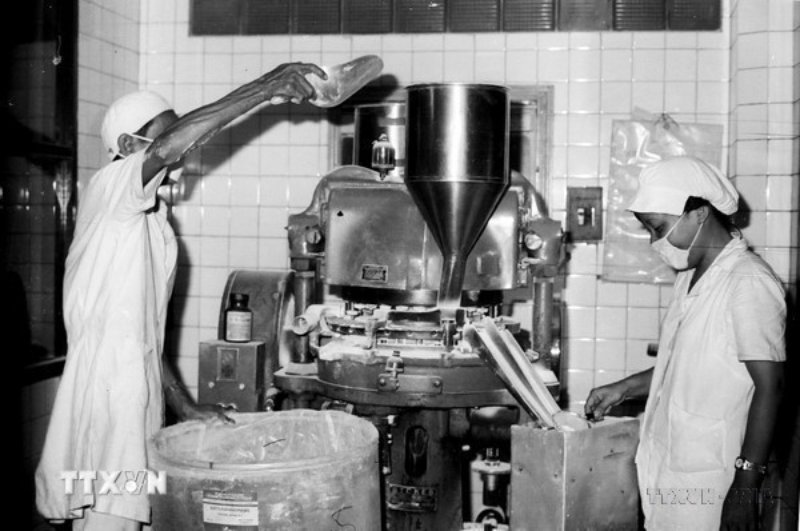
State-owned enterprise reform at this time is also taking place extremely drastically. About 6,000 state-owned enterprises, mainly at the district level, were dissolved due to inefficient operations, prolonged business losses; subsidies were cut. This "very painful but mandatory" decision paved the way for the domestic private economic sector to form clearly, while FDI capital began to flow strongly when sanctions were gradually lifted.
1994 marked an important turning point in the thinking of our Party and State when the Law on Encouraging Domestic Investment was born, followed by the Law on State Enterprises and the Law on Cooperatives, which opened up a mechanism for Vietnamese people to freely do business and get rich, forming a multi-sectoral economy.
The two "wings" of reform - domestic market and international integration, have now flew in the same direction.
In particular, Vietnam's normalization of relations with the United States, joining ASEAN, and then signing the Vietnam-US Trade Agreement (BTA) in 2000 opened up a new development space. Exports grew rapidly, becoming the main driving force of the economy.
The peak of the institutional reform wave was the Enterprise Law and Investment Law of 2005, creating a unified legal framework for all economic sectors, paving the way for Vietnam to join the WTO in 2007, attracting record FDI flows in 2008, with total registered capital reaching more than 64 billion USD.
Recognizing those pivotal policies, Ms. Manuela V. Ferro, Vice President of the World Bank (WB) in charge of East Asia and the Pacific region, emphasized: The bold decision to open up the economy and prioritize exports from the late 1980s was one of the key factors creating Vietnam's success today.
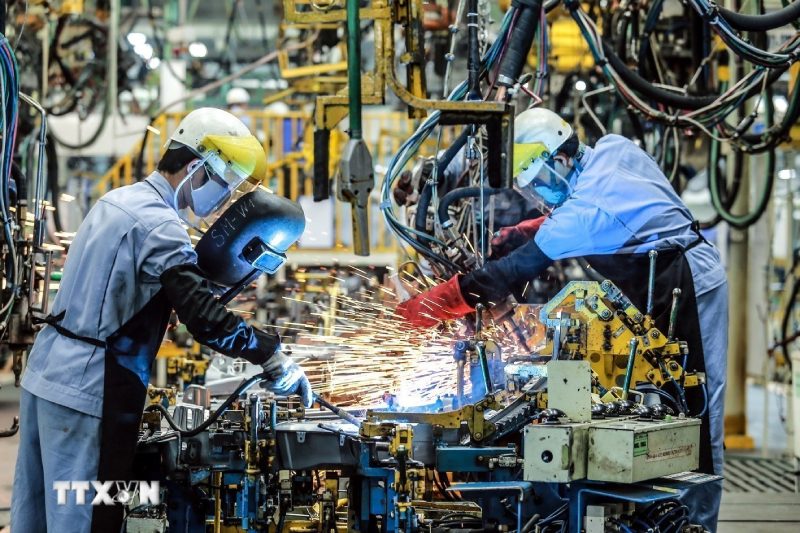
Dr. Nguyen Dinh Cung also affirmed that the biggest success of Doi Moi is not only GDP growth, but that we have established an economic order based on the market and the rule of law. When the State shifts from "working for" to "creating", when businesses and people are trusted, the economy can operate effectively. This is very clearly and specifically manifested in life. Markets are more crowded, goods are more abundant, there are more jobs, people are starting to accumulate and invest in the long term. From worrying about eating every meal, society has switched to worrying about learning, working and the future for future generations.
However, reform is not always successful. The reappearance of the "ask and give" mechanism or the ineffective state-owned corporation models in the past shows that institutional reform always needs to be renewed and strengthened. But the truth is that Doi Moi, especially in the early 1990s, created a historical turning point.
Innovation has rebuilt the belief that people who are empowered will know how to get rich legitimately, and the market, if led by the right institutions, will allocate resources more effectively than administrative orders," Dr. Nguyen Dinh Cung emphasized.


