
Double-digit growth cannot be the result of the old growth model
On May 20, at the Party Central Committee Headquarters, General Secretary and President To Lam chaired a working session with the Central Policy and Strategy Committee and relevant agencies on assessing the country's development resources associated with the implementation of the goal of striving for double-digit economic growth and establishing a new growth model.
Also attending the working session was Politburo Member, Standing Secretary of the Secretariat Tran Cam Tu.
Concluding the working session, General Secretary and President To Lam affirmed that our country has large and important foundations to enter a higher stage of development.
To achieve the very high goals set out by the 14th Party Congress Document and the 5-year socio-economic development plan 2026-2030, it is necessary to fundamentally change the organization and operation of development resources. In other words, double-digit growth cannot be the result of the old growth model being prolonged.
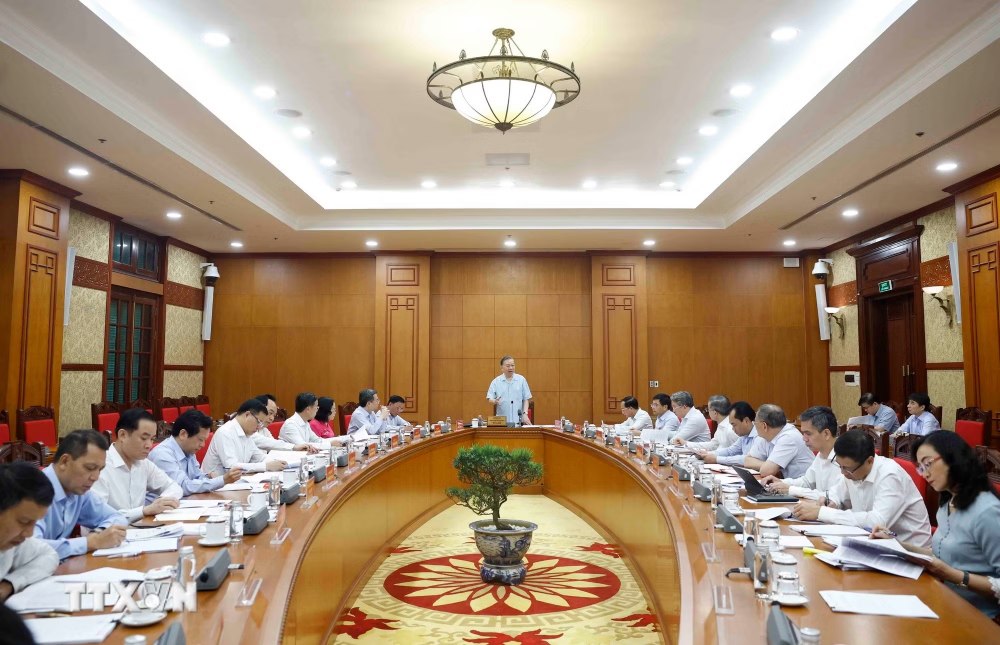
General Secretary and President emphasized that it is not possible to just rely on increasing investment capital, expanding credit, exploiting more land, increasing projects, using cheap labor, processing, assembling or attracting FDI with simple incentives. These motivations are still necessary, but not enough.
A very important issue is to innovate thinking about resources. Resources cannot be considered available, finite, static, just for distribution. Resources must be created, enriched, connected and multiplied.
The State must not only allocate resources, but also create an environment, shape development space, reduce initial risks, lead and activate social resources, resources within the people, private resources, intellectual resources, data resources and cultural resources.
Two-digit growth is a high-quality development goal, not growth at all costs. It is impossible to trade stability for growth; it is impossible to underestimate quality for speed; it is impossible to ignore efficiency for scale; it is impossible to undermine the long-term foundation for the immediate future.
Public resources must lead private resources
The General Secretary and President emphasized that the mechanism of mobilizing, allocating, using and transforming resources must be considered the focus. Not only asking "what resources do we have", but also asking "what mechanisms are there for resources to enter development", serving growth.
Currently, many resources are stuck. If these bottlenecks are not removed, they will fall into the situation of: having resources but not being able to use them; having potential but not being able to transform them; having correct policies but slow results; having high goals but tools not strong enough to implement them.
In particular, it is necessary to review, classify and thoroughly handle resources that are slow to be put into use; do not let national resources lie idle in procedures, disputes, fear of responsibility or in slow coordination between agencies.
Regarding resource allocation, it is necessary to shift from widespread, average, local allocation, by term, by administrative boundaries, to allocation based on efficiency, productivity, spillover and output results.
Public resources must lead private resources. Public investment must activate social investment. FDI must attract domestic enterprises. Infrastructure must open up development space. Science and technology must go into products, revenue, productivity, quality and competitiveness.
The General Secretary and President pointed out that it is necessary to clarify the conditions for resources to serve the double-digit growth target; it is necessary to clearly establish a new growth model and an organizational mechanism for implementation.
The new growth model must rely more on productivity, science and technology, innovation, digital transformation and data.


