
According to the expected program, on April 23, the 16th National Assembly will vote to pass the revised Capital Law.
In the discussion session at the hall on April 12, the majority of National Assembly deputies (NA deputies) agreed with the necessity of amending the Capital Law; at the same time, many opinions expressed support for the policy groups in the draft law, especially the regulations on strong decentralization and delegation of power to the Hanoi City government.
Accordingly, this empowerment will help Hanoi City increase its proactiveness in realizing development aspirations, reaching out and flying high in the new era.
However, it should be noted that thorough and comprehensive decentralization of power for Hanoi City needs to be accompanied by a control mechanism and accountability.
Delegate Trinh Xuan An (Dong Nai delegation) expressed high agreement with the policy of promoting decentralization and delegation of power, strongly empowering localities, especially large cities in the coming time.
The delegate noted a prominent breakthrough point that for the first time the National Assembly is expected to delegate a very large volume of authority to the Capital Government, in which the center is the City People's Council (HĐND).
According to the review, the Hanoi City People's Council is assigned more than 130 powers, spanning many fields, from planning, finance, investment to science, technology and organizational structure. In particular, the City People's Council is empowered to issue special mechanisms and decide on piloting many new policies.
Delegate Trinh Xuan An emphasized that with this approach, the Hanoi City People's Council is no longer a local institution according to the traditional model, but is being positioned as a "policy-creating institution" at a high level, which can be considered a "Urban National Assembly". However, the delegate also noted that when power is granted greatly, the power-enforcement institution must be upgraded correspondingly.
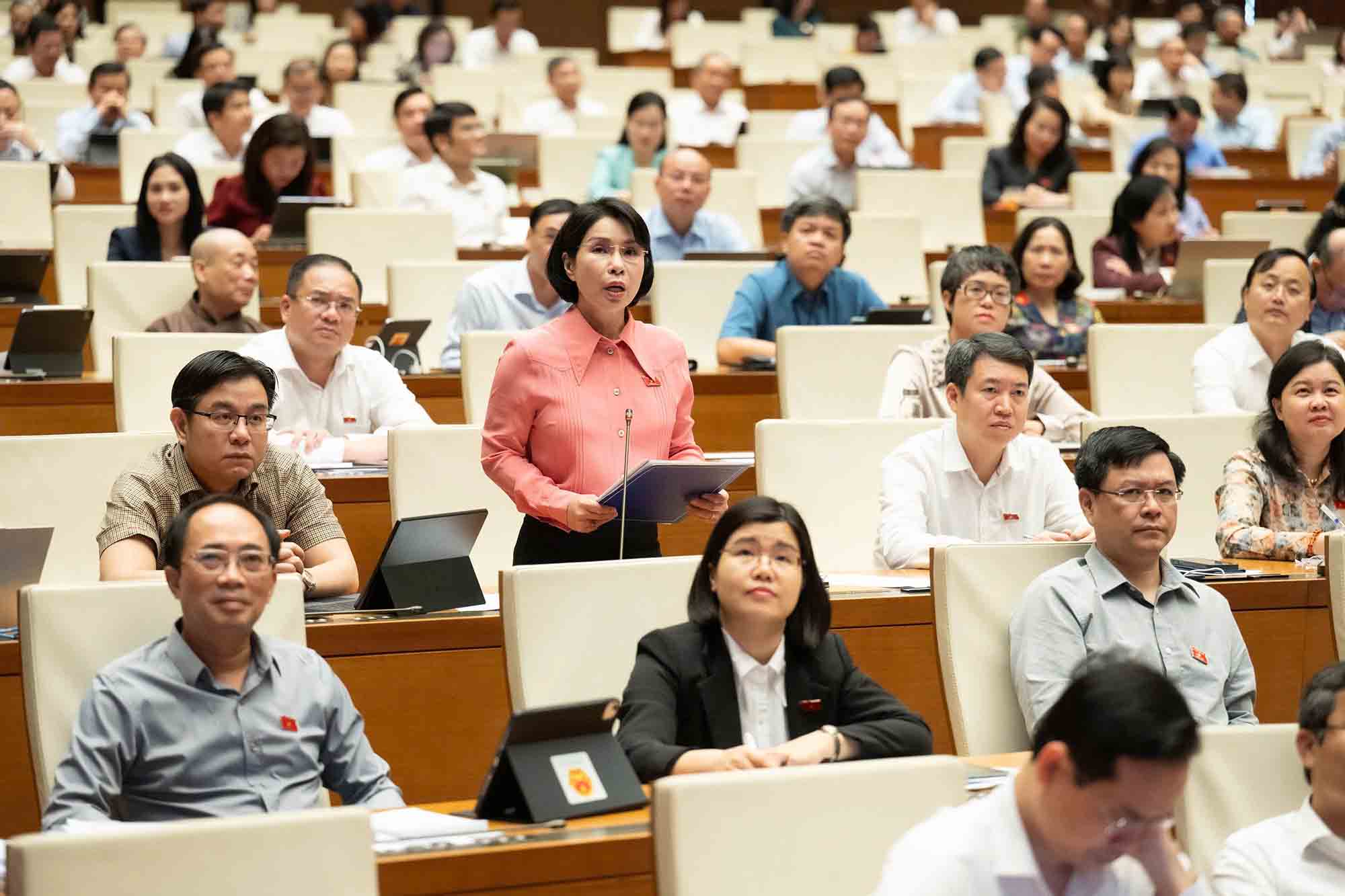
Article 7 of the draft revised Capital Law stipulates that the Hanoi City People's Council is assigned to regulate the organization and operation of villages and residential groups, according to delegate Tran Thi Nhi Ha (Hanoi City delegation), such regulations do not clarify the authority to establish these units.
Meanwhile, according to delegate Tran Thi Nhi Ha, the Law on Organization of Local Government stipulates that the Commune People's Council has the authority to establish villages, and the Ward People's Council has the authority to establish residential groups. Therefore, this regulation in the draft Law is not really suitable for the specific characteristics of the current Capital.
Practice in Hanoi shows that many communes have formed new urban areas, high-rise residential areas with clear urban characteristics. At the same time, there are also wards with rural residential areas and agricultural production, leading to inadequacies in population management and community life organization.
The draft law has also oriented the construction of the capital's overall plan in the direction of integration and stability. Therefore, the lack of flexible mechanisms right now will create institutional delays, reducing the effectiveness and efficiency of governance" - delegate Tran Thi Nhi Ha analyzed.
Delegate Tran Thi Nhi Ha proposed to supplement Article 7 in the direction that the City People's Council stipulates that the People's Councils of communes and wards are allowed to decide to establish villages and residential groups when fully meeting the criteria. Thereby ensuring flexibility in organizations and residential units at the grassroots level, not completely depending on traditional administrative boundaries.
Sharing the same view, delegate Nguyen Minh Tam (Quang Tri Provincial Delegation) proposed to consider the contents of regulations on the organization and operation of villages and residential groups and regulations on the number of establishments, reorganizations, and dissolutions of specialized agencies and administrative organizations under the commune-level People's Committee specified in point d, clause 1, Article 7, then delegate authority to the commune-level government.


