
On the afternoon of September 14, at the Party Central Committee Headquarters, General Secretary and President To Lam chaired a working session with the Central Policy and Strategy Committee and relevant agencies on the Project to build new regulations on party members working in the private economy, according to VNA.
Concluding his speech, the General Secretary and President emphasized that the policy of party members doing private economics is the result of a process of innovating thinking, summarizing practice and developing the Party's theory.
The new regulations must inherit the principles that are still valuable and solve new issues of ownership, production organization, distribution and party member responsibility in the socialist-oriented market economy.
The General Secretary and President clearly stated that it is necessary to affirm the right of party members to participate in legal economic activities associated with legal status, responsibilities and specific obligations.
Party membership requires higher exemplary responsibility, not creating business privileges.
All support policies must be based on the criteria of publicity, equality, and not allowing businesses to be discriminated against because the owner has or does not have Party membership.
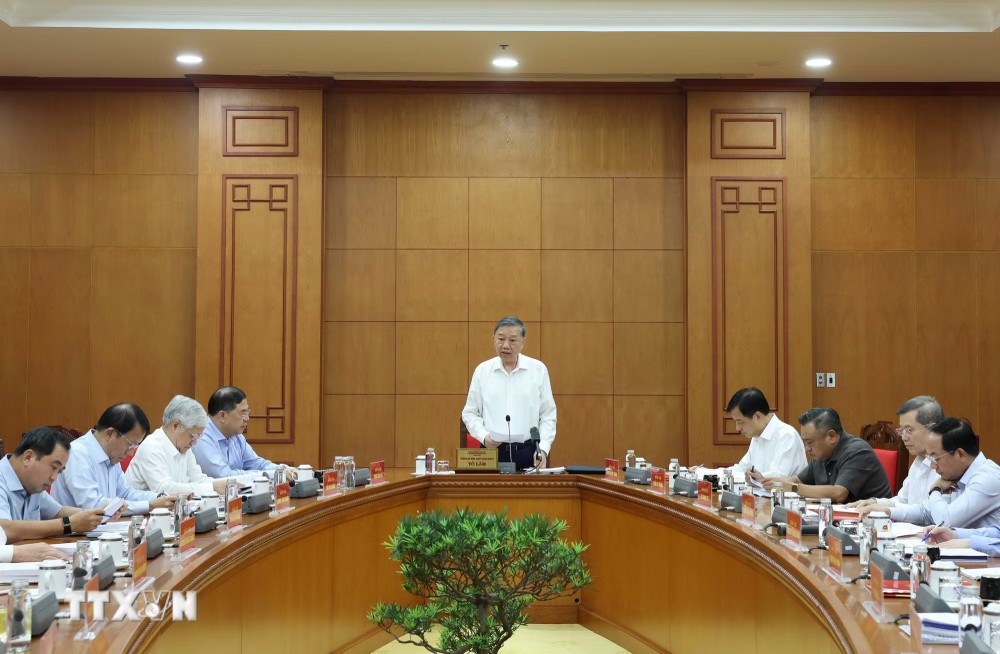
The General Secretary and President requested to clarify the current situation and correctly define the scope of the new regulations; the summary report must increase the analysis of causes and actual effectiveness; the name of regulations on party members doing business in the new development period, and proposed to continue to improve them in the direction of covering legal forms of economic participation, clearly defining regulatory limits.
Central regulations need to be concise, clearly defining principles, subjects, limits, responsibilities and authority. The contents directly deciding the scope of work to be done and not to be done must be clearly defined.
The General Secretary and President emphasized the contents of defining rights and limits according to each group of party members: outside the public sector; incumbent cadres and civil servants; public employees; party members in the People's Army, People's Police; leaders of state-owned enterprises, state capital representatives; people who have resigned from their positions, retired, or quit their jobs.
The motivation for striving, qualities, prestige and training process must be considered substantively, not chasing after quantity or taking the ability to sponsor as a basis for admitting party members.
Assessing party members doing business must value productivity, innovation, and the implementation of tax, salary, insurance, labor safety and environmental protection obligations.
Social responsibility must start from those who are creating values with us, it is impossible to use sponsorship and charity to compensate for violations of obligations to employees. Good practices need to be praised with verified results, thereby spreading the culture of honest business.
The General Secretary and President assigned the Central Policy and Strategy Committee to take the lead in receiving and completing the project; coordinate with the Central Organization Committee to clarify the classification of party member management and cadre mechanisms; coordinate with the Central Inspection Committee to complete the control, supervision and handling mechanisms.
The Government Party Committee leads the review of relevant laws; proposes a roadmap to institutionalize and coordinate with the National Assembly Party Committee on contents under the authority of the National Assembly.
General Secretary and President affirmed that the new regulations on party members doing private economic activities must help party members feel secure in contributing and doing business in accordance with the law; help the Party organization manage substantively; help people and businesses be confident in the fairness and integrity of the apparatus; promote resources for development; make the Party cleaner, stronger, and more attached to the people.


