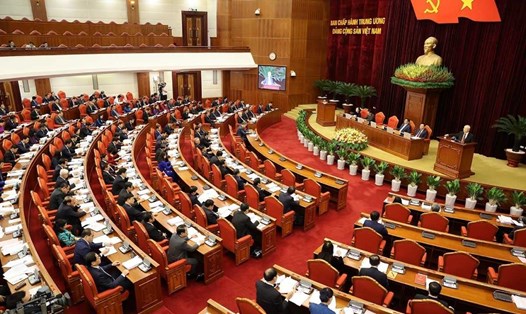
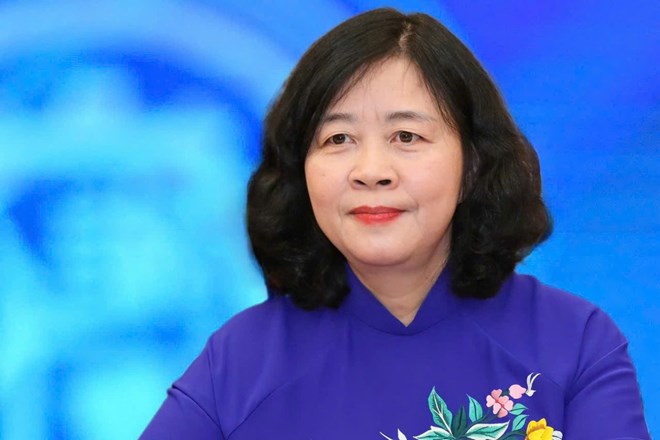
In the atmosphere of the 14th National Congress of the Party, Ms. Bui Thi Minh Hoai - Member of the Politburo, Secretary of the Party Central Committee, Secretary of the Party Committee of the Fatherland Front (MTTQ), Central mass organizations, Chairwoman of the Central Committee of the Vietnam Fatherland Front had an article: "Promoting the people's right to mastery in participating in building and perfecting institutions, strengthening the great national unity bloc; directions and tasks, solutions in the 14th Congress of the Party".
The article not only sets out task orientations, but also suggests many important issues in the process of building and perfecting institutions and consolidating the great national unity bloc.
Institutions for the People - People build institutions
In today's flow of innovation, the most frightening thing is not the lack of ideas, but the lack of a sufficiently broad mechanism to listen to social wisdom, sufficiently deep to turn the People's voice into policies, and sufficiently sustainable to maintain trust as the foundation for development. The article by Chairman of the Central Committee of the Vietnam Fatherland Front Bui Thi Minh Hoai places it right at that "bottleneck", when firmly affirming: "Promoting the people's right to mastery in participating in building and perfecting institutions is of particular importance".
The word is short, but the meaning layer is very thick. "Especially important" because institutions are not only management tools, but the backbone of the nation, a place to crystallize leadership wisdom, legal discipline and the breath of life. A strong institution cannot only be strong in rigidity, but must also be strong in persuasiveness; not only correct in principle, but also correct in people's experience; not only built by closed meeting rooms, but must be continuously tested by the social pulse. Therefore, democracy - in the deepest sense - is not "saying for show", but is a method of development, a mechanism for policies to self-adjust, for power to self-examine, for the apparatus to innovate from within.
Here, "the right to mastery" is seen as a constructive capacity, not just a legal competence. People participate in building and perfecting institutions not to "supplement more voices", but to help institutions have vitality, feasibility, and practical resilience. When people participate substantively, policy decisions will reduce inequality, reduce barriers, and reduce formality. When society receives transparent feedback and consensus, it will be more sustainable. And when social trust is consolidated, the country will have "spiritual internal strength" - an invisible internal strength but determines the resilience of a nation in all pivotal stages.
The Chairman of the Central Committee of the Vietnam Fatherland Front quoted the spirit of the Documents of the XIII Congress as a theoretical - political support: "Promoting the role of the subject, the central position of the people in the country's development strategy, in the entire process of building and protecting the Fatherland". The noteworthy point is: putting the People at the center is not only to establish priority order, but to change the way of designing policies: from "promulgation-implementation" to "consultation-co-creation-supervision-response". That is the modern institutional axis: policies are not an administrative order, but a product of collective intelligence, social dialogue, accountability and the culture of respect for the law.
Great solidarity is a culture of consensus and national action capacity
If institutions are the backbone, then great unity is the bloodline. Without that bloodline, the national body cannot be healthy. Because a country wants to rise up not only needs to grow, but also needs social consensus, community trust, and a "spiritual asset" large enough to overcome fluctuations. Therefore, Chairman of the Central Committee of the Vietnam Fatherland Front Bui Thi Minh Hoai emphasized: "Consolidating and promoting the strength of national great unity is an urgent requirement, a strategic task".
This message, if read in depth, is an affirmation of the role of culture in national governance. Great solidarity is not a slogan to hang on major holidays. Great solidarity must become a system of values, a standard of conduct, a culture of consensus to help us resolve differences, harmonize interests, connect communities and move towards common interests. The Vietnam Fatherland Front is in its historical role: not only a place to gather forces, but also a central institution of the great solidarity bloc, a place to connect the Party's will and the people's hearts.
Chairman of the Central Committee of the Vietnam Fatherland Front Bui Thi Minh Hoai wrote: "The Vietnam Fatherland Front... is a bridge between the Party, the State and the people". "The bridge" cannot be understood as just a one-way transmission channel. "The bridge" in the true sense is a two-way mechanism: On the one hand, bringing the Party's guidelines and State policies to the people by being close to the people, understanding the people, and being in line with the people's hearts. On the other hand, conveying thoughts, aspirations, and recommendations from the grassroots level to competent agencies with a sense of responsibility, with reason, and with persuasiveness.
This message also shows one very noteworthy thing: the great unity of the new era must be built by a mechanism to protect legitimate rights, by dialogue channels, by supervision and social criticism. That is: the great unity must have a "institutional backbone", a "social immune system". People are not only encouraged to participate in the movement, but also protected by law, listened to by mechanisms, and responded to with accountability. At that time, the Front truly becomes a place to "converge trust" - so that each citizen sees themselves as a part of the cause of building the country, not standing outside the development flow.
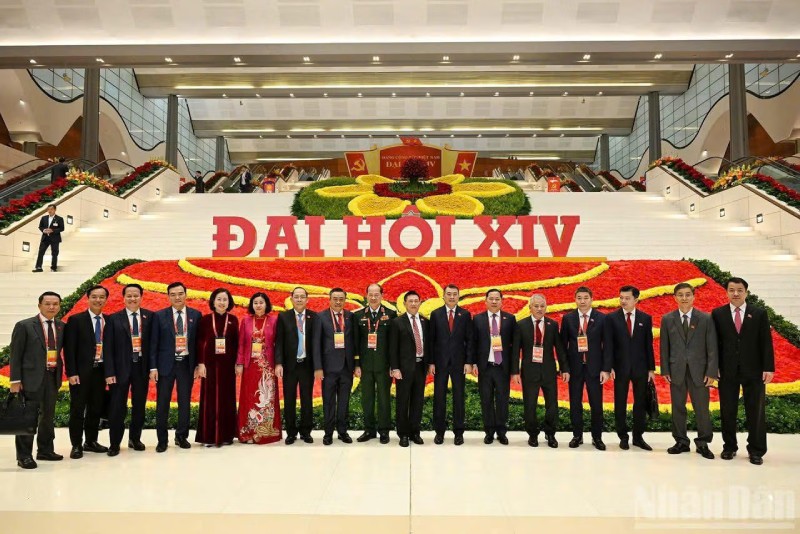
In a deeper perspective, today's great unity is also a response to the challenges of the digital age: the faster society connects, the easier it is to fragment quickly. Fake news, distortion, and incitement - if there is no "culture of consensus" and "timely feedback mechanism", will create cracks in trust. Therefore, great unity must go hand in hand with new management capacity, where each institution knows how to listen in time, handle promptly, speak clearly, and do things substantively.
To digitally transform and expand real ownership
Chairman of the Central Committee of the Vietnam Fatherland Front Bui Thi Minh Hoai not only emphasized the principle of democracy, but also set a very modern requirement: democracy must have new tools. When people have entered cyberspace as a living space, when social emotions form every hour, when public opinion can spread in just a few minutes, then the way of "hearing people" cannot keep pace with the old cycles. Democracy, to be substantive, must go faster - more transparent and respond more promptly.
From the traditional starting point, the Chairman of the Central Committee of the Vietnam Fatherland Front emphasized the basic motto: "people know, people discuss, people check, people supervise, people benefit" - a familiar saying, but if placed in today's context, it has a new content: people not only "know" through announcements, but also must "know" through transparent data; people not only "discuss" in conferences, but can "discuss" in digital space; people not only "supervise" with emotions, but need tools to supervise with evidence, procedures and accountability.
The suggestive new point of the article lies in the orientation of digitalizing social listening and feedback activities: grasping the People's situation in cyberspace; receiving multi-channel opinions; timely feedback; monitoring the process of receiving recommendations. And especially, the proposal to deploy the "Digital Front" platform, receive opinions 24/7, and implement "People's Voice Month" shows a very clear thinking: digital transformation is not just a technical story, but a story of democratic governance.
If viewed by modern governance standards, the "Digital Front" must be understood as an ecosystem of the people's hearts: Reception - classification - transfer - processing - monitoring - feedback. If done well, this will be a very big step forward: people see that their voice is not falling into the void; state agencies have more vivid data to adjust policies.
More importantly, digital transformation in the practice of democracy is also directly linked to the task of protecting great unity. Cyberspace is a place of connection, but also a place that is easily exploited for division. Therefore, if there is an early grasp and correct response mechanism, it will not only solve each case, but also maintain the "trust cord" to keep the great unity bloc from being damaged.
The Chairman of the Central Committee of the Vietnam Fatherland Front placed this task in the big vision of the 14th Congress term: Organizing elections, strengthening supervision, and perfecting the mechanism for the People to participate more deeply in building the Party and State, and practicing democracy at the grassroots level. This shows a consistent philosophy: if you want the country to go far in the new era, you must know how to fully exploit the greatest resource - the People's resources.
In the digital age, digital transformation cannot only be a story of convenience or speed, but must become a tool to expand democracy, connect people's hearts, and maintain great unity. When institutions are transparent enough, culture is tolerant enough, and technology serves people enough, then the people's right to mastery will become the strongest driving force to bring the country forward quickly and sustainably in the new era.