
Prime Minister Mikhail Mishustin warmly welcomed General Secretary and President To Lam and the high-level Vietnamese delegation on a state visit to Russia. The Russian Prime Minister believes that this visit by General Secretary and President To Lam will create a turning point in bilateral cooperation in the coming time.
General Secretary and President To Lam expressed his pleasure to pay a State visit to Russia; thanked the leaders, Government and people of Russia for giving the high-level Vietnamese delegation a respectful, thoughtful and warm welcome; respectfully conveyed the words of Politburo Member and Prime Minister Le Minh Hung inviting Prime Minister Mikhail Mishustin to visit Vietnam at a suitable time.
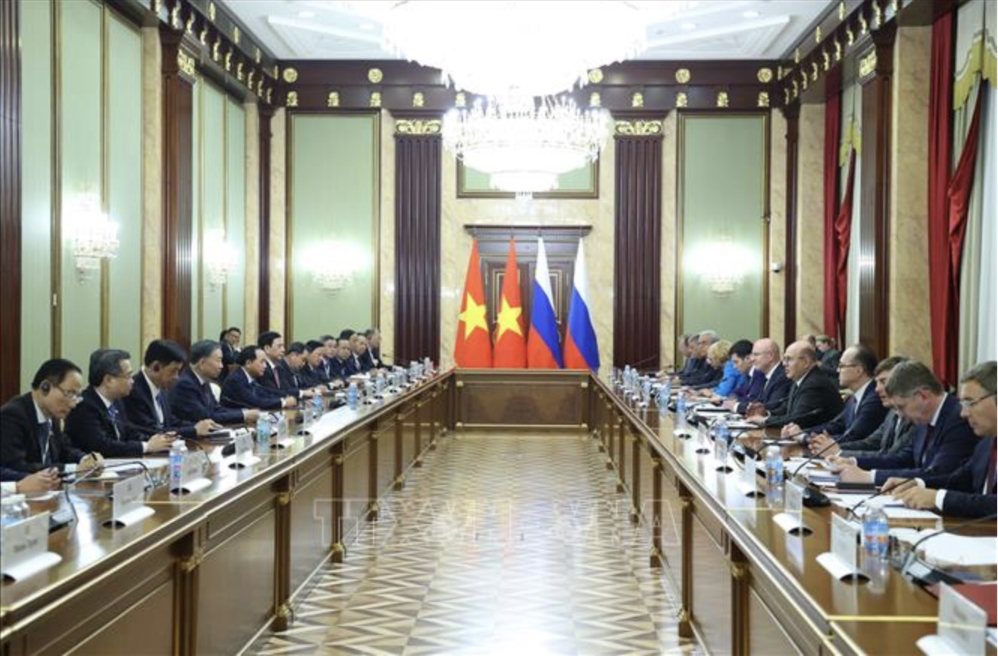
The two sides agreed to continue to promote the effectiveness of existing bilateral cooperation mechanisms, study the establishment of new cooperation mechanisms and new specialized working groups in various fields.
The two sides agreed that it is necessary to create stronger changes in economic and trade cooperation, encourage and create favorable conditions for businesses of the two countries to do business and invest; promote business connections. General Secretary and President To Lam suggested that it is necessary to strongly promote two-way investment in a balanced direction. After the success of TH Group, Vietnam encourages businesses to invest in agriculture in Russia and encourages Russian businesses to invest in industry in Vietnam.
The Russian Prime Minister said that the two sides need to study solutions to improve the efficiency of sea, rail and multimodal transport, thereby forming stable supply chains, facilitating the exchange of goods between the two countries.
General Secretary and President To Lam agreed that the two sides need to create a new strategic connection through cooperation in the field of transportation, especially railways, sea and air.
General Secretary and President To Lam requested the Russian Government to direct relevant ministries and sectors to continue reviewing and removing difficulties and obstacles in economic-trade and investment cooperation; have appropriate solutions for issues of tariffs, quotas, transportation, logistics and market access, and increase Vietnam's trade presence in Russia.
Clearly stating that Vietnam is the first country in the world to sign a free trade agreement with the Eurasian Economic Union (EAEU), of which Russia is a member, General Secretary and President To Lam also proposed that Russia have a voice to promote EAEU countries to open markets, remove trade barriers, and eliminate the threshold trade defense mechanism for Vietnamese goods.
The two sides highly appreciated the effectiveness of oil and gas cooperation projects between the two countries, considering these as vivid proofs of the effectiveness of Vietnam-Russia cooperation. Russia wishes to continue to develop cooperation with Vietnam in the energy sector, not only in traditional fields but also to study expanding to new fields suitable to the needs and development orientations of each country.
General Secretary and President To Lam and Prime Minister Mikhail Mishustin agreed that science and technology are a field with great potential to become a new driving force for bilateral relations, and believe that it is necessary to further enhance cooperation in this field. The two sides agreed to study expanding cooperation to fields such as new energy, biomedical technology...
The two sides agreed to promote cultural, tourism and people-to-people exchanges, thereby helping the younger generation better understand the history and traditions of the two countries' relations.
Prime Minister Mikhail Mishustin expressed his belief that the State visit of General Secretary and President To Lam to Russia and the talks between General Secretary and President To Lam and President Vladimir Putin will create more strong momentum, identify important strategic orientations for Vietnam-Russia relations in the new period; affirmed that the Russian Government will closely coordinate with the Vietnamese Government to concretize and effectively implement the agreements reached at the highest level, shifting political orientation into specific programs, projects and cooperation results.


