
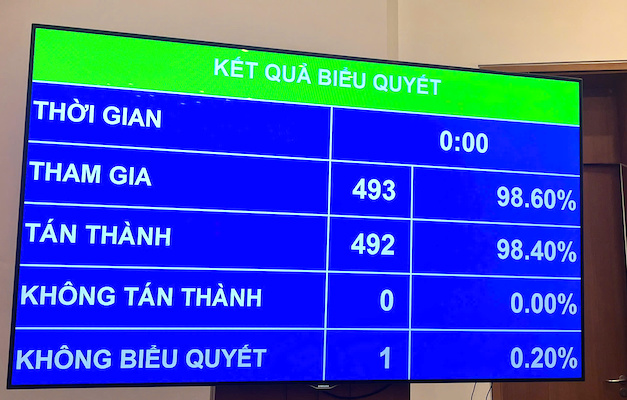
In the afternoon of April 23, with 492/493 delegates present participating in the vote in favor (accounting for 98.4%), the National Assembly officially passed the Law on Access to Information (amended).
The Law on Access to Information (amended) consists of 4 chapters, 31 articles inheriting a number of relevant provisions of the 2016 Law on Access to Information; and at the same time amending, supplementing, and perfecting many regulations related to the scope of information to be accessed; scope and responsibilities for providing information; forms of information disclosure, requested information provision; order and procedures for providing information...
The law takes effect from September 1, 2026.
Before the electronic vote, Minister of Justice Hoang Thanh Tung presented a report on receiving, explaining and revising the draft Law on Access to Information (amended) to submit to the National Assembly for consideration and approval.

Regarding the principles of ensuring information access rights (Article 3), acknowledging the opinions of National Assembly deputies, the draft Law has supplemented regulations to better ensure citizens' access to information in the digital environment, in line with the trend of science, technology and digital transformation development. Forms of public disclosure and information provision are expanded and diversified, and the application of electronic methods is encouraged.
At the same time, Article 24 is revised in the direction of stipulating that agencies and units are responsible for providing information in the form requested by the requester, in accordance with the nature of information and the responsiveness of agencies and units. The Government will continue to detail in sub-law documents appropriate support measures for vulnerable groups (the elderly, children, the poor, people in difficult circumstances... ) to ensure inclusiveness and fairness in accessing information.
The draft Law stipulates that information must be widely publicized to ensure synchronization with specialized laws in fields such as health, education, culture, food safety, environment, finance, land, construction, bidding, labor...
For the field of education, the draft Law proposes to supplement (currently not regulated in the law) information that must be made public to the people, including:
General information about educational institutions;
Financial revenue and expenditure of educational institutions;
Conditions to ensure quality, plans and operating results for preschool education, general education, and continuing education;
For information that is not listed but specialized laws stipulate that it must be disclosed, the draft Law identifies continuing to implement it according to the provisions of specialized laws. This approach both ensures completeness and avoids duplication, while maintaining the flexibility of the legal system.
Regarding exemption and reduction of information access costs (Article 25), taking into account the opinions of National Assembly deputies, the draft Law stipulates in the direction of assigning the Minister of Finance to specifically stipulate the actual cost level for printing, copying, photographing, and sending information. Cases eligible for exemption and reduction of costs will be specified in sub-law documents.
This regulation aims to ensure transparency and consistency in application; and at the same time create a flexible basis for adjusting to suit socio-economic conditions in each period, ensuring that citizens' right to access information is not limited by cost factors.


