
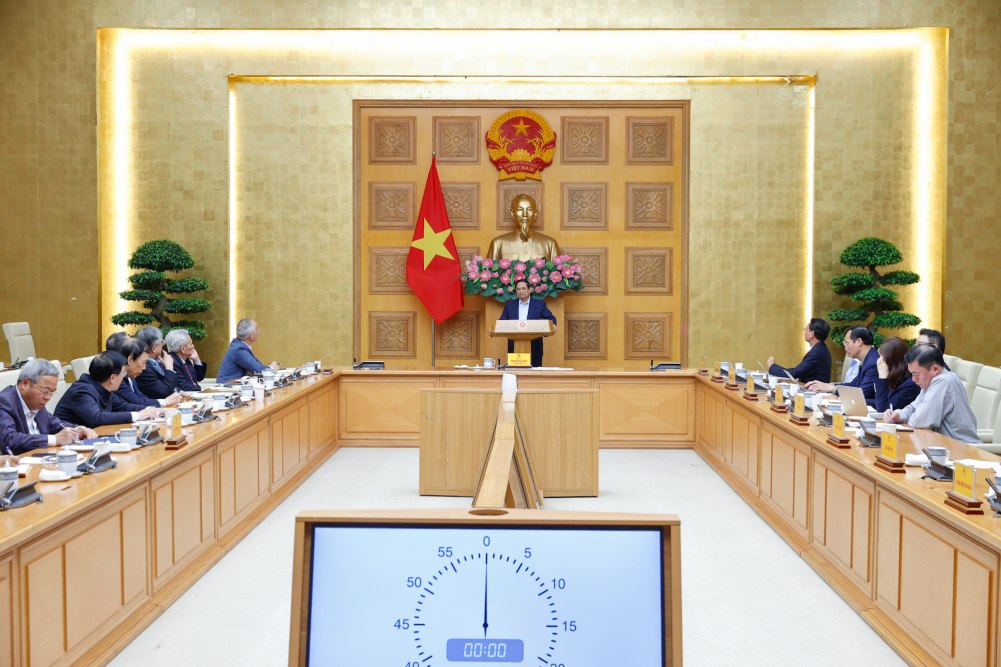
On March 7, at the Government Headquarters, Prime Minister Pham Minh Chinh chaired a meeting with the Policy Advisory Council, discussing the socio-economic situation in February, two months of 2026, new developments in the world affecting Vietnam, and key tasks and solutions for the coming time.
According to the Government Office, in his concluding remarks, the Prime Minister emphasized the need to steadfastly pursue the goal of maintaining macroeconomic stability, controlling inflation and promoting growth from 10%, ensuring major balances of the economy.
Generalizing 9 specific groups of solutions, firstly, regarding the energy solution group, the Prime Minister requested not to let the gasoline and oil shortage, electricity shortage, and energy shortage occur; and at the same time identified this as an opportunity to transform green energy, exploit different potentials, outstanding opportunities, and competitive advantages of the country.
Second, regarding macroeconomic stability, the head of the Government emphasized to continue to manage macroeconomic policies synchronously, flexibly and effectively; especially focusing on close coordination between fiscal policy and monetary policy.
Manage monetary policy proactively, flexibly, promptly and effectively, in accordance with reality, stabilize exchange rates and interest rates, and increase national reserves.
Continue to implement focused and key expanded fiscal policy; must increase revenue, save expenditures, encourage production and business, consider building and implementing demand stimulus packages if necessary; review tax, fee, and charge policies to support businesses and business households.
Third, regarding strategic autonomy, striving for energy autonomy, national resource autonomy, thereby decentralizing and delegating power to localities.
Fourth, remove difficulties and obstacles; focus on handling backlog projects, removing obstacles for business households; bottlenecks in land, electricity, and resources; mobilize social investment to increase by about 5% compared to 2025; promote public investment, bringing the ICOR coefficient down to about 5.
Fifth, the group of solutions on human resources, promoting the training of high-quality human resources, identifying people as the center, the subject, the decisive factor in the country's destiny, deciding the transformations, changes in state and investing in people is investing in development, such as in regimes, policies, wages, encouraging creativity, protecting those who dare to think, dare to do for the common good and without personal motives, no personal gain, no corruption.
Sixth, the group of solutions on building and perfecting institutional building, innovation, removing current bottlenecks and especially encouraging innovation; reducing input costs for people and businesses by promoting infrastructure development, reducing compliance costs through administrative procedure reform, improving the business environment, and increasing the competitiveness of businesses, products and the economy.
Seventh, promote science and technology development, focus on developing artificial intelligence on the basis of data from the whole country and ministries, branches, localities, units, ensuring sufficient electricity; operating based on data.
Eighth, stimulate domestic demand, tourism; develop social housing with adequate, synchronous, bright-green-clean-beautiful infrastructure and facilities, expand access to social housing; increase supply to reduce housing costs. At the same time, expand export markets, diversify markets, products, and supply chains.
Ninth, local authorities must be more proactive and active, eliminate the mentality of waiting, relying on, and asking for; improve the implementation capacity of grassroots cadres.


