
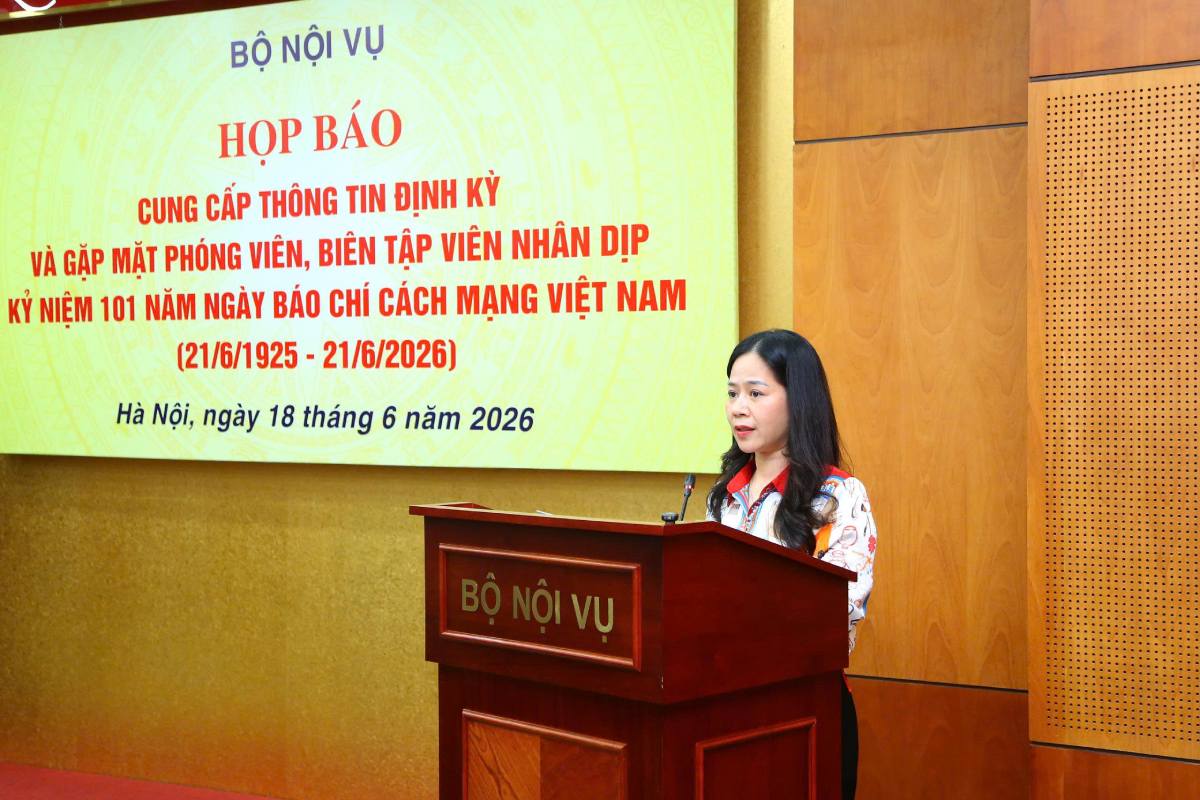
At the press conference on the afternoon of June 18 organized by the Ministry of Home Affairs, Deputy Chief of Office of the Ministry of Home Affairs Tran Thi Thai informed about the results of the implementation of tasks in the second quarter and the deployment of key tasks in the third quarter of 2026 of the Ministry of Home Affairs.
In which, one of the key tasks in the third quarter, the Ministry of Home Affairs will continue to prioritize comprehensive investment in building and perfecting institutions and policies in the field of internal affairs.
Focus on completing 4 draft laws to meet the requirements of operating local governments at 2 levels, including: Law amending and supplementing a number of articles of the Labor Code, Law on Archives, Law on Border Management and Law on Red Cross Activities; Law amending and supplementing the Law on Occupational Safety and Health; Law amending and supplementing a number of articles of the Law on Social Insurance; Law amending and supplementing a number of articles of the Law on Vietnamese Workers going to work abroad under contract.
Notably, the Ministry of Home Affairs will continue to advise on streamlining the internal organizations of ministries, central agencies and departments and branches in localities; streamlining public non-business units and state-owned enterprises under leadership and management.
Focus resources and promote the removal of arising obstacles to effectively implement the 2-level local government model.
Assess the implementation of decentralization and delegation of power; comprehensively review the regulations on decentralization and delegation of power, propose contents that need to be adjusted, contents that need to be further guided; advise the Government to amend and supplement relevant Decrees to ensure synchronization, unity, and feasibility when implementing.
Closely coordinate with the Central Organization Committee to thoroughly review and advise competent authorities on the staffing of the political system to ensure synchronization, especially grassroots-level staffing to ensure the required progress of competent authorities.
Continue to focus on reviewing and completing the construction and management of job positions in the political system; linking the approval of job positions in administrative agencies, organizations and public non-business units with restructuring and improving the quality of the contingent of cadres, civil servants, public employees and implementing staff streamlining.


