
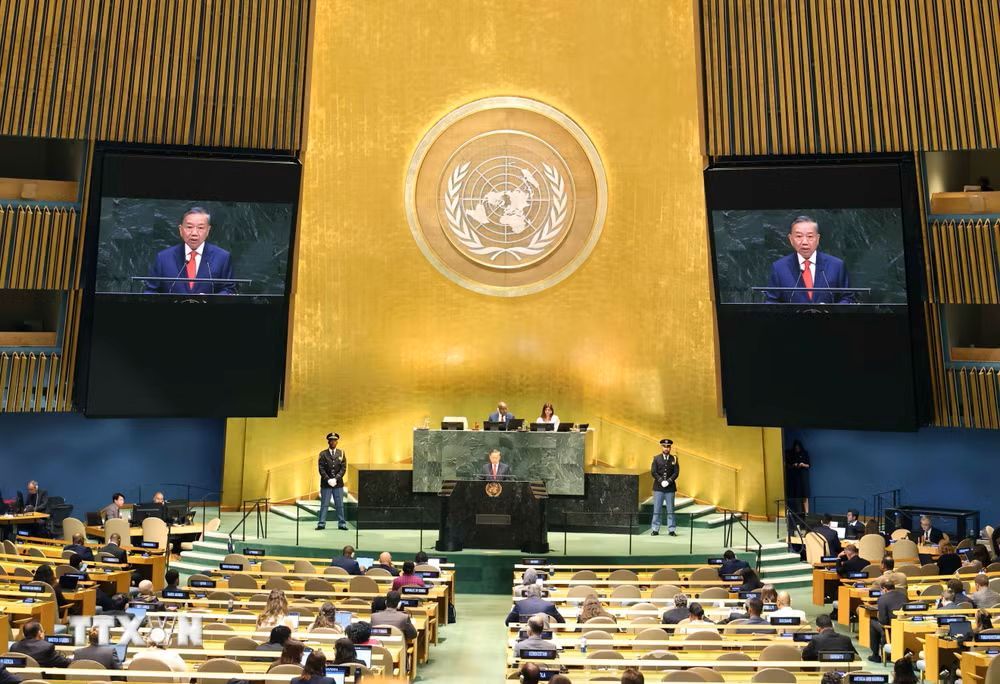
On September 22 (local time), at the United Nations Headquarters, New York (USA), General Secretary and President To Lam delivered an important speech at the high-level discussion session of the 81st session of the United Nations General Assembly.
Assessing the world situation, General Secretary and President To Lam said that the world is undergoing profound changes in the international order with full of risks and uncertainty; the world economy is increasingly trending towards fragmentation with the increase of trade, investment and technology barriers.
Supply chain disruptions and economic instability are narrowing the development opportunities of many countries. Climate change, natural disasters, epidemics and new risks from technology continue to directly threaten people's lives, livelihoods and the development and stability of many countries.
In order to orient and manage change so that competition does not become confrontation, difference, does not lead to conflict and scientific and technological progress does not create new divisions, General Secretary and President To Lam proposed 4 major orientations.
First, restore trust between nations on the basis of respecting the United Nations Charter and international law. The United Nations Charter and international law are the foundation of the world order, and must be fully, consistently and non-selectively respected.
Every nation must respect each other's independence, sovereignty, territorial integrity and the right to choose the path of development; not interfere in internal affairs, not threaten to use force contrary to the United Nations Charter.
Restoring trust does not require countries to eliminate differences, but to jointly manage differences responsibly. Crisis must be prevented. Competition must be controlled. Dialogue must be maintained. Commitments must be respected and fully implemented.
Major countries need to take the lead in respecting international law, restraining and responsibly resolving common issues. The United Nations must play a central role in those efforts.
In all conflicts, civilians must be protected, international humanitarian law must be respected and humanitarian aid access must be guaranteed. Vietnam supports the right to self-determination of the Palestinian people and the two-state solution, with the independent State of Palestine coexisting peacefully with the State of Israel, in accordance with international law and relevant resolutions of the United Nations.
In Asia-Pacific, nearly 60 years of development of the Association of Southeast Asian Nations - ASEAN shows that countries can turn suspicion into trust, turn confrontation into dialogue, turn division into cooperation, turn individual strength into collective strength.
In that spirit, Vietnam persistently resolves disputes, including the East Sea, by peaceful means, in accordance with international law, especially the 1982 United Nations Convention on the Law of the Sea; resolutely protects its sovereignty, sovereign rights and jurisdiction. The sea and ocean must be a space of peace, cooperation, connectivity and sustainable development.
Also in the spirit of peace and the rights to development of nations, Vietnam is always united with the State and People of Cuba; calling on the United States to end unilateral encirclement, embargoes and energy blockades against Cuba, and at the same time remove Cuba from the list of countries financing terrorism.
Second, promote fair, humane, inclusive and sustainable development. International commitments need to be transformed into actions and bring a peaceful, safe, civilized and happy life to the people.
Therefore, the Document of the Summit Future and Agenda 2030 - our promise to today's and future generations - needs to be implemented seriously and fully.
Financial commitments for development, including the Sevilla Commitment, also need to be implemented with specific solutions: Expanding access to long-term capital sources at appropriate costs, supporting debt-burdened countries and increasing the voice of developing countries in international financial and monetary institutions.
The multilateral trade system needs to be strengthened in a direction that is open, fair and transparent, ensuring development opportunities for all countries.
Responding to climate change needs to be placed in a suitable position in development cooperation, especially finance for adaptation, technology transfer and equitable energy transition. Development must put people at the center, not leaving anyone behind. Growth must be linked to social progress and justice, protecting the environment and livelihoods of people, especially in vulnerable countries and communities.
Global progress must ensure humanity in the behavior between nations, ensure legitimate interests and respect differences in history, culture and development conditions of nations.
Third, proactively shape technology governance to make progress to serve people and common development. Science, technology, digital transformation and artificial intelligence are opening up unprecedented opportunities, but also posing new challenges.
The future of technology does not necessarily guarantee fairness. Technological progress must contribute to narrowing the gap, expanding development opportunities, and not creating new forms of dependence or sources of conflict.
We need to build inclusive, safe, transparent and responsible governance principles and frameworks, ensuring technology serves people, respecting national sovereignty, digital sovereignty and development autonomy.
Developing countries must be effectively involved in the process of building laws and have equal access to the achievements of scientific and technological progress.
The organization of the Opening Ceremony of the United Nations Convention against Cybercrime in Hanoi in 2025 expresses Vietnam's desire to make practical contributions to global digital cooperation. Vietnam is ready to work with partners to promote cooperation, improve capacity to prevent and combat cybercrime, so that people can live safely and benefit from technological advances.
Vietnam is also ready to support international initiatives on green transformation, digital transformation and building effective governance frameworks, so that science and technology truly become the driving force for common development.
Fourth, consolidate multilateralism and the central, irreplaceable role of the United Nations. The strength of the United Nations is not in being able to replace the responsibilities of nations, but in its prestige and ability to build consensus, build norms and develop laws, and mobilize global efforts to jointly respond to common challenges.
To adapt the United Nations to the changes of the times, Vietnam supports efforts to reform the United Nations, especially the General Assembly, the Security Council, and the Secretariat, in the direction of enhancing efficiency, prioritizing structural reform, streamlining the apparatus, and at the same time promoting the organization's advantages in implementing global agendas, ensuring the interests of developing countries.
On the Vietnamese side, General Secretary and President To Lam emphasized that Vietnam today is increasingly proactively contributing to the common work of the United Nations, bringing Vietnam-United Nations relations to develop deeply and substantially.
The tradition of independence and self-reliance is the foundation for Vietnam to consolidate strategic autonomy and proactively integrate internationally. Towards the goal of becoming a developing country with modern industry, high average income by 2030 and a developed country with high income by 2045, Vietnam is establishing a new development model based on productivity, quality and added value; taking science, technology, innovation, digital transformation and high-quality human resources as motivation; linking growth with cultural development, progress, social justice, and environmental protection.
General Secretary and President To Lam affirmed that autonomy also means proactively adapting and cooperating equally with the world. Therefore, Vietnam consistently adheres to the foreign policy of independence, self-reliance, self-strengthening, peace, friendship, cooperation and development; multilateralization and diversification of foreign relations.
Vietnam will persistently protect the United Nations Charter and international law, promote dialogue and peaceful resolution of disputes, and participate more deeply in peacekeeping operations.
Vietnam is joining hands to build a united, resilient and strong ASEAN, actively preparing to assume the role of APEC host in 2027, contributing to peace, cooperation, and development of the region and the world.
In its capacity as a member of the United Nations Human Rights Council, Vietnam emphasizes dialogue and cooperation to promote and protect human rights, ensuring that all people enjoy the fruits of development. Vietnam is ready to share experiences in poverty reduction, agricultural development and climate change adaptation, and expand cooperation with partners for the common good.
General Secretary and President To Lam emphasized that Vietnam chooses peace, cooperation and development. As an active member, reliable partner and responsible nation, Vietnam persistently works with other countries to strengthen the United Nations, respect international law and turn commitments into practical benefits for the people, building a more peaceful, fair, inclusive and better world for all.


