
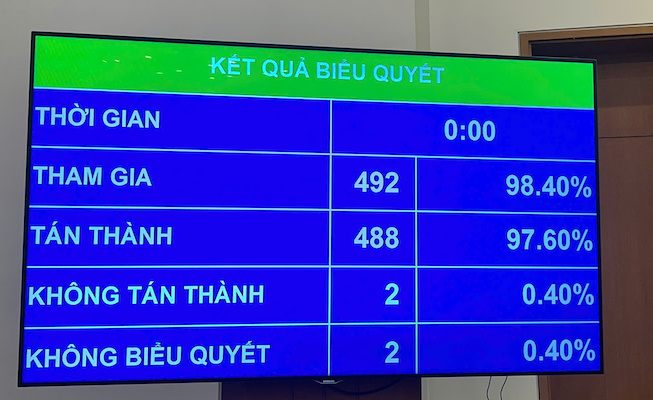
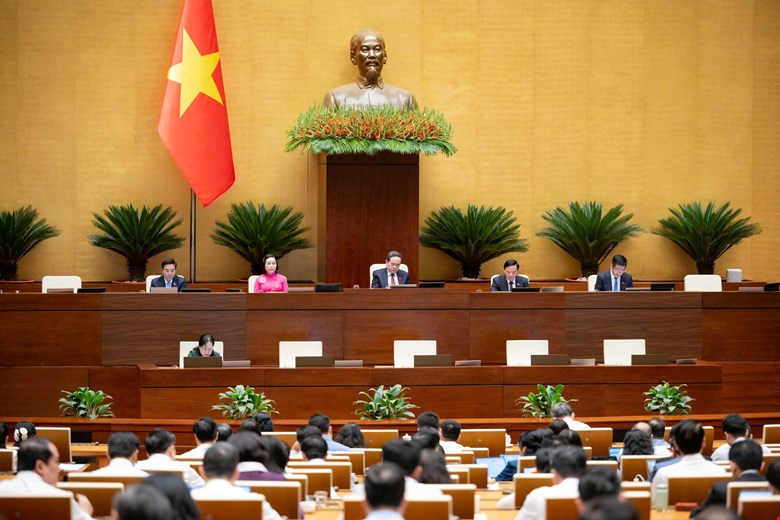
On the afternoon of April 23, with 488/492 delegates present participating in the vote in favor (accounting for 97.6%), the National Assembly officially passed the revised Capital Law.
The Law takes effect from July 1, 2026.
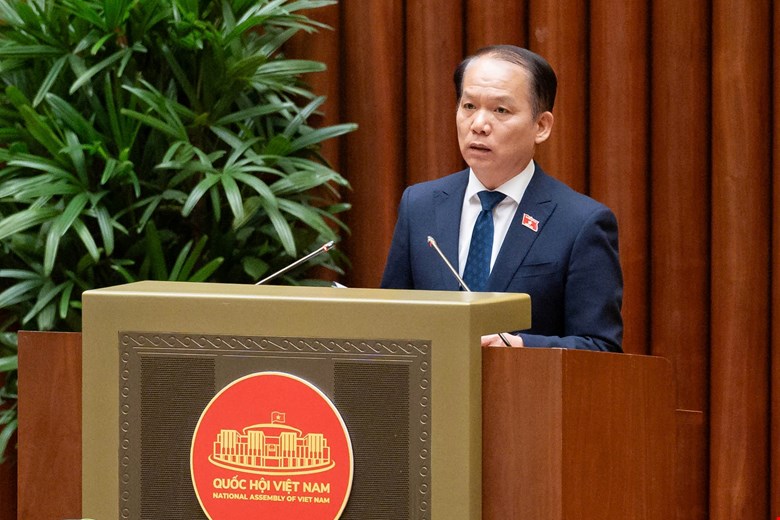
Before the electronic voting, Minister of Justice Hoang Thanh Tung presented a report on receiving, explaining and revising the draft revised Capital Law to submit to the National Assembly for consideration and approval.
The Minister said that the draft Law maintains the structure consisting of 9 chapters, 36 articles; 26/36 articles have been revised; and at the same time assigned the City government 199 special and superior powers (People's Council: 127; People's Committee: 56; Chairman of the People's Committee: 16), creating a synchronous and comprehensive legal basis for the City to maximize its potential, position and proactiveness and creativity in building and developing the Capital according to the motto "Localities decide, localities do, localities take responsibility".
The draft Law supplements regulations to ensure strictness, including: Not applying simplified procedures in the development of legal normative documents; clarifying the authority to issue documents of the Chairman of the People's Committee; supplementing requirements on determining the inspection and supervision mechanism, accountability when issuing documents, responsibility for evaluating the effectiveness of post-issuance documents and summarizing practice...
Regulations on specific mechanisms and policies are reviewed and improved in a strict, feasible, controlled and practical direction, focusing on: Clarifying the authority of the City government in planning, managing development space and requiring coordination with relevant ministries to ensure strict control, especially for high-altitude space; empowering the City People's Council to decide on policies and criteria for urban renovation, embellishment, and reconstruction to address population density, environment and urban development issues;
Improve specific policies in the health sector in the direction of clearly stipulating the responsibilities of medical facilities in the area in participating in supporting the Capital's health system, especially in outpatient emergency and coordinating health care;
Granting the City People's Council the power to decide on the application of special mechanisms and policies for large and important projects based on the consent of competent authorities and after consulting with relevant ministries and sectors, deciding to extend the time by no more than 6 months to complete the conditions for starting construction of works for projects implemented under Resolution No. 258 of the National Assembly,...
Regarding financial management, budget, and tax incentives (Article 21), the draft Law is revised in the direction of inheriting current regulations, not issuing tax incentive policies beyond the general legal framework, ensuring the consistency of the legal system and the leading role of the central budget.
At the same time, selectively supplement the beneficiaries of incentives and support to promote priority areas; supplement flexible mechanisms in budget management to meet development requirements and macroeconomic stability.
In addition, the Draft Law is revised in the direction of affirming the central and leading role of the Capital; designing the concept of "Capital Region" in an open and flexible direction; creating a mechanism for localities to actively participate in linking, applying the provisions of the Capital Law when implementing joint projects; allowing the use of local budgets for inter-regional investment to solve infrastructure, environment, and essential services to serve common interests.
The draft Law also clearly stipulates the principle of excluding and waiving legal liability for cases of exercising authority, procedures, and not for personal gain but still incurring damage.
At the same time, clarifying that this is not the only condition but placed in the overall mechanism of power control, supervision and accountability; not adding the criterion "professional standards" because there is no unified legal content, avoiding causing difficulties in application.


