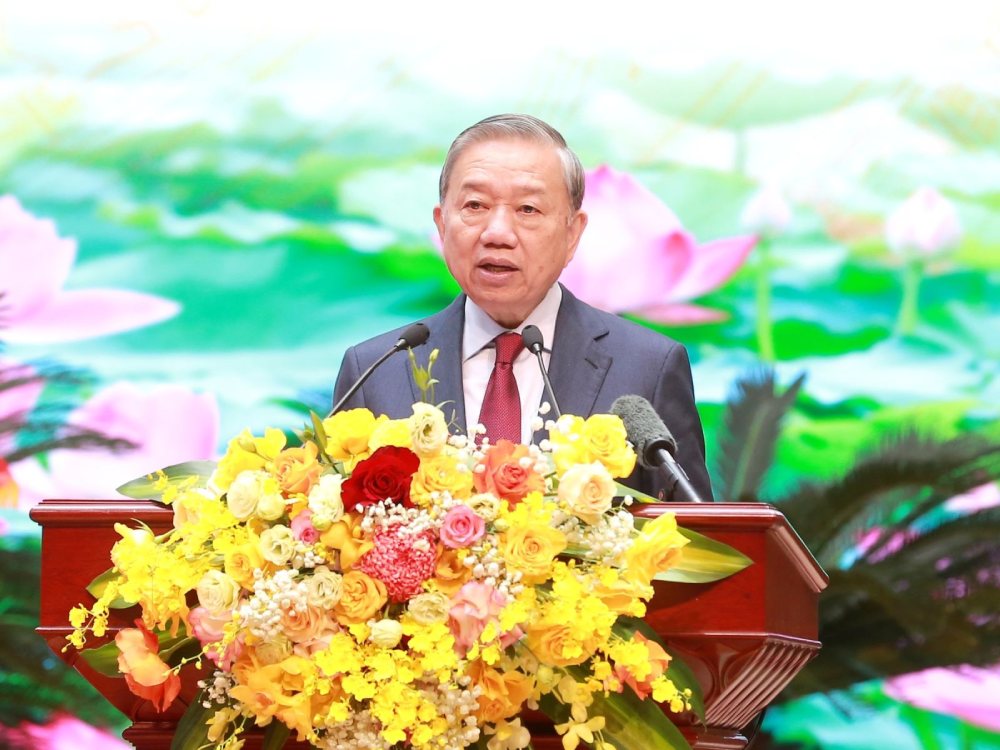
On behalf of the Politburo, General Secretary To Lam signed and promulgated Resolution No. 80-NQ/TW of the Politburo on the development of Vietnamese culture.
Resolution 80 clearly states that the world is in the process of establishing a new order with rapid and unprecedentedly complex changes, notably competition between cultures, including competition for value and the influence of the cultural industry.
Traditional and non-traditional security challenges, along with the impact of the scientific and technological revolution, are fundamentally changing behavioral standards and cultural values, posing an urgent need for national positioning in the new world order.
The requirements for developing the country in the new era require there to be breakthrough strategic and synchronous policies and policies to overcome limitations and inadequacies; proactively seize opportunities, overcome challenges to promote cultural development. Culture must go ahead and see the way, imbue each development policy, and promote humanistic values and social ethical standards.
Building and developing culture must truly become a solid foundation, the internal strength of the nation and a regulatory system for rapid and sustainable development of the country, towards the goal of 100 years of Party establishment and 100 years of State establishment; affirming the position and stature of Vietnamese culture worthy of a socialist-oriented developed country, with long-standing cultural and literary traditions, making worthy contributions to the flow of human civilization.
The Politburo's Resolution defines guiding viewpoints, which are:
Cultural and human development is an important foundation and endogenous resource, a great driving force, a pillar, and a regulatory system for rapid and sustainable development of the country.
Cultural values must be closely and harmoniously linked, deeply ingrained in the entire social life, from politics, economy, society, environment to national defense, security, foreign affairs, truly becoming the soft power of the nation in the new era.
Developing culture for the perfection of socialist human character in the new era and building people to develop culture. Creating a humane, healthy, civilized, and modern cultural environment.
Comprehensively develop Vietnamese culture and people on the foundation of national value system, cultural value system, family value system and standards of Vietnamese people; promote patriotism, bravery, intelligence, spirit of national self-reliance and self-strengthening, promote morality, talent, creativity and aspiration to contribute to the prosperity, civilization, and happiness of the people and the strong development of the Vietnamese nation in the new era.
Cultural development is the cause of the whole people led by the Party, managed by the State, the people are creative and beneficial subjects, the team of intellectuals, artists, cultural cadres, and entrepreneurs plays an important role, while enhancing the pioneering and exemplary nature of the team of cadres and party members.
The cause of cultural development is both strategic and long-term, and also an urgent requirement, which needs to be carried out proactively, actively, creatively, persistently, regularly and in accordance with objective real conditions.
Investing in culture is investing in the sustainable development of the country, for the future of the nation. Fundamental and comprehensive innovation in thinking about mobilizing all resources for cultural development, in which state resources play a leading role, social resources, and the private sector are important driving forces; institutions play a key role, especially breakthrough mechanisms and policies to mobilize and effectively use investment resources for culture, attract and value talents. Developing science, technology, innovation, and digital transformation creates a new space and new impetus for cultural development.
Maximizing the value and strength of Vietnamese culture and people in the new era; recognizing and harmoniously and effectively handling the intrinsic relationships of culture: Between "building" and "resistant"; tradition and modernity; nation and international; preservation and development; public and scientific; real life and digital space; open data and ensuring security and digital cultural sovereignty.