
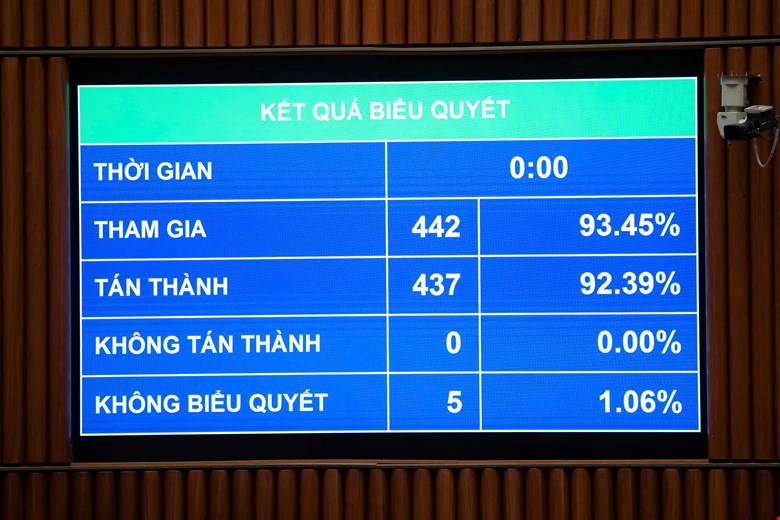
On the afternoon of December 10, with 437/442 delegates in favor, the National Assembly passed the Law on Civil Servants (amended), effective from July 1, 2026.
According to the law, civil servants who are Vietnamese citizens are recruited according to job positions, working at public service units under the working contract regime, receiving salaries from the salary fund of public service units and from other legal sources of income.
The amended Law has converted the method of managing civil servants according to job positions, taking job positions as the main basis for recruiting, arranging, evaluating, planning, appointing, training, fostering and implementing regimes and policies for civil servants.
Job position is a job associated with the position and title of a civil servant based on the functions and tasks of a public service unit.
According to the new law, civil servants are allowed to sign labor contracts or service contracts with other agencies, organizations and units if the law on sectors and fields does not prohibit or ensure that there are no conflicts of interest as prescribed by the law on corruption prevention and control, is not contrary to the agreement in the work contract and does not violate professional ethics.
In case there is no agreement in the work contract, the civil servant must have the written consent of the head of the public service unit; for the head of the public service unit, the written consent must be from the direct superior.
Officials are also allowed to practice as individuals if the law on sectors and fields is not prohibited; are allowed to contribute capital, participate in the management and operation of enterprises, cooperatives, hospitals, educational institutions, organize scientific research in the non-public sector, except in cases where the law on corruption prevention and control, the law on enterprises or the law on sectors and fields have other provisions.
This amendment also has new regulations related to the assessment and classification of civil servant quality. Accordingly, the law stipulates principles, authority, and evaluation content based on performance results; attitude towards serving people and businesses; capacity to innovate, be creative, dare to think, dare to do, dare to take responsibility for the common good...
In the assessment, civil servants will apply science, technology, digital transformation; ensure publicity and transparency.
The Government will guide the development of a framework for evaluating criteria for civil servants at public service units in sectors and fields.
Based on the results of monitoring and evaluation, civil servants are classified as having excellent quality according to the following levels: Completing tasks excellently; Completing tasks well; Completing tasks; Not completing tasks.
The results of periodic or annual quality assessment and classification are the basis for competent authorities to decide on training, fostering, planning, transferring, appointing, and reappointing civil servants; as well as implementing the salary, reward or termination of employment regime for civil servants who do not complete their tasks or do not meet the requirements of the tasks.
The law also stipulates 7 things that civil servants are not allowed to do, including evasion, delegation, pushing in the performance of assigned duties and tasks; causing dispatch, disunity; arbitrarily quitting work, quitting work; participating in public holidays; posting, disseminating, and expressing false information.
Officials are not allowed to commit acts of embezzlement, corruption, waste, negativity, profiteering, harassment and other acts that violate the law during the performance of their duties.


