
At the 10th Session, the 15th National Assembly passed the Law on Public Employees (amended). The Law takes effect from July 1, 2026.
One of the new points of the Law on Public Employees 2025 is the regulation on the rights of public employees in performing professional activities and business activities.
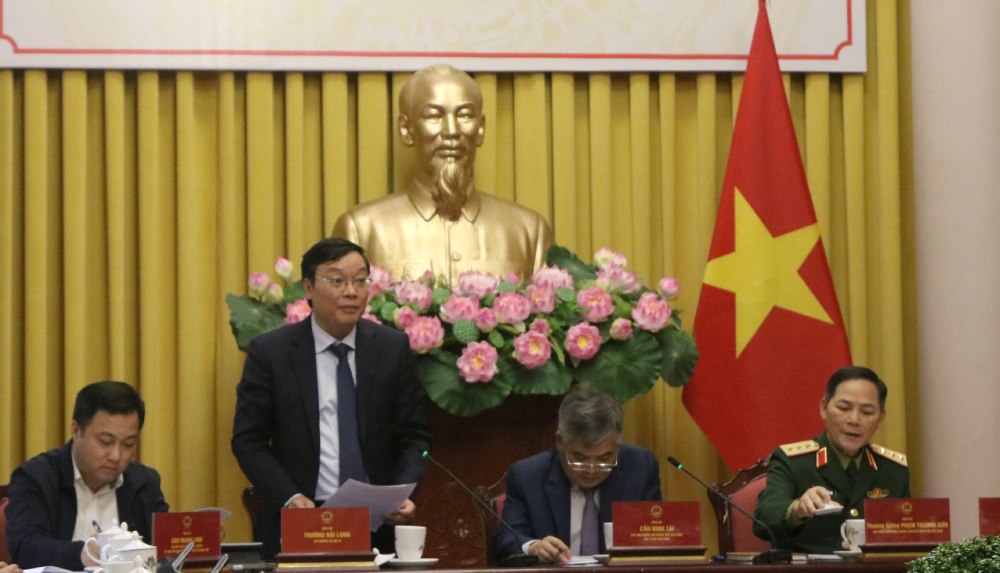
According to Deputy Minister of Home Affairs Truong Hai Long, the Law has supplemented and completed regulations on the obligations and rights of civil servants, allowing civil servants to sign contracts to perform professional activities outside public service units according to the principle that civil servants are responsible for completing assigned tasks at public service units, complying with the provisions of law on industry and field management and not conflicting interests according to the provisions of law on anti-corruption;
Also according to the provisions of the law, civil servants are allowed to participate in capital contribution and operation of enterprises if the law on anti-corruption does not prohibit it or specialized laws do not have other regulations, synchronized with specialized laws on science and technology, education and training.
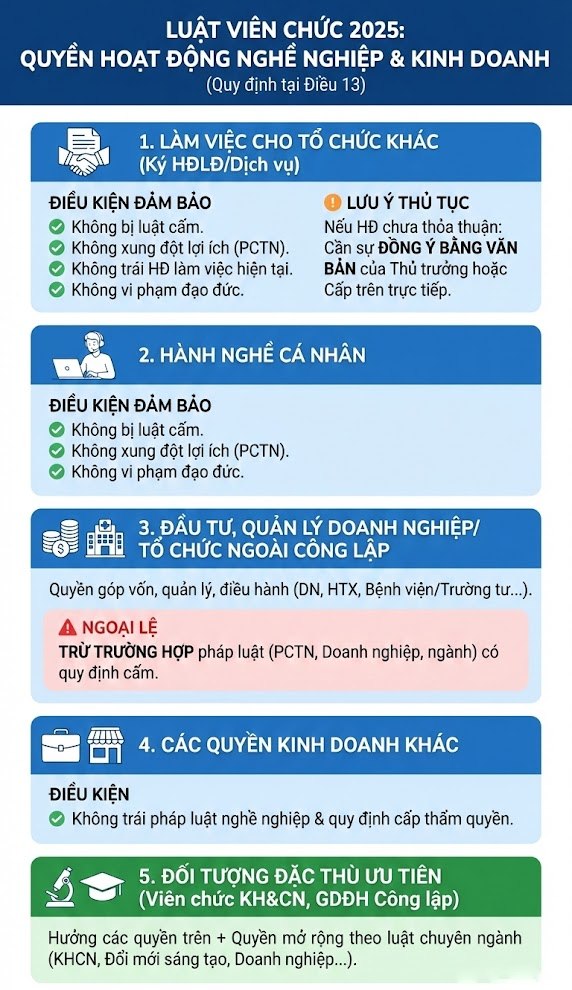
This content is stipulated in Article 13 of the Law on Public Employees 2025: Rights of public employees in performing professional activities and business activities.
Accordingly, civil servants are allowed to sign labor contracts or service contracts with agencies, organizations, and other units if the law on the industry or field does not prohibit it, ensures that there is no conflict of interest according to the provisions of the law on anti-corruption, is not contrary to the agreement in the working contract, and does not violate professional ethics.
In case there is no agreement in the working contract, it must be writtenly agreed upon by the head of the public non-business unit; for the head of the public non-business unit, it must be writtenly agreed upon by the directly managing superiors.
Civil servants are allowed to practice as individuals if the law on the industry or field does not prohibit it, ensuring no conflict of interests according to the provisions of the law on anti-corruption and not violating professional ethics.
Civil servants are allowed to contribute capital, participate in the management and administration of enterprises, cooperatives, hospitals, educational institutions, and non-public scientific research organizations, except in cases where the law on anti-corruption, the law on enterprises or the law on industries and fields have other regulations.
Civil servants are allowed to exercise other rights in business activities if they do not violate the provisions of the law on professional activities and the regulations of competent authorities.
According to Clause 5, Article 13, public employees working in public non-business units in the field of science and technology, public higher education institutions are entitled to exercise the rights specified in this Article, other rights according to the provisions of law on science, technology and innovation, law on enterprises and other relevant laws.
According to Deputy Minister of Home Affairs Truong Hai Long, the 2025 Law on Public Employees has shown innovative thinking, creating a synchronous legal corridor for public employee management in a dynamic, transparent, and effective direction, improving the quality of operations of public non-business units associated with the requirements of innovation and digital transformation in the new period.


