
Previously, businesses only met students when they came for internships or applied for jobs. With the new program between the Military Industry - Telecommunications Group (Viettel) and Vietnam National University Ho Chi Minh City, businesses will participate earlier. Students are assigned tasks, participate in projects and have mentors. The module at Viettel can be up to 30 credits.
Businesses participate from the specialized stage
Recently, Viettel and Vietnam National University Ho Chi Minh City signed an agreement to implement a strategic technology human resource training cooperation program under the CO-OP model for the period 2026-2030.
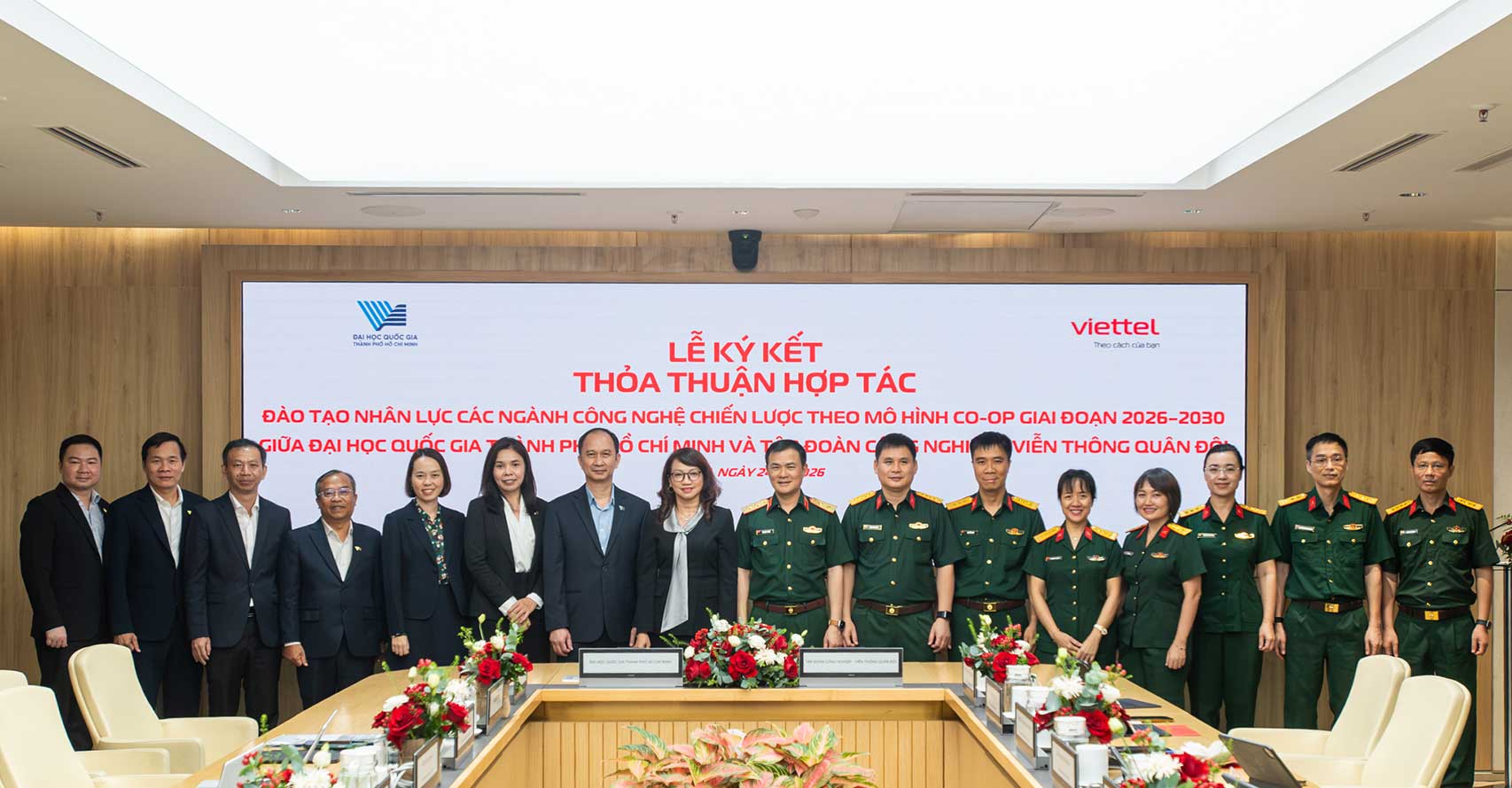
CO-OP, abbreviation of Co-operative Education, is a model that combines learning at school with the process of practicing, working or implementing projects with guidance at the enterprise. The learning part at the enterprise has goals, output standards, learning volume and evaluation mechanisms to be recognized for credits.
In the 2026-2027 academic year, the two sides plan to recruit 200 students from 5 majors: artificial intelligence, data science, information security, microchip design and electronics - telecommunications engineering. Each major is expected to have 40 students. Vietnam National University Ho Chi Minh City develops enrollment criteria and output standards; Viettel coordinates preliminary selection and interviews.
In the first two years, students learn basic knowledge at the school. From the third year, when entering the specialized stage, Viettel experts participate in building content, co-teaching some modules and project guidance.
Each student is arranged with a receiving unit, a guide and working tools. Students are entitled to monthly support according to Viettel's regulations, in addition, students practicing outside Ho Chi Minh City, especially in Hanoi, are considered for travel and accommodation expenses.
Ho Chi Minh City National University still manages academics, decides scores, considers graduation and grants degrees. Viettel evaluates work results and sends comments to the school. This assignment method helps the program both meet practical needs and maintain university standards.
Manpower preparation for strategic technology
Viettel determines to participate in 9/10 national strategic technologies, many fields need human resources to be prepared in a long time.
The development program will help bring the necessary business skills into the specialized stage, thereby students can be exposed to products and practical technical requirements.
Lieutenant General Tao Duc Thang, Member of the Party Central Committee, Chairman cum General Director of Viettel Group, once emphasized that enterprises deploying strategic technology are a practical environment to train talented students, universities should create conditions for students to have time to practice at enterprises into credits in the training program. The agreement with VNU-HCM is a step to concretize this orientation.
Previously, Viettel Digital Talent - Viettel's talent search program - received about 500 students each year into practical projects. The new program goes deeper when Viettel participates in building content, co-lecturing and evaluating results.
The five industries selected are all fields where Viettel is developing products and has human resource needs. Students therefore have the opportunity to work on the system being deployed, instead of just practicing on a simulated model.
Specifying the model of State - School - Enterprise
The program is a step to concretize the model of State - School - Enterprise in the spirit of Resolution No. 57-NQ/TW.
In which, the State builds policies, creates a legal corridor and invests in foundational competencies. The school ensures knowledge, output standards and training quality. Businesses include in the program problems, tools and requirements that are being raised in reality. This coordination helps the training process to be closer to the development needs of technology industries.
The value of the model is not only in the fact that businesses have more recruitment sources. When exposed to the working environment early, students have conditions to apply knowledge, participate in projects and train problem-solving skills. Schools also receive feedback from reality to update programs, while businesses reduce time and costs of retraining new personnel.


On a larger scale, this is a way to prepare human resources for the fields Vietnam is prioritizing for development. The effectiveness of the program is therefore not only measured by the number of students recruited, but by the ability of learners to work immediately, participate in solving practical problems and contribute to technology products owned by Vietnamese people.
If effectively implemented and replicated in universities and other technology businesses, the model can contribute to forming a new training method: human resources are prepared from real needs, learn through real problems and mature in a real product development environment. The greatest value then does not only belong to a school or a business, but to creating a team of human resources capable of meeting the strategic technological development requirements of the nation.


