
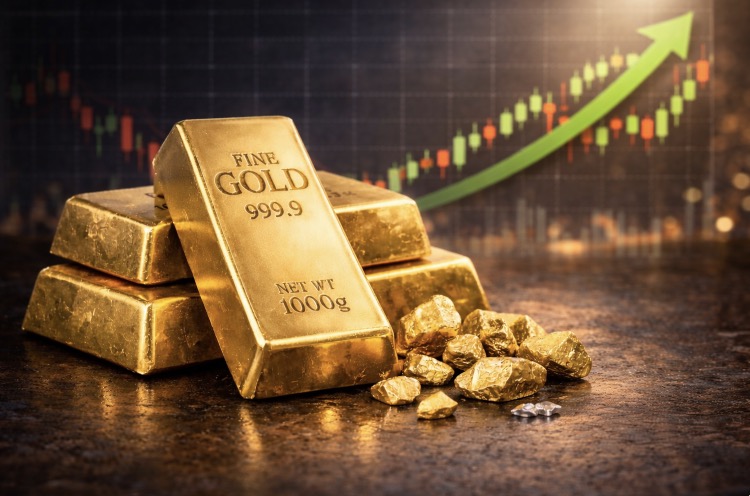
In the latest updated report, commodity analysts at ANZ (one of the largest banking groups in Australia and New Zealand) said they expect gold prices to reach 5,800 USD/ounce in the second quarter, a sharp increase compared to the previous forecast of 5,400 USD/ounce.
Although recent fluctuations have made many people question whether gold prices have peaked or not, we believe that the upward momentum is still not ripe enough to reverse in the near future" - the analysis group commented.
The sharp drop in gold prices from a record high of nearly 5,600 USD/ounce last month has caused a part of investors to worry that the market may witness a deep plunge, similar to previous cycles such as the peak of 1980 or the 2011 period.
However, ANZ believes that the current context is significantly different. Gold is still firmly supported as the US Federal Reserve (Fed) is expected to cut interest rates at least twice this year. Cooling inflationary pressure also makes the market consider the possibility of a third interest rate cut in December.
We forecast that the Fed will have two waves of 25 basis point interest rate cuts, in March and June. This will further reduce real yields, thereby supporting cash flow into gold. Geopolitical and economic instability is likely to remain.
The market is gradually paying attention to the potential impact of tariffs - a factor that does not fully reflect economic and inflation data. At the same time, concerns about the Fed's credibility still exist. This context will boost demand for holding real assets such as gold" - ANZ analyzed.
Not only affected by US monetary policy, ANZ believes that gold continues to play the role of "ultimate insurance" against rising risks in the global financial market.

This trend is not only happening in the US, as high public debt in many countries makes global bonds, including Japanese government bonds, less attractive.
The global financial system is undergoing structural shifts. US Treasury bonds are facing a problem of confidence. Skyrocketing public debt, concerns about the Fed's independence and sanctions risk have changed the position of this instrument. Investors are now demanding higher risk compensation for long-term bonds, as evidenced by the widening yield gap between long and short terms" - ANZ said.
In that context, gold becomes a transitional asset, bringing stability and diversification as traditional'anchors' weaken. Therefore, strategic allocation to gold is still appropriate, at least until geopolitical stability is restored, US fiscal issues are resolved and the Fed's credibility is strengthened - which is unlikely to happen in the short term. Gold's role in preserving value and hedging risks therefore becomes even more important.
From an supply-demand perspective, ANZ said that gold buying demand from central banks is forecast to remain strong until 2026. However, the main driving force this year is likely to come from investment demand.
Even in high price zones, experts believe that there is still room for increase as investors continue to boost capital inflows into gold ETF funds.
We expect capital inflows into gold ETFs to continue, with total holdings possibly exceeding 4,800 tons this year. In addition to Western markets, significant growth is forecast to come from emerging economies such as China and India. The proportion of gold ETF holdings in these regions may exceed the current 10% level" - ANZ said.
The risk of price increase for our forecast is the possibility of capital flows shifting from stocks and bonds to gold if geopolitical or political tensions escalate. Currently, gold ETF assets account for less than 3% of the total portfolio of stocks and bonds, so even small adjustments can have a significant positive impact on gold prices.
Besides gold, ANZ also maintains a positive view on silver. However, due to large fluctuations, this metal is assessed to be unlikely to outperform gold this year.
The diễn biến of silver is still closely linked to gold prices. Strong investment demand opens up room for price increases. However, the ability of silver to outperform is decreasing as industrial demand responds to high price levels and investors become more cautious. The fluctuation range of silver prices is expected to be wider" - the report concluded.


