Officials in Thanh Hoa cross forests and streams to find names for martyrs

QUÁCH DU |

Thanh Hoa - To collect DNA samples in remote and isolated areas, police officers and soldiers have crossed forests and streams to reach households.

Overcoming difficulties to collect tens of thousands of DNA samples

On July 2nd, information from Thanh Hoa Provincial Police said that so far, the unit has completed the collection of 37,808 DNA samples of relatives of martyrs. This is the locality with the largest number of DNA samples of relatives of martyrs collected in the country.

To achieve the above results, immediately after the Ministry of Public Security issued a plan to deploy DNA information collection for relatives of unidentified martyrs, Thanh Hoa Provincial Police quickly and proactively advised the Provincial People's Committee to issue a plan to deploy throughout the province.

Thanks to that, departments, agencies, branches and local authorities simultaneously got involved with a spirit of responsibility and high determination. Martyrs' records were reviewed from the beginning; relative information was verified and updated for each case. All work is aimed at the highest goal of not letting any relatives who are eligible for sample collection escape, and not missing any opportunity to identify martyrs.

For localities in the delta region, sampling mainly takes place at centralized points. However, in mountainous areas, DNA sampling is more difficult. Officials have to cross forests, wade streams, and walk many kilometers to reach remote and isolated households, ensuring that biological samples are brought to Hanoi as soon as possible to serve DNA analysis.

In addition, during the implementation process, functional forces also encountered many obstacles. In many highland villages, many relatives of martyrs are ethnic minorities, who do not know how to read or write, have never heard of the concept of DNA. When hearing officials mobilize blood collection, many people are confused and worried. Some families have to be explained many times, even having to ask village heads and reputable people to come to propagate.

In many families, documents related to martyrs are only a faded Fatherland Gratitude Certificate or an old death certificate. People who once knew information about martyrs are now old and their memory is no longer clear. This makes it difficult to verify blood relations and complete dossiers.

Therefore, to ensure accuracy, each information must be compared many times, because even a small mistake can affect the appraisal results later.

Relatives find martyr after decades

According to Thanh Hoa Provincial Police, to date, there have been 8 martyrs identified by DNA testing in the province.
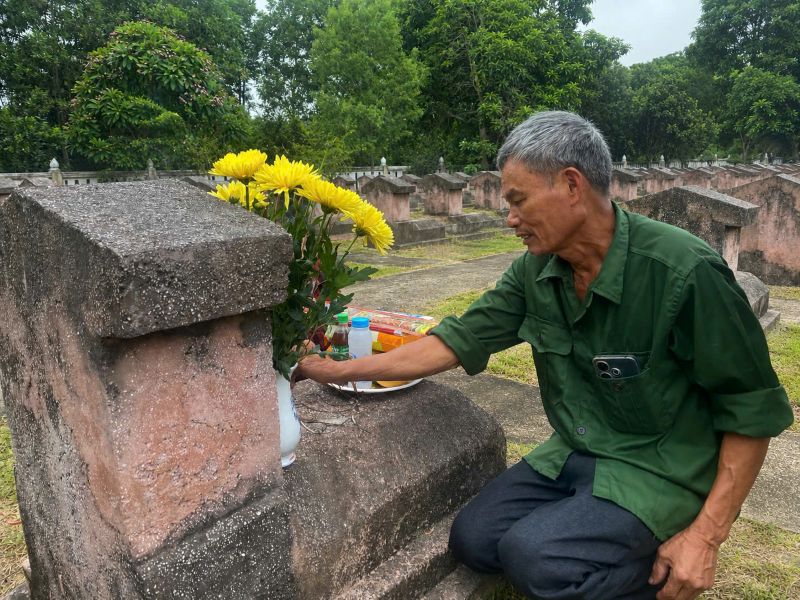
Thân nhân tìm thấy phần mộ của liệt sĩ Nguyễn Trọng Cát sau nhiều thập kỷ,  nhờ phương pháp xét nghiệm ADN. Ảnh: Công an Thanh Hóa
Relatives find the grave of martyr Nguyen Trong Cat after decades, thanks to DNA testing method. Photo: Thanh Hoa Police

Among these 8 cases is martyr Nguyen Trong Cat, from Minh Dan commune, former Trieu Son district, now Hop Tien commune, Thanh Hoa province. Martyr Nguyen Trong Cat sacrificed himself on the Southern battlefield in 1972.

Mr. Nguyen Trong Bay, born in 1960, younger brother of martyr Nguyen Trong Cat, said that his parents passed away more than 30 years ago. Before closing their eyes, his parents always instructed their children and grandchildren to find the grave of their older brother by all means, and bring him back to his hometown for the family to burn incense regularly.

“The day we received the notification of the DNA results accurately identifying his grave, the family was very happy. We are happy to have fulfilled the wishes of the elders when they were alive. I don't know what else to say, the family thanks the Party, the State, the Police force and all those who silently took samples day and night, determined identities, so that my brother and many other martyrs no longer have to lie in unidentified graves” - Mr. Bay shared.

QUÁCH DU
RELATED NEWS

Taking DNA samples from relatives, adding hope to identify martyrs

|

Hanoi - Linh Nam Ward People's Committee organizes DNA sampling of 67 relatives of martyrs, contributing to building a database to serve the identification of martyrs' remains.

Nghe An youth cook rice to support relatives of martyrs taking DNA samples

|

Nghe An - More than 200 free meals were handed over by youth union members of Dai Dong commune to relatives of martyrs during the peak period of DNA sample collection.

A martyr from Thanh Hoa identified by DNA after more than half a century

|

Thanh Hoa - From a relative's DNA sample, the identity of a martyr has been identified after more than half a century of family searching.

The Propaganda and Mass Mobilization sector continues to take the lead in paving the way and arousing the aspiration for development

|

The Propaganda and Mass Mobilization sector determined to continue the task of "going ahead, opening the way", doing a good job of orienting public opinion, and arousing the aspiration to develop the country.

Garbage is partially cleaned up, residents of Imperia Garden apartment building still suffer from the stench

|

Hanoi - The situation of garbage congestion at Imperia Garden apartment building (Thanh Xuan ward) has changed. However, the amount of accumulated garbage and stench still make residents worried.

Hundreds of workers collectively stop working to petition about welfare regimes

|

Thanh Hoa - Hundreds of workers at Long Yi Vietnam Footwear Co., Ltd. have collectively stopped working to petition about welfare regimes.

HCMC must glorify Uncle Ho's name with new achievements

|

Ho Chi Minh City must glorify Uncle Ho's name with new achievements, new values, and new contributions to development.

Red Trade Union - the core uniting the worker force in the early years of the revolution

|

On February 3, 1930, the Communist Party of Vietnam was established. Under the leadership of the Party, the Red General Confederation of Labor gathered the force of workers and boatmen, the main force of the Vietnamese revolution, creating the Xo Viet Nghe Tinh rise 1930-1931.

Cụ bà 5 năm không nhận được tiền trợ cấp BHXH: Cán bộ đã xuống tận nhà trao hơn 177 triệu đồng

Thùy Linh |

Sáng 1.7, đại diện cơ quan Bảo hiểm xã hội Hà Nội đã đến tận nhà cụ Nguyễn Thị Ngát trao số tiền trợ cấp BHXH của cụ bị dồn lại suốt 5 năm qua.

Taking DNA samples from relatives, adding hope to identify martyrs

Hạnh Thơm |

Hanoi - Linh Nam Ward People's Committee organizes DNA sampling of 67 relatives of martyrs, contributing to building a database to serve the identification of martyrs' remains.

Nghe An youth cook rice to support relatives of martyrs taking DNA samples

MAI NGÂN |

Nghe An - More than 200 free meals were handed over by youth union members of Dai Dong commune to relatives of martyrs during the peak period of DNA sample collection.

A martyr from Thanh Hoa identified by DNA after more than half a century

QUÁCH DU |

Thanh Hoa - From a relative's DNA sample, the identity of a martyr has been identified after more than half a century of family searching.
