
On August 3, the Steering Committee for searching, repatriating and identifying martyrs' remains of Khanh Hoa province coordinated with the Party Committee, government, and Vietnam Fatherland Front Committee of Tay Nha Trang ward to organize a ceremony to offer flowers and incense and deploy biological sample collection for martyrs' remains that have not been identified at Hon Dung Martyrs' Cemetery to serve DNA testing.
This is an activity under the 500 days and nights Campaign to promote the search, repatriation and identification of martyrs' remains of Khanh Hoa province, in order to gradually identify martyrs with missing information.
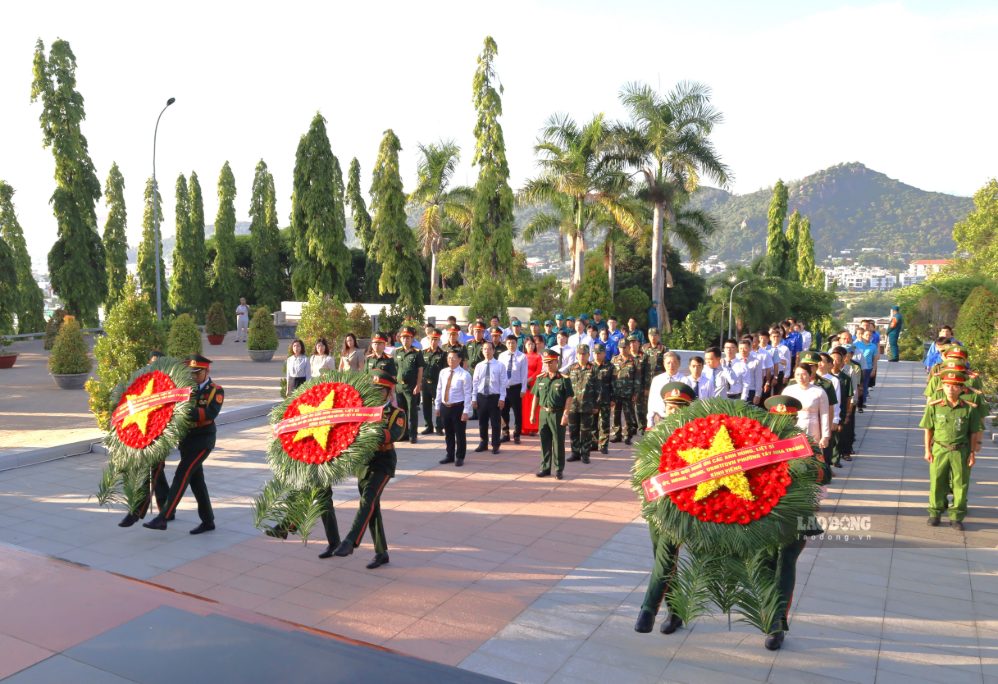
In a solemn atmosphere, the delegates respectfully offered flowers and incense to commemorate the heroic martyrs who sacrificed for the independence and freedom of the Fatherland, and at the same time expressed their determination to complete the goals of the campaign.
Immediately after the memorial ceremony, the specialized force proceeded to take samples of remains according to an 8-step technical process including: determining the sample location, determining the grave, approaching the remains, making a sample taking decision, creating an identification code, taking samples, packaging samples, completing the sample taking dossier.
After completion, the biological samples are temporarily stored at the cemetery before being handed over to the Military Forensic Institute for DNA testing, serving the identification of martyrs' remains.
Hon Dung Martyrs' Cemetery currently has 750 martyrs' graves, of which 240 graves have not been identified.
According to the plan, the sampling work here will be completed before August 8. After that, the Steering Committee will continue to deploy at Suoi Hiep Martyrs' Cemetery.
According to the Khanh Hoa Provincial Military Command, the unit has established a specialized team to take biological samples at martyrs' cemeteries in the area.
Among them, 2,183 martyrs' graves have not been identified at 7 martyrs' cemeteries, functional forces have exhumed and taken samples of 501 graves, of which 277 samples are eligible for DNA testing.
In parallel with the sampling work, the Provincial Military Command also actively receives and verifies information about martyr burial places provided by organizations and individuals.
Accelerating the collection of biological samples, combined with collecting and verifying information about martyrs, is expected to contribute to soon returning the names of heroes who sacrificed, easing the pain of relatives and continuing the journey of gratitude with specific results.


