
Lang Son Provincial People's Committee has just approved the list of villages and communes in ethnic minority and mountainous areas in the area. In which, 16 communes and wards are recorded without villages or hamlets that are particularly difficult.
According to the decision issued on January 29, 2026, Lang Son province currently has 1,646 villages in ethnic minority and mountainous areas, of which 385 villages are identified as particularly difficult villages.
In particular, through review, there are 16 commune and ward-level administrative units that no longer have particularly difficult villages according to current criteria.
4 wards including Dong Kinh, Ky Lua, Luong Van Tri and Tam Thanh all do not have villages or hamlets that are particularly difficult.
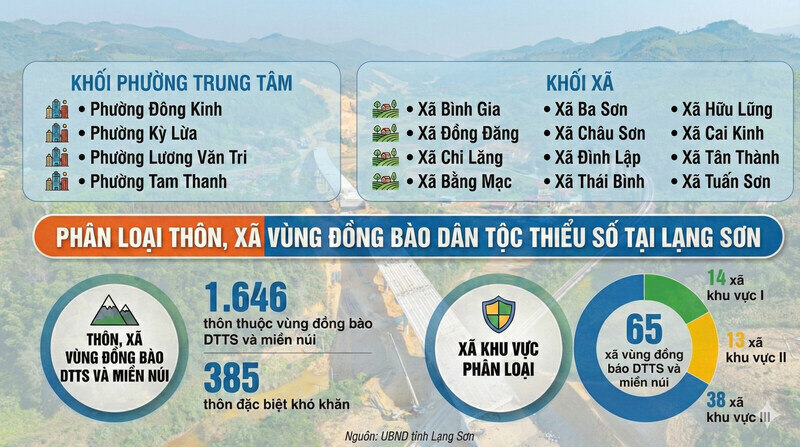
In addition, 12 communes including Binh Gia, Dong Dang, Chi Lang, Bang Mac, Ba Son, Chau Son, Dinh Lap, Thai Binh, Huu Lung, Cai Kinh, Tan Thanh and Tuan Son also do not have particularly difficult villages.
After the merger, Lang Son still has 65 communes and wards. Thus, the number of 16 communes that no longer have particularly difficult villages currently accounts for 24.6%, nearly 1/4 of the DTTS communes of Lang Son.
Lang Son Provincial People's Committee said that the list of village and commune classification is the basis for determining the area to apply ethnic minority policies, social security, sustainable poverty reduction and other socio-economic development programs of the State.
Clearly identifying "white" communes with particularly difficult villages helps localities develop policies suitable to reality, while ensuring the allocation of resources to the right people and the right level of difficulty.
According to the assignment, the Department of Ethnic Minorities and Religions and the People's Committees of communes and wards are responsible for the accuracy of the dossiers and data submitted for approval.
The list will also be used as a basis for reviewing and adjusting support programs in the next phase, contributing to narrowing the development gap between regions in the province.


