
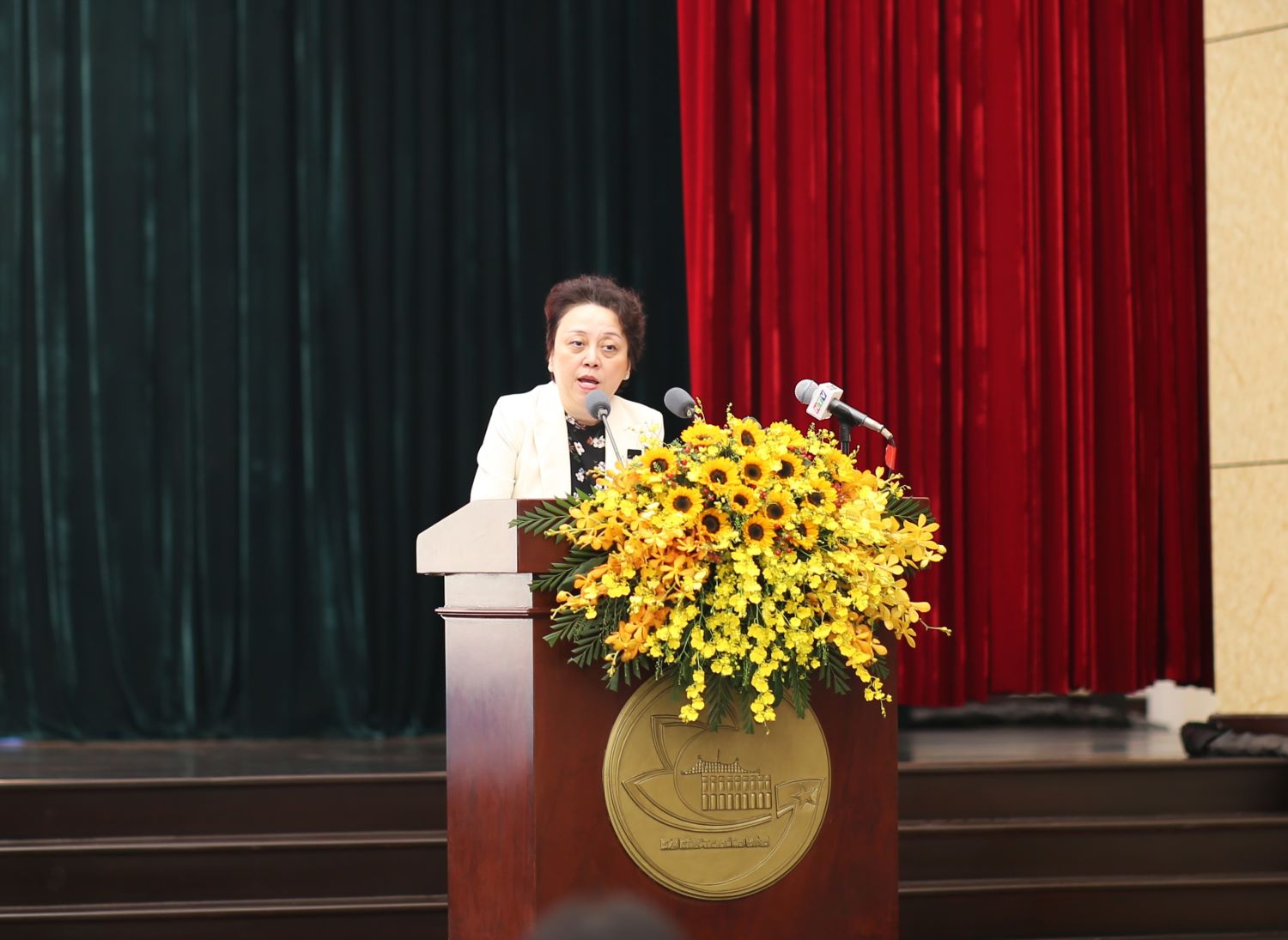
On the morning of December 10, at the question-and-answer session of the Ho Chi Minh City People's Council, Director of the Department of Food Safety (ATTP) Pham Khanh Phong Lan received many questions related to school food safety, traceability and street food management.
Delegate Ngoc Nhu Tam expressed concern about the quality of school meals when the unit price is too low, posing a potential risk of insecurity. She suggested that the Department of Food Safety coordinate with the Department of Education and Training to build a minimum "technical fence" on nutrition and safety, as a legal basis to eliminate bidding documents with unusually low prices.
Explaining, Ms. Pham Khanh Phong Lan said that Ho Chi Minh City currently has about 3,500 schools and enough models from self-organized collective kitchens, asking companies to make meals at school or book meals...
According to Ms. Lan, parents in Ho Chi Minh City are willing to sacrifice everything for their children, so low prices are not a problem like in export processing zones, industrial parks...
The most worrying problem, according to Ms. Lan, is "close friendship". Many schools tend to choose a catering unit as a "regular" for a long time.
To rectify, the Department of Food Safety has coordinated with the Department of Education and Training to organize training, communication, and raise awareness for schools.
"We do not interfere in choosing any partner, but we require ensuring safety. If an incident occurs, the principal is the first person to be responsible. There have been positive changes in the past time" - Ms. Lan emphasized.
At the same time, the Department strengthens periodic inspection work in each semester, regardless of public or private schools. Parents' Association is also encouraged to participate in supervision from the stage of choosing ingredients to organizing meals.
Delegate Tran Quang Thang raised the issue of the risk of poisoning from street food - a popular and uncontrollable type.
Ms. Lan admitted that food from small establishments, in hot and humid climate conditions, has great potential risks. The awareness of sellers and consumers in general is still not high.
However, the management agency affirmed that street food cannot be banned, because this is a part of the culinary life of Ho Chi Minh City. Statistics show that the city has about 14,200 street food stores, the number changes every day.
To manage more effectively, Ho Chi Minh City is developing "cuisine streets" such as Vinh Khanh Food Street (formerly District 4), some routes in Tan Phu District formerly..., to focus operations and facilitate sanitation control.
Street vendors are trained in food hygiene and safety and mobilized to equip themselves with necessary equipment. Cases of violations that cause unsafety will be strictly handled.
The Director of the Department of Food Safety said that the most important thing is still community awareness. People need to proactively choose clean and clear selling locations; if they see places that are not guaranteed, they will "not eat".
Ms. Lan said that many comments on social networks show that people are more interested in food hygiene. I was very happy to see comments like: I dont know if its delicious or not, why not wear handbags, because the display is so messy and dirty. That shows that awareness is increasing" - Ms. Lan said.


