
On June 7, Mr. Le Thanh Dung - Deputy Director of U Minh Ha National Park, Ca Mau - said that the decline in the quality of cajeput forest in many areas of the core area of the national park.
According to initial assessments, the area of degraded forest is currently about 200-300ha, concentrated in sub-zone 1 and sub-zone 4. Many areas of melaleuca trees died, fell, and the ability to regenerate naturally is very limited.
The cause was identified as many forest areas that had been developed for a long time, entering an old age. Along with that, the affected areas are mainly located in low-lying areas, flooded for more than 6 months a year, affecting the growth process of trees.
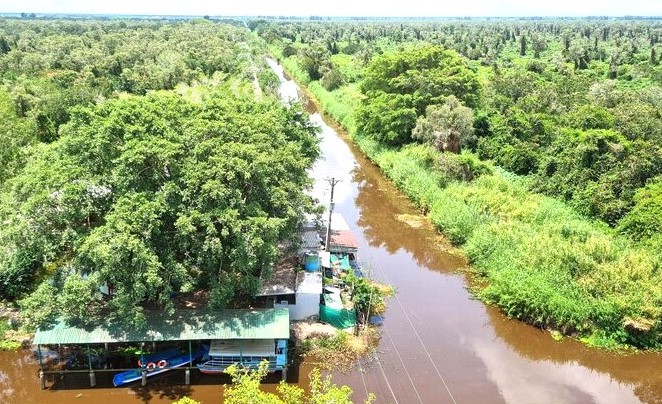
According to Mr. Dung, one of the important reasons is the phenomenon of U Minh red water arising from coal mud soil. This water source reduces the ability of young melaleuca trees to receive light, affecting the photosynthesis process, making it difficult for forests to regenerate naturally.
Over a long period of development, a layer of coal mud forms at the foot of the forest, 0.5-1.5m thick. In the dry season, the layer of coal mud becomes porous, reducing cohesion, causing many long-standing melaleuca trees to no longer cling firmly and easily fall.
According to the natural law of development, when cajeput trees decline, other plant species will develop to replace them. In fact, in many areas, large patches have appeared with grass, năng, reeds, and dớn growing strongly.
If cajeput trees cannot continue to develop, this area will move to another ecosystem," Mr. Dung said.
Faced with the above situation, U Minh Ha National Park is coordinating with research institutes and central specialized agencies to assess the current situation of forest degradation and mud to propose appropriate solutions.
According to the leader of U Minh Ha National Park, in the coming time, the unit will propose to competent authorities to study solutions to balance water resources to create conditions for melaleuca trees to recover and regenerate.
U Minh Ha National Park is one of the three core areas of the Mui Ca Mau World Biosphere Reserve recognized by UNESCO. This area has more than 8,500 hectares of core area, of which over 2,500 hectares are melaleuca forests on gravelly soil that are strictly protected, preserving the unique ecosystem and valuable biodiversity of the Mekong Delta region.


