
Talking to Lao Dong Newspaper, lawyer Nguyen Thu Trang, Deputy Director of Heva Law Company Limited, said that the current regulations on motorbike insurance are implemented according to Decree 67/2023/ND-CP dated September 6, 2023.
According to Clause 3, Article 10 of the Decree, insurance enterprises are allowed to issue electronic insurance certificates, with legal value equivalent to traditional paper copies.
Thus, the insurance certificate can exist in the form of a paper or electronic copy. However, people need to pay attention to some details to distinguish between real and fake insurance.
A survey by Lao Dong Newspaper at official websites of insurance companies shows that many units have issued warnings about forms of fake motorbike insurance. In fact, this situation is happening with many sophisticated tricks.
One of the common forms is forging insurance certificates right at car dealerships. When buying a new motorbike, customers are often invited to buy compulsory civil liability insurance.
However, if the price offered is unusually low, people may buy fake motorbike insurance, or non-compulsory motorbike insurance.
According to regulations, the civil liability insurance premium for motorbikes ranges from 55,000 - 66,000 VND per year. Products priced from only 20,000 - 40,000 VND are often not legal.
In addition, selling insurance at "sidewalk" points of unknown origin also poses risks. Buyers may receive certificates that are not legally valid or be confused between compulsory insurance and voluntary insurance.
Notably, with the development of technology, online scams are becoming increasingly common. Consumers can access fake websites, buy insurance through unofficial social networks or through e-commerce platforms at unusual prices.
Even, there are cases of using images of an insurance company but selling products of another unit, causing confusion for buyers.
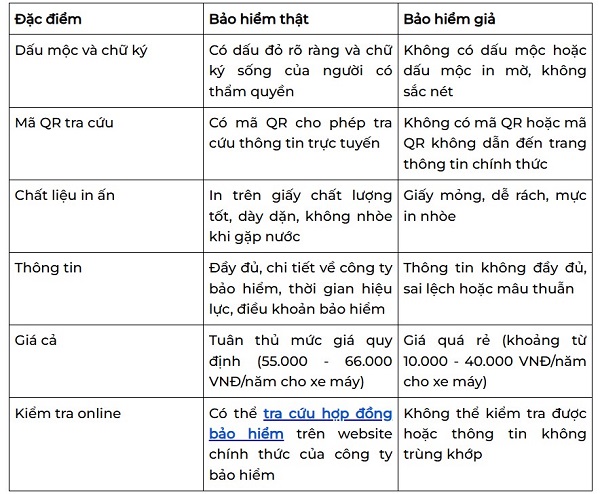
Using fake motorbike insurance leads to many consequences. Buyers not only lose money but also are not paid when an accident occurs, and must bear all compensation costs themselves. In addition, the risk of personal information, vehicle information or bank accounts being leaked may also occur if transactions are done through unsafe channels.
To limit risks, people need to equip themselves with real insurance identification skills. One of the common ways is to check the QR code on the certificate. When scanning the code, the system will lead to the official website of the insurance company to compare information. If the code is invalid or leads to pages of unknown origin, be careful.
In addition, buyers should check insurance company information, compare the certificate sample with the officially announced sample, and verify the distribution agent. It is necessary to find out information in advance through official channels.
Insurance companies also recommend that people should only buy insurance at licensed businesses or authorized agents. Be wary of unusually cheap prices, check the full information on the certificate and prioritize transactions through official websites.
After buying, people should keep invoices and payment receipts and proactively check the validity of insurance. These are important steps to protect their rights when participating in traffic in the context of increasingly strong digital transformation.


