
No longer stable for long
Ms. Nguyen Thi Thuy Chi - accountant at a company specializing in importing food and pharmaceuticals from Japan to Vietnam - said that in 2025 alone, her entire company dismissed 13 employees, and her department alone had 3 people in this category. All employees who were dismissed were intermediate staff, with qualifications that did not meet the new requirements of the job or the job was automated.
At the age of 41, after 9 years of attachment to the company and her current job, Ms. Chi said "have never seen the word "stable job" as precarious as it is now".
Previously, a job that has been attached for 5-10 years was often considered stable. However, reality now shows that that stability is becoming fragile. Many businesses are restructuring, cutting personnel, automating production lines, and strongly transforming digitally. Positions that do not meet the requirements are more likely to fall into the category of reduced working hours, job changes, or termination of contracts. I decided to study in depth the work I am undertaking so as not to be eliminated," Ms. Chi said.
Not only Ms. Chi, many workers once thought that many years of experience was a solid "shield", but when businesses change technology and processes, old experience itself becomes a barrier if not updated. Clearly aware of this, many workers choose to continue studying while still having work instead of waiting until they lose their jobs to struggle to find a new direction.
Mr. Nguyen Xuan Huy - deputy head of training department of a vocational college in Cau Giay ward (Hanoi) - said that the trend of labor returning to studying takes place in many industry groups. Especially, for the group of technical workers, many people register for advanced skills classes, learning to operate new machines. The group of office workers register to study digital skills, data analysis, foreign languages. Even many middle-aged workers boldly learn new professions to expand job opportunities.
The common point of this group of workers is the clear awareness of the risk of being replaced if they do not upgrade themselves. When businesses invest in technology, prioritizing multi-skilled labor, people who can only do one single job are easily eliminated from the game. Learning not only helps workers maintain their current position, but also increases internal mobility, avoiding falling into a passive position when businesses restructure," Mr. Huy said.
Skills are the "asset" of workers
Although aware of the importance of learning, this path is not easy at all. Most workers who are both studying and working face double pressure on time, finance and health. After working hours, they continue to go to class, study online or self-study at night and on weekends.
For families, arranging study time is even more difficult when balancing work, children and family responsibilities. "Going to school at this time, at this age is a stressful choice but you still have to accept it if you don't want to be left behind," Ms. Chi admitted.
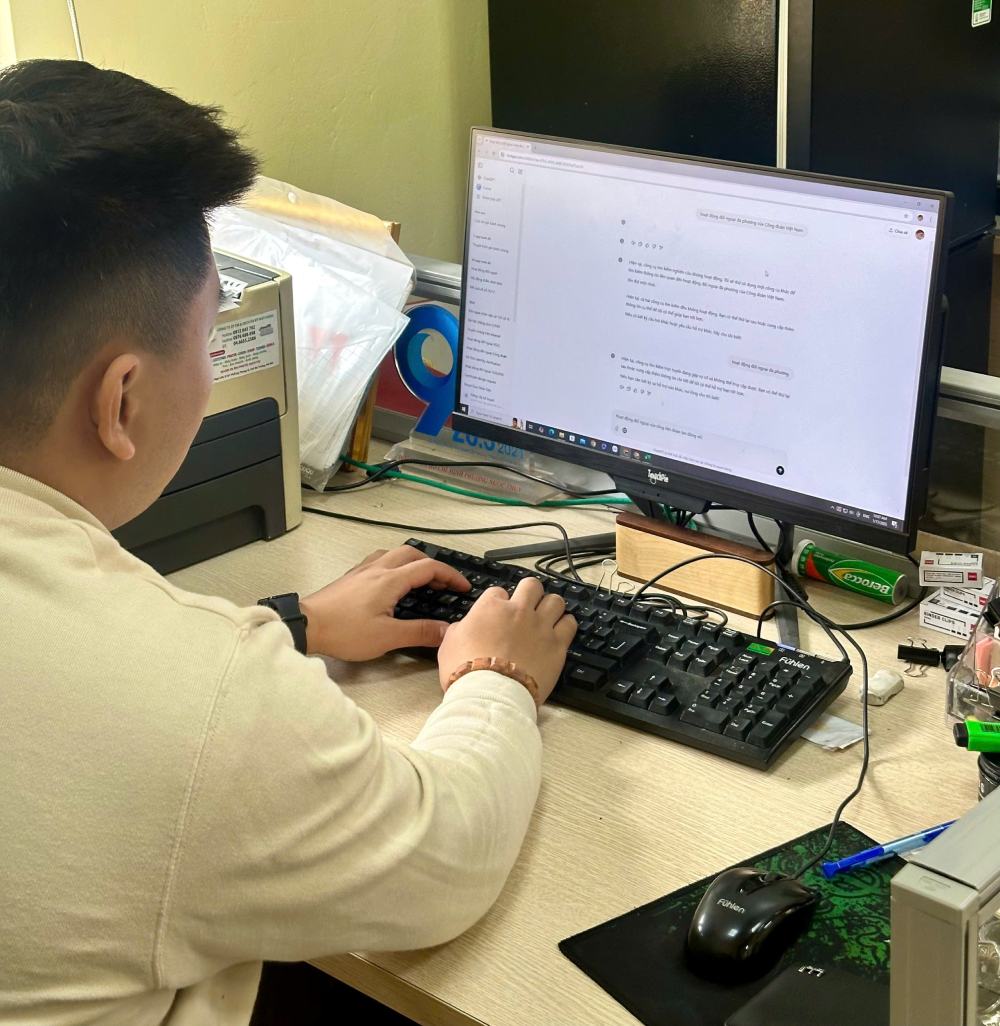
Mr. Nguyen Duc Binh - deputy head of technical department of a company specializing in electrical equipment in Viet Hung ward (Hanoi) - has registered for a master's degree class, starting from February 2026.
According to Mr. Binh, at his age of 43, the pressure of studying is very high but there is no other choice because of the change in the labor market. “In addition, I myself also receive changes in my thinking. Instead of completely relying on businesses, I choose to actively invest in myself, considering studying as an essential part of the labor process,” Mr. Binh shared.
Mr. Bui Sy Loi - former Deputy Chairman of the National Assembly's Committee for Social Affairs (now the Social Committee) - said that the current labor market shows that skills are the most important "asset" of workers.
Degrees can be a starting point, but continuous learning ability determines long-term existence. Learning is not limited to formal schools, but also short-term training courses, online learning, learning at businesses. Notably, many workers deeply understand that learning is not only to increase salaries, but more importantly to maintain jobs and initiative. When they have skills, they are more confident in the face of fluctuations, and can choose to stay or change jobs, instead of passively waiting for decisions from businesses," said Mr. Bui Sy Loi.
Agreeing with the efforts of workers to learn more and improve their skills, Mr. Loi also said that they need more "support" to be assured of learning: The State needs to expand retraining programs, skills training, and support for learning costs for working workers, especially vulnerable groups; businesses need to consider training as long-term investment, not only serving immediate benefits but also helping to stabilize human resources.
It's a bit of a bit of a bit of a bit of a bit of a bit.


