
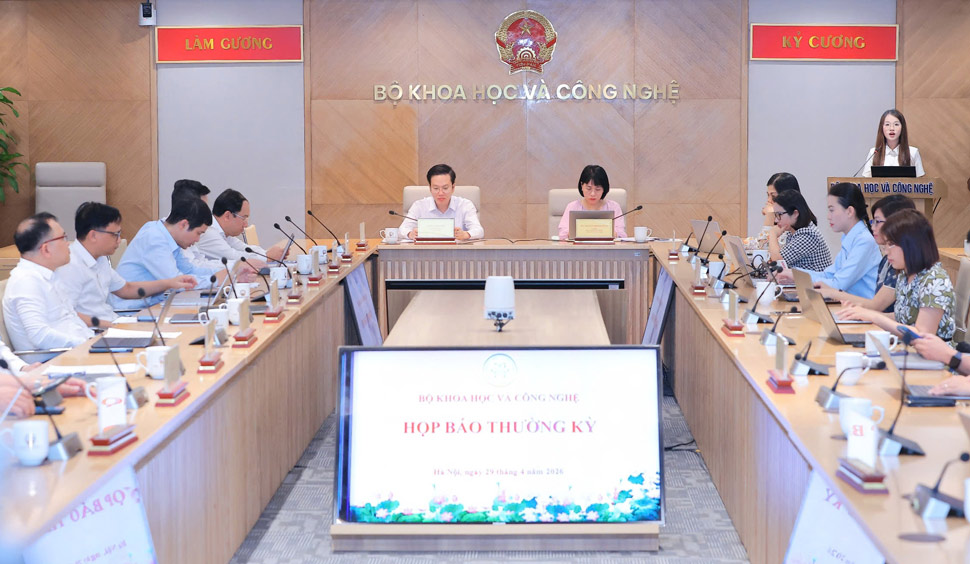
On April 29, the Ministry of Science and Technology held a regular press conference for April. Many published results show that science and technology, innovation and digital transformation are becoming new driving forces for the development of the economy.
According to the Ministry of Science and Technology, in April 2026 alone, the Ministry advised and submitted to the Government for promulgation 4 decrees, submitted to the Prime Minister 6 decisions and issued 13 circulars according to its authority.
The documents focus on many major impact areas such as technology transfer, intellectual property, digital transformation of small and medium-sized enterprises, telecommunications, technical standards and science and technology market development.
The Ministry of Science and Technology said that promoting the completion of institutions helps remove many bottlenecks in development, create conditions for businesses to access new technologies, promote the commercialization of research results and improve management efficiency in the context of rapid digital transformation.
This is also the foundation for implementing the objectives of Resolution 57-NQ/TW on science and technology development, innovation and national digital transformation.
In the field of scientific research, Vietnam had 2,761 international publications in April. Prominent fields include engineering, computer science, mathematics, medicine, environment and agriculture.
The national science and technology information system recorded more than 168,500 downloads of international scientific documents. According to the Ministry of Science and Technology, this reflects the increasing demand for exploiting scientific knowledge in the research community, universities and businesses.
Currently, 589 science and technology tasks are being implemented. Of which, 190 tasks have been applied in practice. The total budget allocated and paid for the tasks reached more than 100 billion VND.
Notably, the Ministry of Science and Technology is developing a list of strategic technologies and strategic technology products to focus resources on areas with potential for breakthroughs such as artificial intelligence, semiconductors, biotechnology, new materials, new energy and space technology.
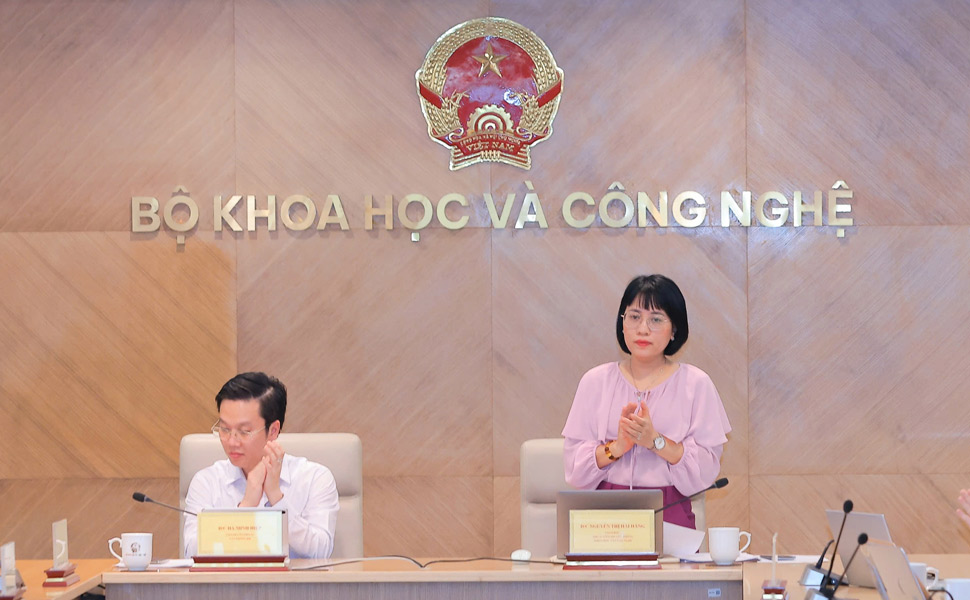
The Ministry is also completing a project to effectively exploit and use national space. This is considered a step to expand Vietnam's high-tech capacity in the coming time.
On the international level, scientific and technological cooperation activities continue to be expanded. Vietnam has coordinated to extend UNESCO's recognition and sponsorship for the International Center for Mathematics and Physics for another 8 years.
The Ministry of Science and Technology also promotes cooperation with South Korea, India, Cuba and China in strategic technology fields such as artificial intelligence, semiconductors, biotechnology and digital transformation.
Innovation continues to spread in the business ecosystem. As of April 2026, the country has 30 certified high-tech enterprises and many high-tech application and incubation organizations operating.
A network of 20 science and technology exchanges is also being invested and operated to connect research activities with the market.
In the field of digital transformation, the whole country has issued nearly 29.5 million digital signature certificates, equivalent to more than 42% of the adult population.
The total online application rate reached 46.1%. The national data integration and sharing platform recorded more than 4.3 billion transactions.
Digital infrastructure continues to grow strongly. Vietnam currently has more than 110.5 million mobile broadband internet subscribers. The rate of households using fiber optic cable reaches 85.8%, while the rate of using IPv6 reaches 65%.
In the field of digital technology industry, revenue in April 2026 is estimated to reach more than 622,400 billion VND, an increase of 38% compared to the same period last year. Currently, there are more than 80,000 digital technology enterprises operating nationwide.
According to the Ministry of Science and Technology, in the coming time, it will continue to focus on building a specific mechanism for strategic technology, promoting the mechanism for the State to order and purchase the first technology product and deploy a controlled testing model to create momentum for rapid and sustainable growth.


