
socialization is necessary but must be suitable for the conditions of each region
This is an issue raised by National Assembly deputies at the recent discussion session on the Investment Policy for the National Target Program on modernization and improvement of the quality of education and training for the period 2026 - 2035.
Delegate Chu Thi Hong Thai (Lang Son Delegation) said that the draft and report on acceptance and explanation stated that the socialization rate only accounts for 10% of the total investment in projects on preschool, general education and vocational education, mainly to supplement equipment, learning space, playgrounds, experiential activities, etc. But the explanation did not fully assess the risks in disadvantaged areas.

Ms. Thai pointed out the reality that in many mountainous communes, remote areas, there are almost no businesses with enough financial potential, and people with low incomes, so the ability to mobilize social resources is very limited.
In that context, if a socialization rate of 10% is still set but not achieved by businesses, the existing risk is that educational institutions and grassroots authorities will shift to mobilizing and calling for voluntary contributions from parents to complete the target on facilities and equipment.
"This approach leads to a paradox that in the name of the State implementing the policy of exempting tuition fees or not increasing tuition fees, in reality, the total educational costs that households have to bear can increase through revenues other than tuition fees such as socialization fees, subsidies, equipment fees, experiences, etc.
"If not well identified and controlled, the socialization mechanism as modernly designed can risk reducing the effectiveness of tuition exemption and reduction policies, creating more financial pressure on poor families, especially in ethnic minority areas and going against the fairness goal in access to education set by the program" - the delegate frankly said.
Emphasizing the view that socialization is necessary but must be consistent with the conditions of each region, the delegate suggested not applying the correct 10% rate and limiting the mobilization from parents and only socializing supplementary items, essential items must be guaranteed by the budget to not increase education costs for people, especially when we are implementing the policy of exempting tuition fees for high school students.
Strong enough policy is needed to attract English teachers
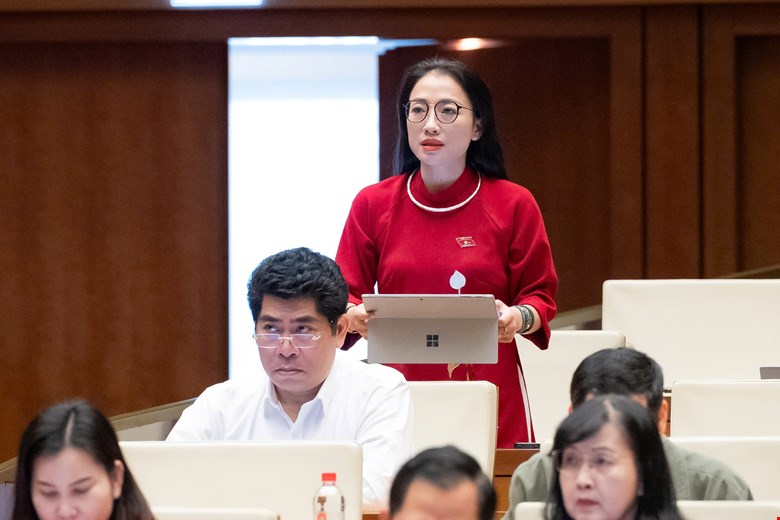
Delegate Tran Khanh Thu (Hung Yen delegation) stated that the program has set a goal of making English the second language in the national education system, in which by 2030, 30% of preschool and general education institutions will have equipment to implement teaching and learning in English.
By 2035, the program strives for 100% of preschool and primary schools to meet the standards on facilities and teaching equipment to implement teaching and learning in English, gradually making English the second language in schools.
Ms. Thu believes that this is a major orientation, demonstrating the determination to integrate deeply into the international community, but to successfully implement it, it is necessary to frankly and thoroughly assess the conditions and challenges of facilities as well as human resources and the environment.
According to the report of the Ministry of Education and Training, we still lack about 4,000 English teachers at all levels of general education. Team capacity is also a problem. On the other hand, the average age of English teachers is currently quite high (44.2 years old).
Some elderly teachers are less interested or still have difficulty in exploring modern teaching methods, suitable for each student group, so the quality and teaching efficiency of the subject have not been as expected.
Therefore, the female delegate suggested that there should be a specific roadmap to implement these contents, especially in mountainous provinces and disadvantaged areas.
In particular, it is necessary to increase investment in facilities for provinces, especially mountainous provinces, such as supporting the construction of standard foreign language rooms for 100% of mountainous district schools before 2030; prioritizing mountainous areas, border areas, and areas with particularly difficult socio-economic conditions.
In addition, there should be strong enough policies to attract high-quality English teachers, such as increasing allowances to attract up to 70-100% of basic salary for teachers in disadvantaged areas; supporting housing, and committing to long-term contracts.
In addition, there should be policies to promote the application of technology, connect online classes, use artificial intelligence (AI) to support to compensate for teacher shortages; build an English center in disadvantaged areas according to the inter-commune model.


