Innovating growth models to avoid "three big traps
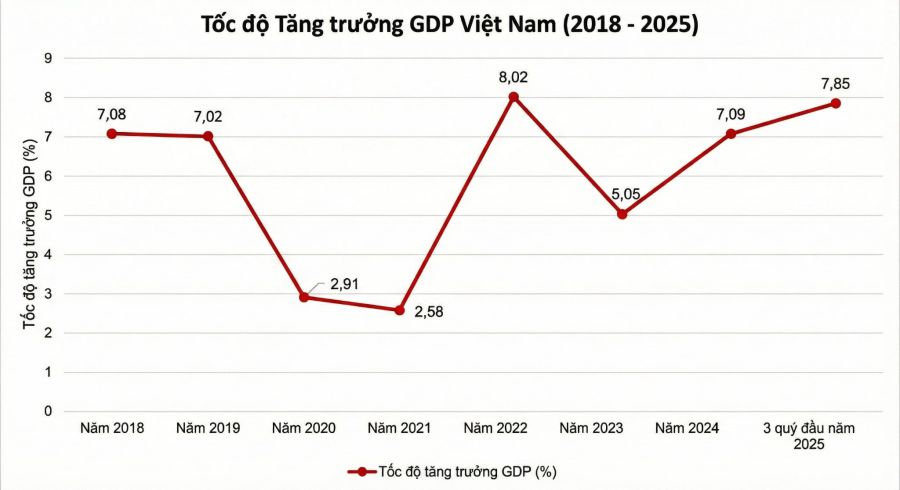
Over 40 years of renovation, Vietnam's economy has had positive changes, achieving an average growth rate of 6%/year. The economic structure has shifted strongly, from an agricultural proportion reduced to 12%, while industry and services accounted for 88% in 2024. However, the economy is showing signs of slowing growth. The growth rate decreased by about 0.5% after each 10-year cycle. The current growth model mainly relies on resource exploitation and cheap labor, which is preparing to push the economy into a middle-income trap.
With the signing of free trade agreements (FTAs), but the rate of taking advantage of incentives from these agreements only reaches about 31%, we face the risk of falling into the free trade trap. Foreign investment accounting for more than 70% of export turnover has caused Vietnam to lose its comparative advantage in the domestic investment sector. In addition, the localization rate in industrial products is only 36.6%, which could lead to a "manufacturing trap", causing the economy to lag behind.
The issue of Vietnam's labor productivity is also worrying. Vietnam's labor productivity index is only 1/15 of Singapore and 1/12 of Korea, while energy and raw material consumption is still very high. To meet sustainable development goals, Vietnam needs a new growth model that can reduce emissions and meet international commitments.
Switching from breadth growth to depth
Vietnam's new growth model needs to shift from broad growth (based on cheap labor and resource exploitation) to deep growth. To achieve double-digit growth, Vietnam needs to change the economic structure, invest in high-tech industries such as semiconductor industry, artificial intelligence, renewable energy, and mechanical engineering. These are industries with great spillover potential into the national economy.
In addition, the new growth model needs to maximize resources from all economic sectors: state, collective, private, and FDI sector. In which, the role of the private economy needs to be strongly promoted, because this is an important driving force to promote creativity and productivity.
The goal of this model is to improve productivity and quality of growth, promote innovation and optimize production processes, minimize waste and maximize economic efficiency.
Exploiting and effectively using all resources
To shift the growth model effectively, Vietnam needs to focus on mobilizing development capital sources. Capital from the state budget must be improved through increasing budget revenue and implementing key public investment projects. At the same time, it is necessary to mobilize investment from domestic enterprises, from socialized capital sources, and from domestic and foreign capital markets.
In addition, the exploitation of resources such as oil, gas, forests, seas, and land needs to be carried out sustainably, associated with reasonable planning and transparent mechanisms. These resources are not only of great economic value but also have a strong impact on sustainable development.
High-quality human resources will be a decisive factor in successfully implementing the new growth model. To meet this requirement, Vietnam needs to focus on training and developing human resources in high-tech and strategic industries.
Proactive, deep and substantive international integration
International integration will play an important role in the new growth model. Vietnam needs to promote proactiveness and positivity in integration, adhere to the principle: internal strength is decisive, external strength is important, and national interests are supreme. Participating in international trade agreements will promote the development of industries with competitive advantages and help Vietnam adjust its economic structure to suit global trends.
International integration not only helps Vietnam attract investment capital and high technology, but also creates opportunities to develop high-value industries such as exports, finance, and technology. This will promote the dynamism of the economy, while strengthening the strength of the domestic economy, helping to strengthen resilience to external impacts.
Digitalization and greening - new development axis to improve competitiveness
One of the pillars of the new growth model is the commitment to reduce net emissions to 0 by 2050. This not only demonstrates Vietnam's responsibility to the international community but also helps the country transition to a green economy. The green growth model will require the development of green supply chains, clean energy, green businesses and green consumption.
Promoting green industries, green real estate, green transportation, and green tourism will create many new investment opportunities, while ensuring sustainable development in the long term. Green standards will help Vietnam not only maintain growth but also achieve sustainable development goals.
Vietnam's new growth model in the period 2026-2030 will not only be a transition in economic structure, but also a breakthrough process in effectively using all resources, promoting creativity, innovation, and transitioning to a green economy. With strong internal resources and deep international integration capabilities, Vietnam can completely achieve sustainable development goals, high growth, and move towards a modern industrial economy by 2045.