
Strong growth
The new ranking puts Vietnam ahead of some leading technology economies. In the mobile ranking, Vietnam (ranked 10th) ranked above the US (ranked 12th) and China (ranked 13th). In the fixed ranking, Vietnam's 307.11 Mbps speed is 2.4 times higher than the global average, only behind the world's leading country Singapore with 451.14 Mbps.
To have this position, Vietnam has come a long way.
At the end of 2015 - when 2G networks were still popular and 3G was just starting to be deployed - the average Internet speed in Vietnam, according to Akamai Technologies' records, only reached 3.8 Mbps, ranking 95th out of more than 100 markets measured, near the bottom of the global ranking. For many years after that, during the 3G and 4G exploitation period, Vietnam's mobile download speed fluctuated around the threshold of 35-50 Mbps, ranking 50-58th in the world - almost standing still.
The turning point came when 5G was commercialized at the end of 2024: Vietnam for the first time surpassed the 37th position in the world. The increase then continued continuously. By March 2025, Vietnam for the first time entered the group of 20 fastest countries.
More than a year later, according to Ookla's Speedtest Global Index ranking for the July 2026 data period, Vietnam's mobile Internet increased by 10 places, rising to 10th place in the world with a median download speed of 205.58 Mbps - nearly double the global median speed of 109.73 Mbps. The fixed network follows a similar trajectory, rising one place to 7th global position and almost doubling speed in just 18 months.
In other words, the journey from near the bottom of the 2G/3G era to the top 10 in the world has gone through three generations of network technology in about a decade, but most of the breakthrough has been concentrated in less than two years since 5G appeared. In the July/2026 report, Vietnam was also the market with the strongest ranking improvement in the world, while most other countries almost maintained their positions.
Behind the speed measurement figures is the volume of infrastructure built in a short time. According to the Ministry of Science and Technology, 5G coverage in Vietnam increased from 0.93% of the population in 2023 to 90.2% in 2025, the number of 5G stations increased from 184 stations to more than 30,000 stations. By March 2026, 4G infrastructure covered 99.48% of the population, creating a foundation for the entire upgrade process. The whole country has 22.41 million 5G subscribers, showing that this technology has passed the testing phase to become widespread.
In that picture, Viettel plays the role of the largest deployment force. On October 15, 2024, Viettel inaugurated the first commercial 5G network in Vietnam with 6,500 broadcasting stations. In 2025 alone, the group installed 23,500 new stations, raising the total number of stations put into operation to 30,000, reaching 90% of outdoor coverage and 70% of indoor coverage nationwide - the deployment volume puts Viettel into the group of 15 network operators with the largest number of 5G stations in the world in 2025.
Not stopping there
On September 15, 2026, Vietnamese telecommunications enterprises officially stopped broadcasting 2G networks nationwide. The bandwidth once exploited for 2G is now utilized for 4G and 5G technology. This is the backbone for Internet speed in Vietnam to continue to increase in the coming time.
This prospect can be foreseen because the low frequency range of 900 MHz possesses its own physical characteristics of radio waves: waves travel far and penetrate obstacles. In rural areas, a 900 MHz station can cover a radius of 5-10 km, many times wider than high frequency ranges. In densely populated urban areas, a 900 MHz station can transmit waves through basements, elevators or rooms deep in high-rise buildings.
With the new bandwidth, Viettel owns all three frequency layers: the low layer including 700 MHz and 900 MHz for wide coverage, the medium and high layer for capacity in crowded user areas, allowing to use the correct frequency range for the correct terrain.
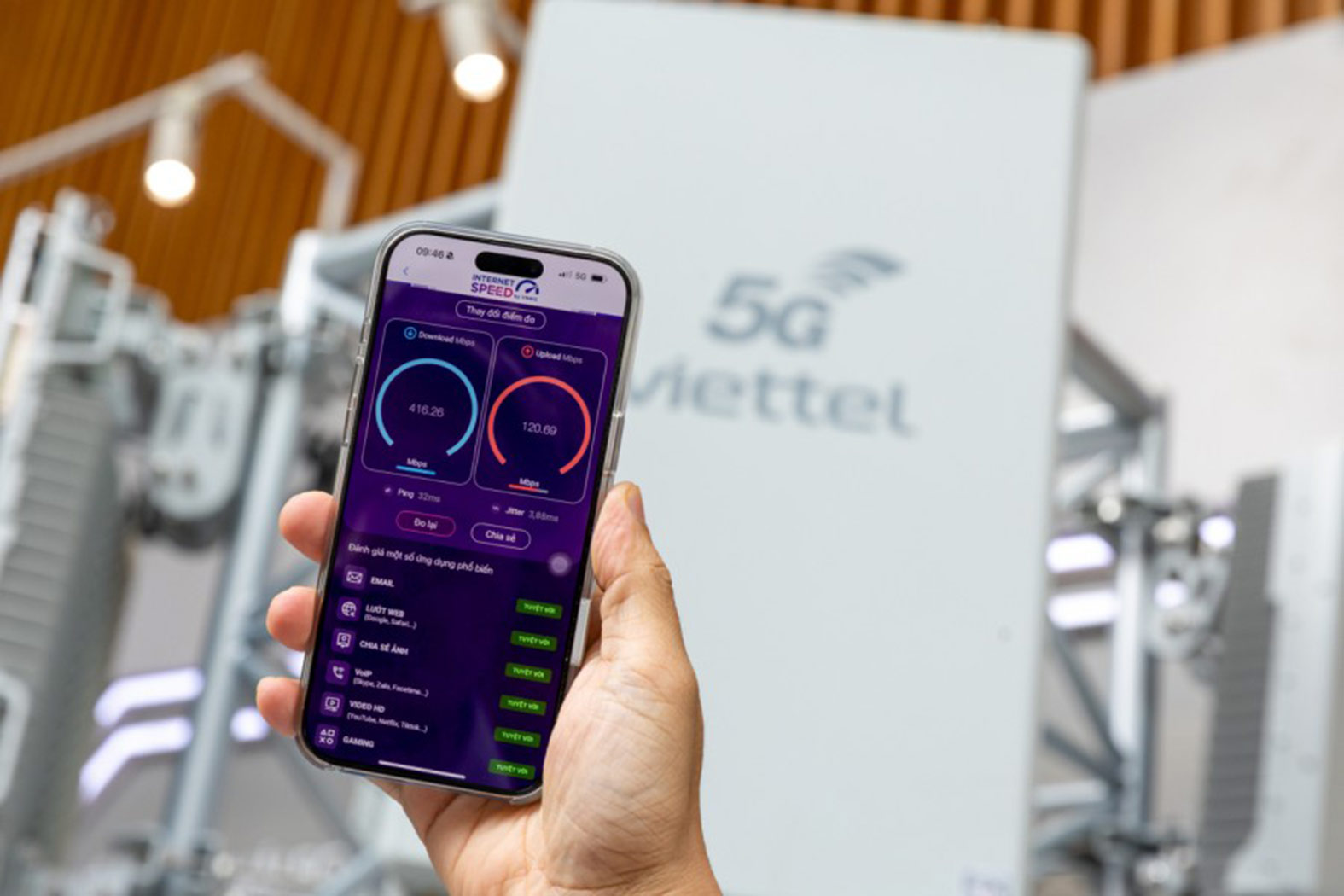
After being put into operation, Viettel's network is expected to increase Internet speed by 10%, while expanding coverage in rural, mountainous and island areas in a cost-saving direction. Based on existing infrastructure and frequencies, Viettel sets a target for 2026 of about 50,000 5G station locations with a wide coverage area reaching 97% of the population.
This goal is part of the general roadmap of the industry. According to the Telecommunications Authority, in 2026 alone, mobile speeds need to reach 170 Mbps, fixed 300 Mbps, 99% of the population is covered by 5G and 40% of people have access to 1 Gbps broadband. Further, Resolution 57 of the Politburo sets a target that by 2030 5G networks will cover the whole country on a super broadband infrastructure.
Internet speed is now seen as an indicator reflecting the digital competitiveness of the entire economy, as a foundational infrastructure for smart factories, remote healthcare, artificial intelligence and the Internet of Things. The 10th position in the world is therefore meaningful beyond a ranking number: that is the input condition for the digital service class that Vietnam is aiming for for the next growth stage.
The most important thing: this breakthrough of the Vietnamese Internet has not stopped.


