
The sun in recent days has shown clear signs of "waking up" when January 18 recorded a X-level solar outburst - the strongest level in the scale of energy eruptions.
This eruption released a massive coronal eruption (CME), moving at high speed and heading straight towards Earth.
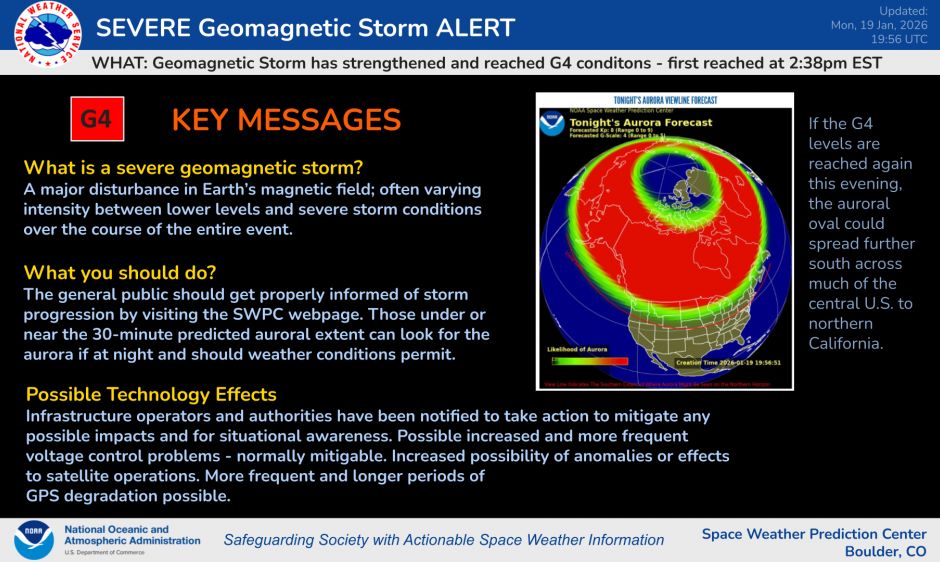
According to the US National Oceanic and Atmospheric Administration's (NOAA) Center for Space Weather Forecasting, the CME's shock wave hit Earth at 2:38 pm on January 19 (US time), which is 2:38 am on January 20 Vietnam time, much earlier than some initial scenarios.
Immediately after the collision, a G4-level geomagnetic storm - a serious level - quickly formed, causing scientists to raise their warnings.
Forecasters say this geomagnetic storm has not ended immediately, as the CME block continues to pass through Earth for hours. This means the risk of geomagnetic activity remaining at a high level, leading to a series of chain reactions to near-Earth space.
Unlike conventional weather phenomena, CME is one of the most unpredictable objects of space weather. The three factors that determine its level of danger include speed, trajectory and especially the magnetic field direction that CME carries.
If this magnetic field turns south, it can directly connect to the Earth's magnetic field, creating conditions for solar energy to flood strongly into the magnetosphere, triggering violent geomagnetic storms.
Conversely, if the magnetic field is facing north, the Earth may have better "resistance", causing significant reduction of impact.
In fact, many CME contain mixed magnetic fields, sometimes south and sometimes north, causing geomagnetic activity to fluctuate erratically, sometimes strongly and sometimes weakly. Therefore, even when the CME has arrived, scientists still have to wait for direct measurement data from solar wind monitoring satellites such as DSCOVR or ACE to accurately assess the level of danger.
Geomagnetic storms are classified from G1 (light) to G5 (extreme). With level G4, this is no longer a "beautiful to admire" phenomenon but a real threat to technology infrastructure.
Storms at this level can be:
Disrupting satellite operation, forcing some systems to switch to safe mode.
Causing GPS signal distortion, affecting aviation, maritime and activities that need highly accurate positioning.
Increasing atmospheric resistance in low orbit causes satellites and spacecraft to lose altitude faster than expected.
On the rare positive side, strong geomagnetic storms can push auroras far beyond polar regions, appearing at medium latitudes - where normally it is rarely seen.
The event of geomagnetic storms coming early this time is clear evidence of the reality: Earth is increasingly vulnerable to changes from the Sun, especially in the context of society's deep dependence on satellites, telecommunications and global navigation systems.


