The US National Oceanic and Atmospheric Administration (NOAA) said that the Agency's Space Weather Forecast Center has issued a terrestrial storm warning until the end of January 3, after recording many strong eruptions from the Sun.
According to forecasts, the Kp index - a global scale of geomagnetic activity - may reach level 6 at some points, equivalent to a G2 level geomagnetic storm (average).
This time is particularly noteworthy because it coincides with the early days of 2026, when the Earth simultaneously suffered many high-speed solar winds and coronal mass (CME) eruptions.
NOAA warns that from the night of January 2nd to January 3rd, the possibility of G1-G2-level geomagnetic storms is quite clear, due to CMEs arriving at Earth and interacting with solar winds emitted from coronal holes.
CME are giant eruptions consisting of plasma and solar magnetic fields. When these eruptions collide with the Earth's magnetosphere, they can cause strong geomagnetic storms, disrupting the electromagnetic environment around the planet.
Meanwhile, heliosphere holes are areas with low plasma density on the Sun's surface, often creating fast solar winds, contributing to catalytic activity.
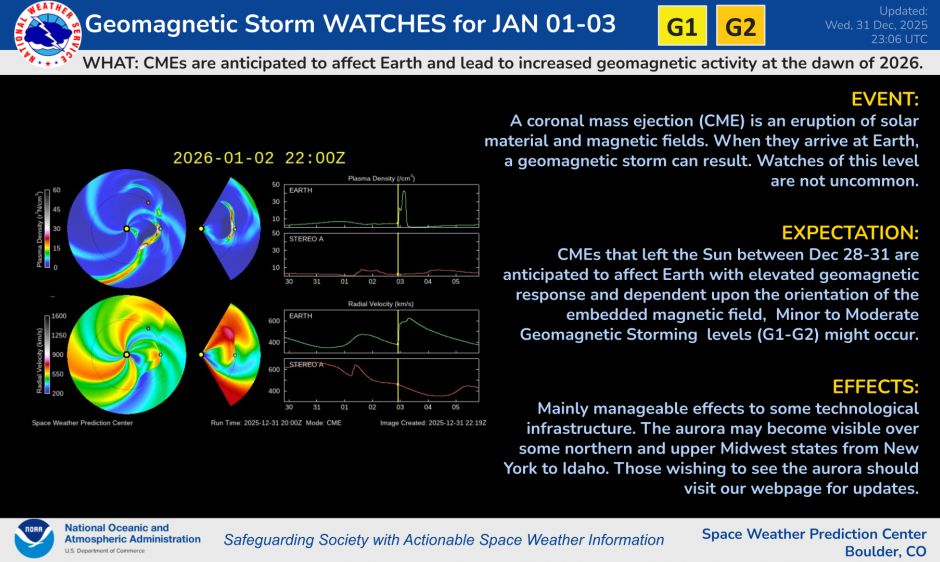
For the public, the most obvious impact of Typhoon Sun on January 3rd is the ability to observe auroras. NOAA said that at level G2, auroras were previously seen far south to New York or Idaho (USA), while Typhoon G1 usually allows observation at higher latitudes such as northern Michigan or Maine (USA).
The best observation time frame usually falls around 1 to 2 am after midnight, with clear skies and away from city lights.
However, the opportunity to see the aurora this time may be limited by the supermoon "Wolf Moon" on January 3rd. This is a full moon that takes place near the time when the Moon is closest to Earth, making it look bigger and brighter than usual. NASA said the supermoon may be up to 30% brighter than the fainterest full moon of the year, reducing the contrast of auroras and even Quadrantid meteor showers.
In the opposite direction, infrastructure operators closely monitor the dien bien of geomagnetic storms. NOAA emphasized that, although not affecting human health, solar storms can cause interference or temporary interruption of GPS signals, high-frequency radio communications - especially in aviation and maritime - as well as create abnormal fluctuations on the power grid. In stronger scenarios, widespread power outages may occur.
The UK Meteorological Agency also issued a similar warning, forecasting the possibility of a terrestrial storm from a "slight to moderate" level on January 3, with some times possibly stronger, related to CME stemming from a solar outburst at the end of December.