
Under the barren soil of Central Turkey, a quiet crack is tearing the Earth's shell in an unprecedented way.
In the area around Tuz Lake, researchers unexpectedly discovered something that went completely against what the scientific model had confirmed: Instead of sliding sideways like other faults in Turkey, the nearly 200km-long Tuz Gölü fracture was severing the Earth's crust vertically, expanding by millimeter per year.
For many years, this area has been classified as a transverse landslide, in line with the " creativity flow" picture used to explain seismic activity in Turkey.
But a new study published in the Journal of Natural Communication on Earth and Environment shows that assumption is completely false.
The turning point comes from surveys around Hasandağ volcano, where ancient ruses are broken and cut through. The international research team led by Axel Schmitt ( Curtin University) used the extremely accurate zircon aging method to re-reads the history of the Earths crusts rotation.
The four eroded lines, aged from 151,000 to 38,800, all have one thing in common: They are lifted or lowered vertically, but have almost no sideways movement. This allows them to measure the vertical deformation rate from 0.9 to 1.23 mm/year - stable over tens of thousands of years.
Meanwhile, previous GPS data had shown that the fracture slid nearly 5mm across the trough every year. New research proves that does not happen at all.
The reason for this confusion lies in the fact that satellite and GPS models only record data for a few decades, while slow movements that last for hundreds of thousands of years are not clearly shown. Only when "reading" the long lines of arranged flowers along history, will the real picture be revealed.
This dismantles the hypothesis that Tuz Gölü acted as a supporter for the nearby Ecemiş slide system. Instead, it is opening a quiet pulture between the Asian-European, Arab and African regions.
Unlike the North Anatolian fault that often causes strong earthquakes, Tuz Gölü has little chance of major earthquakes. This peace of mind has made scientists take it lightly.
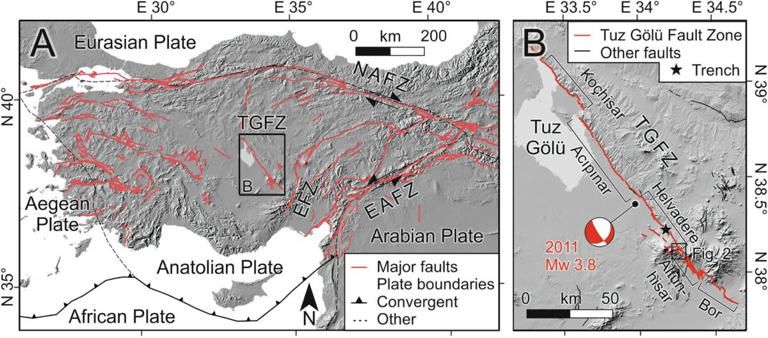
However, research shows that the area around Hasandağ is the focus of the Earth's crust deformation, which combines both tectonic and volcanic activity history. Every trace - from the rising mountain slope to the long cracks - points to a unified deformation of straight, not sideways stretching.
This has forced scientists to reconsider not only the Tuz Gölü fracture, but also similar systems in the world that have been misunderstood due to a lack of long-term data.
What the ancient years have preserved for hundreds of thousands of years shows that the Alpine - Himalaya earthquake belt, where hundreds of millions of people live, is much more complex than any existing map.
And right in Turkey, where the three large tectonic plates intersect, a seemingly peaceful seismic hot spot is silently sending warning signals.


