
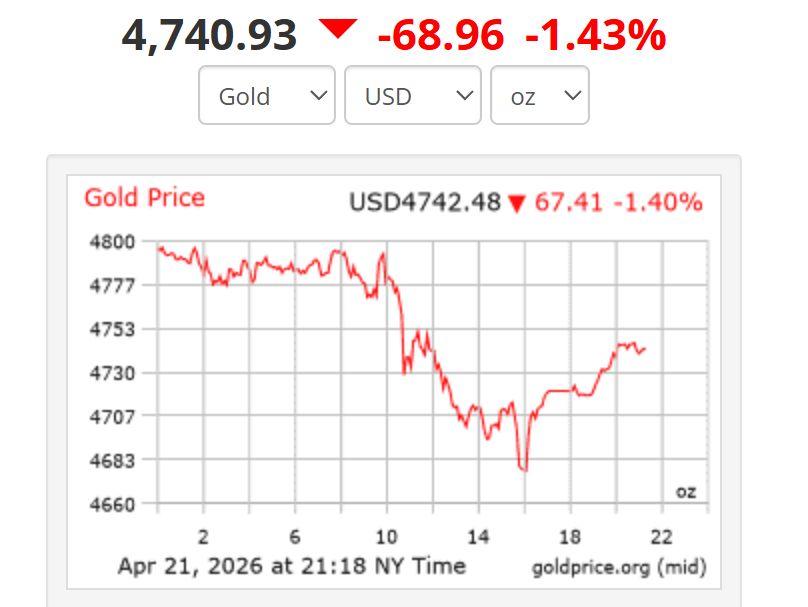
World gold prices this week traded in a weakening state. At 8:18 am on April 22 Vietnam time, world gold prices fell 68.96 USD, equivalent to a decrease of 1.43% to 4,740.93 USD/ounce.
Compared to the historic peak of 5,595 USD/ounce set at the end of January, gold prices have now fallen by about 14% and have continuously failed to approach the 4,800 USD resistance zone. This is also an area strengthened by the 50-day moving average, causing the recovery momentum of the precious metal to be repeatedly blocked.
Pressure from oil, USD and yields
According to experts, the main reason for the decrease in gold prices lies in the monetary channel rather than capital flows. The sharp increase in energy prices has pushed up US bond yields, increasing the opportunity cost when holding gold - an unprofitable asset.
At the same time, the USD index rose to 98.47 - the highest level in more than 1 week - making gold more expensive for investors holding other currencies. This limits safe-haven demand, even as geopolitical tensions escalate.
ETF capital - an important pillar of the gold market - is also faltering. After 2 weeks of drawing back capital in April, this trend may reverse if yields continue to increase.
However, buying power from central banks and prolonged tensions in Eastern Europe are still seen as long-term supporting factors, creating a "floor" for gold prices.
Scenario of falling to $3,400/ounce
Technical analysis by financial expert Damian Chmiel of Finance Magnets shows that gold is "stuck" in the sideways zone from 4,281 - 4,800 USD for many weeks. After the 3rd failure at the 4,800 USD mark, the short-term trend has turned negative.
According to the Fibonacci model, if gold prices break the support zone of 4,281 USD, the next downward target may be around 3,400 USD/ounce - equivalent to a decrease of 28% compared to the present. This is not a random number, but a zone that used to play a strong resistance role in 2025 before the price broke through to the peak.
In technical analysis, when an old resistance zone is broken and then fails to maintain its supporting role, the price usually returns to the starting point. This further reinforces the scenario of deep decline if the 4281 USD mark is broken through on the weekly chart.
In the opposite direction, if gold decisively surpasses 4,800 USD with large liquidity, the market may head towards the 5,400 USD zone - the highest closing peak ever recorded.
Forecast of strong differentiation
Major financial institutions currently make very different forecasts for gold prices at the end of 2026. Some banks such as JPMorgan, UBS or Goldman Sachs still maintain an optimistic view with a target of 5,400 - 6,300 USD/ounce. Conversely, negative scenarios show that prices may retreat to the 4,000 USD range, or even lower.
A Reuters survey shows that the average price in 2026 is about 4,746 USD/ounce, close to the present, reflecting the market's cautious sentiment.
In the short term, the 4,281 - 4,800 USD zone is still the main "operation range". Only when one of these two thresholds is clearly broken, will the new trend of gold prices be truly established.
Regarding domestic gold prices in the Vietnamese market, SJC gold bar prices are currently trading at 168.1 - 170.6 million VND/tael (buying - selling). Bao Tin Minh Chau 9999 gold ring price is trading at 167.6 - 170.6 million VND/tael (buying - selling).


