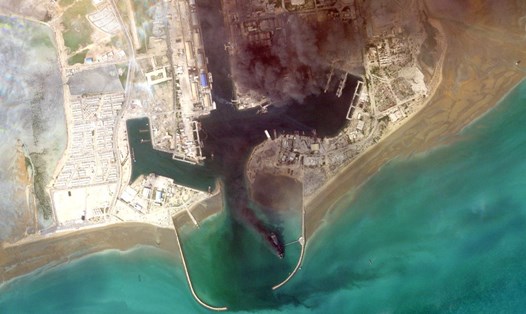
British news agency quoted 3 diplomatic sources as revealing that amid energy transportation through the Strait of Hormuz almost frozen due to the US-Israel conflict with Iran, China is said to be negotiating with Tehran to allow Qatar's crude oil tankers and liquefied natural gas (LNG) tankers to travel safely through this strait.
Escalating conflict has paralyzed the Strait of Hormuz - the world's most important energy transport route. This is a transit route for about 1/5 of global oil and LNG supplies, so the near-complete closure is causing a major shock to the international energy market.
According to diplomatic sources, China is not satisfied with Iran's move to paralyze transportation through the strait. With a fairly friendly relationship with Tehran, Beijing is putting pressure on Iran to allow oil and LNG tankers to pass safely, at least with ships related to China.
About 45% of China's oil imports must pass through the Strait of Hormuz, causing any disruption here to directly threaten the country's energy security.
Ship tracking data shows that an oil tanker named Iron Maiden passed through the strait after changing its identification signal to "China-owned ship". However, experts believe that just a few such ships are not enough to reassure the global market, which is panicked by the risk of prolonged disruption.
Since the Middle East war broke out, world crude oil prices have increased by more than 15%, amid energy facilities in the Gulf being attacked and transportation through Hormuz almost stalled.
According to data from the ship tracking company Vortexa, the number of oil tankers passing through the strait was only 4 on March 1, one day after fighting broke out. This number is much lower than the average of 24 ships/day since the beginning of the year.
Meanwhile, about 300 oil tankers are still trapped inside the strait, according to data from Vortexa and ship tracking company Kpler. The inability of these ships to move puts the global energy supply chain at risk of serious congestion.
Some industry sources said that the rare ships still moving through Hormuz are mainly owned by China or Iran.
Mr. Jamal Al-Ghurair, CEO of Al Khaleej Sugar, based in Dubai, said that some sugar ships are still allowed to pass through the strait, while many others are blocked. However, he did not disclose specific criteria.
Previously, the Iranian government announced that it would not allow ships of the US, Israel, European countries and their allies to pass through the Strait of Hormuz amid escalating conflict. Notably, this statement did not mention China, raising speculation that Beijing may be given a special mechanism.