
A cold front from Nunavut, Canada is forecast to overflow, causing temperatures in many places in the Midwest and Northeast of the US to break cold records from the 1800s on December 4 and 5.
It is forecasted that this weekend and early next week, a strong cold air mass from the Arctic will continue to sweep down the central and eastern regions of the US, possibly setting many new records for severe cold.
About 80 million people in 35 US states have been warned to experience 1-digit or below 0 degrees Celsius temperatures through December 8. There are 14 states that are likely to record record record lowest temperatures in history at this time of year.
This deep cold front comes after the atmosphere suddenly heats up, a rare phenomenon in late autumn. This phenomenon pushed cold air away from the Arctic, causing Canada and Greenland ( Denmark) to heat up more than usual, while stronger cold air masses were pushed south.
US weather forecasters say severe cold in the Midwest and Eastern United States could ease in the second half of December, as cold air accumulates in Alaska.
In the coming days, about 40 locations from Nebraska to Maine are expected to approach or break records for the lowest daily temperatures.
On December 4, temperatures in Des Moines are forecast to reach minus 10 degrees Celsius, near the record of 1886. Detroit and Grand Rapids, Michigan are forecast to reach below 5 degrees Celsius and below 6 degrees Celsius, close to or breaking the record set in 1895.
Kansas City, Missouri is forecast to record a below 15 degrees Celsius drop, breaking the coldest record of 1898. The northern Minneapolis is forecast to drop to minus 29 degrees Celsius in some places.
On the morning of December 5, temperatures in Manchester and New Hampshire are forecast to drop to below 16 degrees Celsius; Springfield and Illinois to below 17 degrees Celsius; and South Bend and Indiana to below 15 degrees Celsius. These temperatures are all likely to approach or break temperature records from the late 19th century.
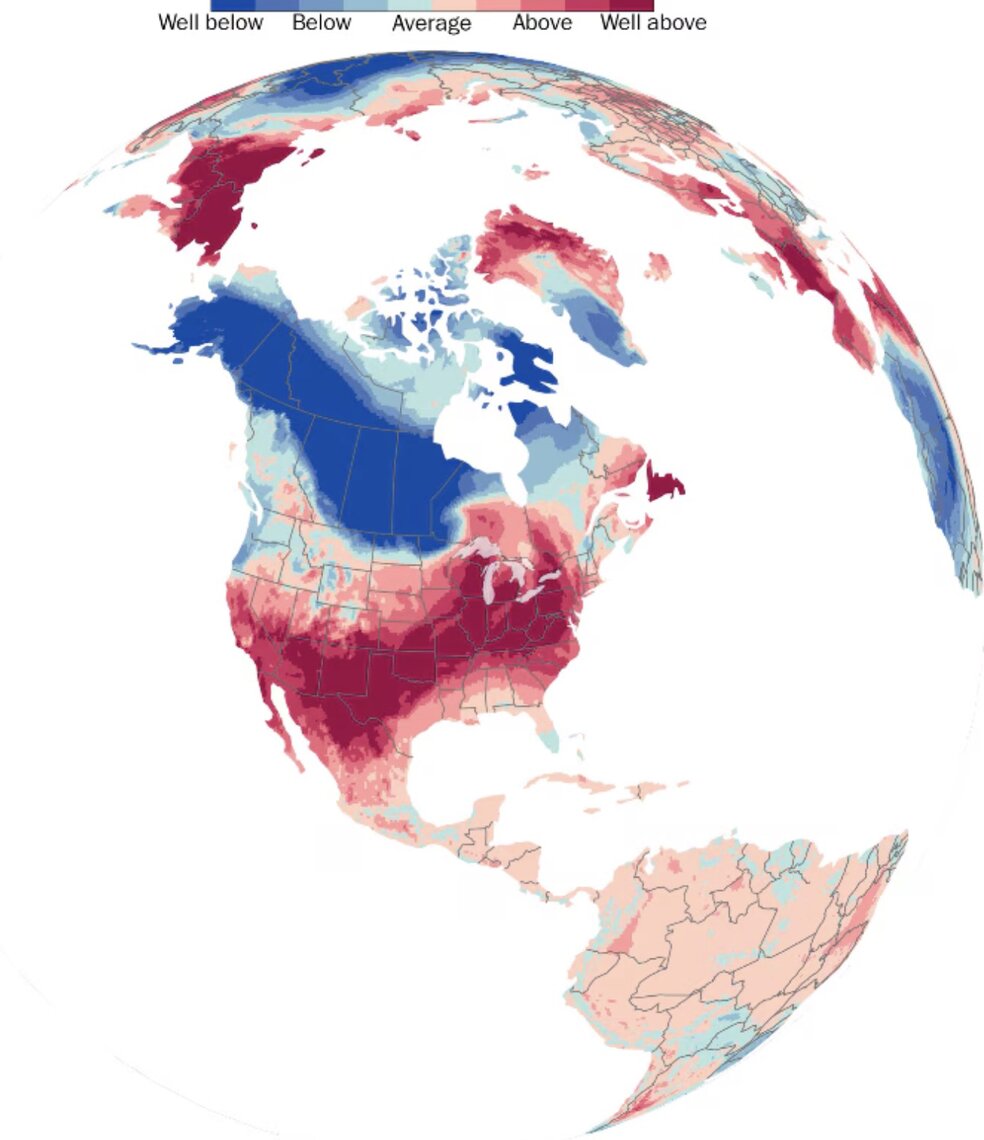
In the next 10 days, it is forecasted that about 13% of the Earth's surface is likely to experience much lower than average temperatures. The largest cold front is forecast to extend from Alaska, USA through Canada to the continental United States.
Meanwhile, 21% of the global area is likely to experience above-average temperatures, including many areas in Northern Canada, Greenland, Europe, Africa, South Asia, northeastern Russia, Australia and New Zealand.
This means that although many places in the US are very cold, most of the world's population is about to experience unusually warm weather.
The US is also not the coldest region on the planet as a recent social media post has shown. Greenland is forecast to be the coldest inland by December 8, with temperatures could drop to minus 51 degrees Celsius, according to cold front forecast models.
In addition, another winter storm could bring ice and snow to the Carolinas, Appalachians and the Mid- Atlantic, with the possibility of affecting the entire Washington D.C. on December 5.


