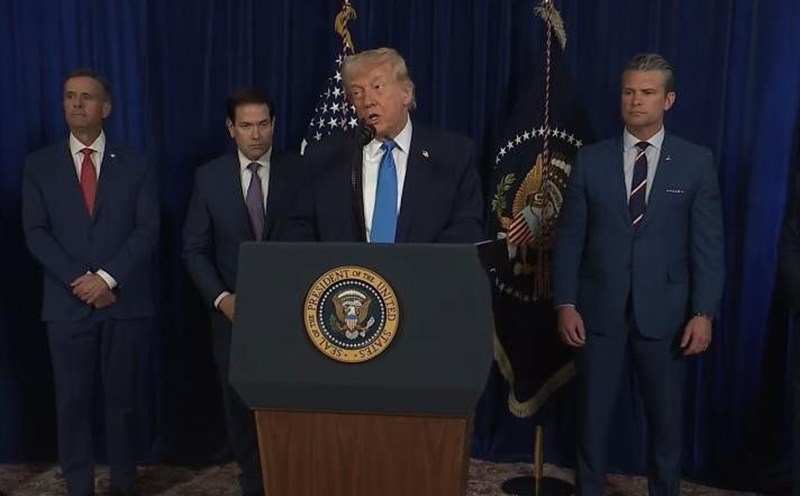
Since US special forces carried out the arrest of Venezuelan President Nicolas Maduro on January 3, US President Donald Trump and senior officials in the administration have continuously issued warnings to Colombia, Cuba, Mexico, Iran and Greenland.
In his latest statement, Mr. Trump affirmed that the US dominance in the Western Hemisphere needs to be absolutely strengthened and emphasized the importance of ensuring that energy flows in the region are not disrupted.
The focus of attention focused on the Arctic when the US President once again mentioned the need to control Greenland. Mr. Trump cited national security reasons, declaring the increasing presence of Russian and Chinese ships in this area as a direct threat. "We need Greenland from a national security perspective," Mr. Trump emphasized.
Responding to this issue, Greenland's Prime Minister Jens Frederik Nielsen made a tough statement. He said that statements from the US side were disrespectful, and affirmed that the island is a democracy and not an object for major powers to exchange. Mr. Nielsen also emphasized the fundamental difference between Greenland and Venezuela to reject any intention of intervention.
In Latin America, diplomatic relations also became tense as Mr. Trump made harsh comments aimed at Colombian President Gustavo Petro. Mr. Trump accused the Colombian leader of failing to control drugs and leaving open the possibility of conducting "operations" in the future.
In response, Mr. Petro affirmed that the Colombian government is making efforts to fight crime and declared that he is ready to return to arms to protect national sovereignty if necessary.
Regarding Cuba, Venezuela's closest ally, Mr. Trump said that this country will soon face an economic crisis due to the loss of free oil supplies from the Maduro administration.
However, Cuban President Miguel Diaz-Canel affirmed that Cuba will still maintain an alliance with Venezuela. At a rally in Havana, he declared that Cuba is ready to face all challenges to defend its position, even if the price to pay may be very high.
At the southern border, Mr. Trump proposed sending US troops to support Mexico in handling drug cartels, saying that the local government is not strong enough. However, Mexican President Claudia Sheinbaum rejected this proposal, affirming that Mexico cooperates in drug control but resolutely defends the principle of non-interference.
Meanwhile, in the Middle East, Mr. Trump warned that there would be a strong military response if the Iranian government used violence against protesters. This statement took place in the context that the US had carried out airstrikes on Tehran's nuclear facility in June 2025, causing relations between the two sides to always be tense.