
Domestic pepper prices: Extending the increase
As of 12:30 today (December 10), domestic pepper prices have increased simultaneously, averaging 149,000 VND/kg. Currently, key areas are trading in the range of 148,000 - 150,000 VND/kg.
The provinces and cities have increased by 500 VND, the price list on the market for specific areas is as follows:
Gia Lai listed at 148,000 VND/kg.
Ho Chi Minh City, Dong Nai have offered prices at 148,500 VND/kg.
Meanwhile, Dak Lak and Lam Dong returned to the price of 150,000 VND/kg.
World pepper prices: Increase and decrease alternately
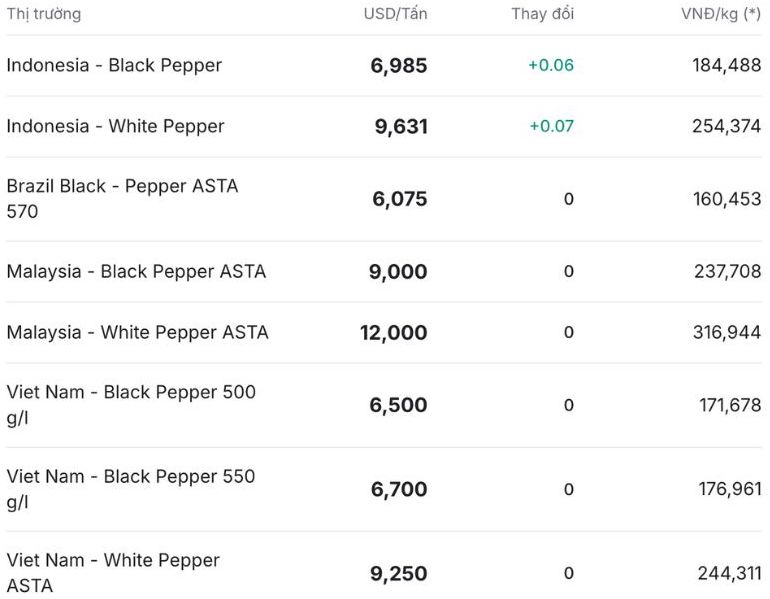
In the world market, pepper prices continue to fluctuate in some regions. The Indonesian exchange - one of the most vibrant markets is no exception. Currently, these two items are traded between 6,985 - 9,631 USD/ton (equivalent to 184,488 VND/kg - 254,374 VND/kg), up 0.06% and 0.07%, respectively.
Meanwhile, the Brazilian market remained unchanged at 6,075 USD/ton (about 160,453 VND/kg). Meanwhile, black and white pepper are traded at 12,000 USD/ton and 9,000 USD/ton.
Notably, in the Vietnamese pepper export market, the price of 500 g/l and 550 g/l black pepper remains in the price range of 6,500 - 6,700 USD/ton. ASTA white pepper prices are currently at 9,250 USD/ton (equivalent to 244,311 VND/kg).
Assessment and forecast
In the last month of 2025, the domestic pepper market remained around 148,000 - 150,000 VND/kg, with slight fluctuations that did not create a strong breakthrough.
Demand from foreign markets, especially in the US, is increasing again, pushing prices up. However, the increase is not strong enough to attract prices to increase significantly in the short term because buying and selling activities are still cautious, in the context of the world market not having any sudden signs.
Domestic pepper output this year continues to be low due to reduced planting area and unfavorable weather, especially heavy rain and storms in the Central Highlands and Southeast. The inventory of growing area owners is still low, leading to many households tending to keep goods, creating a certain scarcity in the domestic market.


