
Domestic pepper prices: Deep drop
As of 11:30 am today (April 23), domestic pepper prices continued to decrease, averaging 140,200 VND/kg, down 800 VND/kg. Currently, key areas are trading in the range of 138,000 - 142,000 VND/kg.
Domestic pepper prices simultaneously decreased, except for Lam Dong province. Currently, the listed prices in areas are as follows:
The strongest decrease was recorded in Gia Lai province, down to 138,000 VND/kg, down 2,000 VND/kg.
Dong Nai and Ho Chi Minh City slightly decreased by 500 VND/kg, respectively anchored at the threshold of 140,000 VND/kg.
While Dak Lak decreased by 1,000 VND/kg, listed at the mark of 141,000 VND/kg, Lam Dong maintained the price mark, offering the highest purchase price in the country at 142,000 VND/kg.
World pepper prices: Reverse downwards
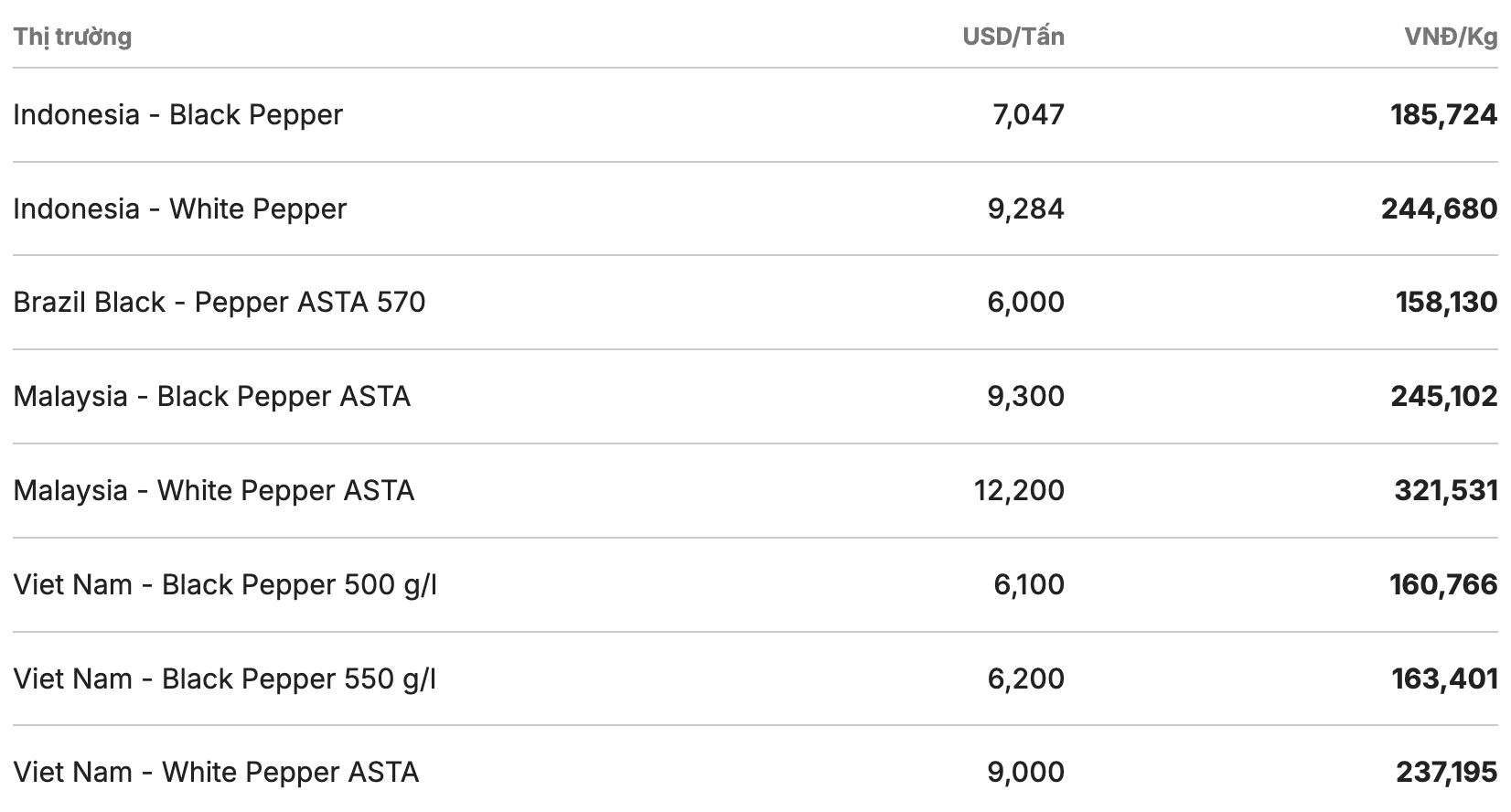
In the world market, pepper prices are mostly stable in countries. In particular, the two items of black and white pepper in Indonesia increased slightly, trading in the range of 7,062 - 9,304 USD/ton (equivalent to 185,724 VND/kg - 244,680 VND/kg), respectively decreasing by 15 USD/ton and 20 USD/ton.
The Brazilian market is listed at 6,000 USD/ton (about 158.130 VND/kg). Notably, black and white peppers remain unchanged, trading at 12,200 USD/ton and 9,300 USD/ton.
In Vietnam's pepper export market, the price of black pepper of 500 g/l and 550 g/l remains at 6,100 - 6,200 USD/ton. In the same direction, ASTA white pepper is offered for sale at 9,000 USD/ton (equivalent to 237,195 VND/kg).
Assessments and forecasts
In the world market, pepper prices in Indonesia turned down. Meanwhile, prices in other key producing countries still maintain a stable trend, showing that current fluctuations are more localized than a widespread downward trend.
Price adjustment pressure may come from short-term profit-taking activities of traders after the previous price increase series, along with market caution as supply is gradually being supplemented after the harvest. The decrease in Indonesian pepper prices also partly affects global trading sentiment, creating a slight pulling force on domestic prices.


