
On the afternoon of June 25, at the Party Central Committee Headquarters, General Secretary and President To Lam - Head of the Central Steering Committee for Science and Technology Development, Innovation and Digital Transformation chaired a thematic meeting on digital transformation in the political system.
Concluding the meeting, General Secretary and President To Lam pointed out that the biggest issue today is no longer awareness or policy. Because the policy is clear, the basic institution has been completed, and resources have been prioritized and allocated.
Practical lessons have shown that where the head directly directs, inspects, and takes responsibility, there are results. Where it is completely contracted to the technical department, digital transformation is slow and lacks substance. The ultimate core issue is still leadership, direction, and implementation organization capacity.
Regarding tasks in the coming time, the General Secretary and President emphasized to focus on thoroughly handling overdue tasks, overdue documents, and identified bottlenecks.
Identifying data as an important foundation, a strategic resource of the nation, must be created, managed, connected, shared and effectively exploited according to the principle (right, sufficient, clean, living, unified, shared); must create real value for agencies, organizations, people, businesses, form a data market, contribute to promoting the digital economy and contributing to economic growth.
Each agency and locality must consider building and cleaning up data as their political responsibility, not a separate task of a specialized information technology agency or a science and technology agency.
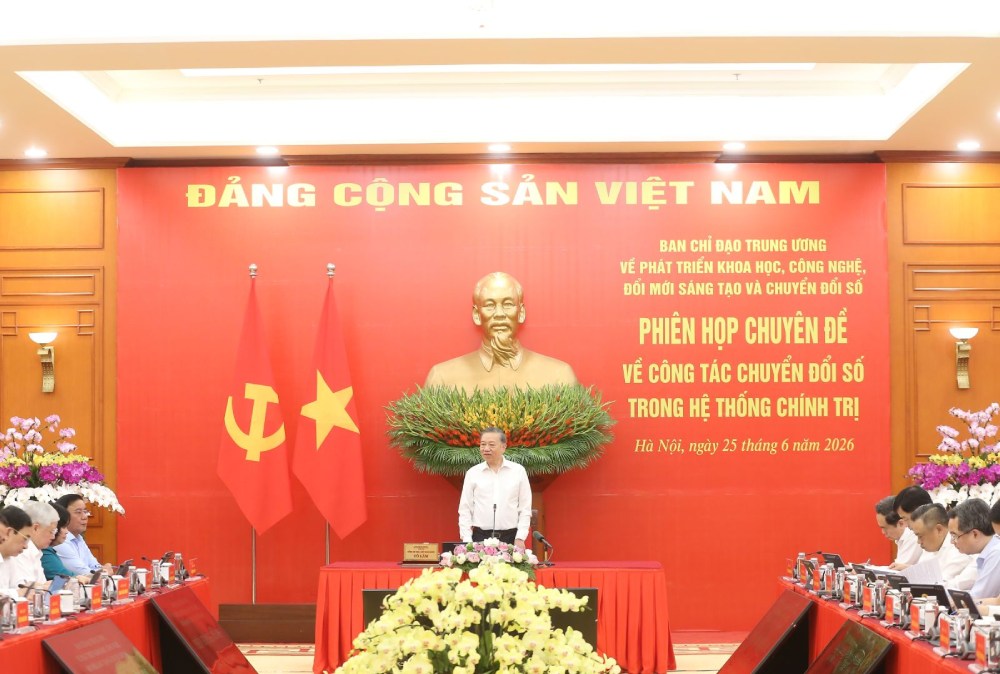
The General Secretary and President requested to conduct a general review, clean up, standardize data, connect and exploit it throughout the entire political system. Ministries and sectors must stop the situation of scattered and incompatible data.
It is necessary to establish common discipline on data and information systems in the political system; prioritize the development of shared digital infrastructure and shared digital application system platforms.
The ultimate goal is that online public services must be substantive and convenient for easy use, reducing time and costs for people and businesses.
For the development and application of artificial intelligence, proactive thinking is needed but absolutely not subjective, artificial intelligence must be considered an important support method to improve work efficiency and work productivity.
Identifying artificial intelligence as a powerful support tool but cannot replace human responsibility, authority and decision-making.
The application of artificial intelligence needs to be ensured in a controlled and responsible manner, and at the same time, absolute national security and data safety must be ensured right from the design and use stage of artificial intelligence.
The General Secretary and President noted that tasks are only considered to be completed when there is a product that can operate, has verified data, has actual users and creates real efficiency.
Party committees and Party organizations at all levels, especially heads of ministries, branches, localities, agencies and units, must be exemplary and take the lead, use digital tools in management and administration; and at the same time include implementation results in the criteria for evaluating emulation, commendation and handling responsibility for delays.
Inspection committees at all levels must have plans to inspect and supervise the implementation of Resolution 57.


