
Continuing the 9th Session, on the afternoon of May 14, the National Assembly discussed in the hall the draft Law on Cadres and Civil Servants (amended). Delegates continued to have constructive opinions on the draft law.
Linking commune-level cadres and civil servants with the province is correct
The Law on Cadres and Civil Servants (amended) has amended regulations to connect commune-level cadres and civil servants with provinces, unifying a civil service regime from the Central to the commune level.
Delegate Nguyen Thi Viet Nga - Member of the National Assembly of Hai Duong province assessed that this is a step in the right direction, necessary and very supported.
According to the delegate, commune-level cadres and civil servants are currently outside the professional civil service system, while they are the ones closest to the people, directly implementing policies, handling administrative procedures and solving practical problems.
However, due to unstable policies, no clear development roadmap, and few opportunities for promotion, it is difficult to attract talented people to work at the facility.
"The interconnected mechanism will create a chain of personnel development from the grassroots through practice to higher positions, instead of just selecting from the top down," said delegate Nguyen Thi Viet Nga.
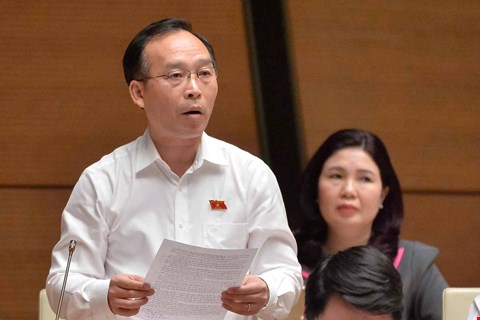
According to delegate Tran Van Tuan - National Assembly Delegate of Bac Giang province, cadres, civil servants and public employees after entering the professional civil service system can easily move from one locality to another, one level to another.
Therefore, input quality factors and recruitment units can affect the overall quality of the entire system.
"The draft law aims to give the right to recruit civil servants at the commune level, so can the quality be guaranteed to be even when there are thousands of recruitment councils", delegate Tran Van Tuan stated.
Proposal to legalize remote working methods
This is the opinion of delegate Nguyen Thi Yen Nhi - National Assembly deputy of Ben Tre province before the National Assembly.
According to the delegate, in the context of strong digital transformation, many countries have been adjusting their legal systems to adapt to the trend of flexible working, especially remote work and online work.
The delegate said that in recent times, especially during and after the COVID-19 pandemic, many state agencies and units have applied remote, online working methods.
Although not yet legalized, this form of work has proven feasible. In many cases, it even helps save costs, improve work efficiency, and create more favorable conditions for cadres and civil servants, especially in mountainous areas, remote areas, and large geographical distances after the merger of administrative units.
In the context of national digital transformation, the deployment of synchronous information infrastructure, work management software, electronic and online document systems has created a solid foundation for working regardless of space or geography.
"However, the current Law on Cadres and Civil Servants does not have official regulations on remote working regimes," said delegate Nguyen Thi Yen Nhi.
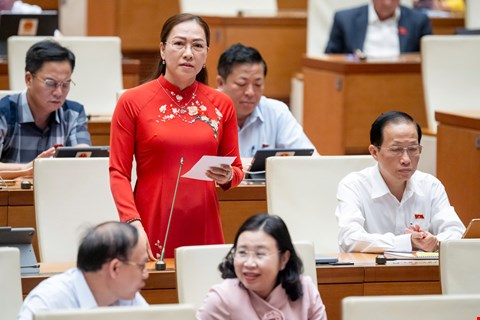
From the above reality, the delegate proposed that the Law on Cadres and Civil Servants (amended) add the following provisions:
First, legalize remote, online working methods as a legal working method in the public sector, applied flexibly, suitable for job positions, work tasks and infrastructure of each agency and unit.
Second, to work remotely effectively, there must be a mechanism to evaluate work results that is truly objective, scientific and based on output efficiency. The law needs to orient the development of an evaluation system based on the results of task completion associated with progress, work quality, and satisfaction of people and organizations when handling online administrative procedures.
Evaluate the initiative in coordination and creativity in performing tasks even when not working directly at the headquarters. Apply digital tools to evaluate work without direct supervision.
Third, it is necessary to clearly decentralize the responsibility of the heads of agencies and units in deciding to allow remote and online work, ensuring the principles of efficiency, discipline and controlling the quality of work.
According to the delegate, in the context of arranging administrative units, streamlining staff and improving management efficiency, remote working helps save travel time and administrative costs.
At the same time, this also contributes to retaining a team of capable but struggling with concentrated working conditions.
"We cannot keep the rigid, mechanical working style, tightly linked to time and location without ignoring real efficiency," delegate Nguyen Thi Yen Nhi stated.


