
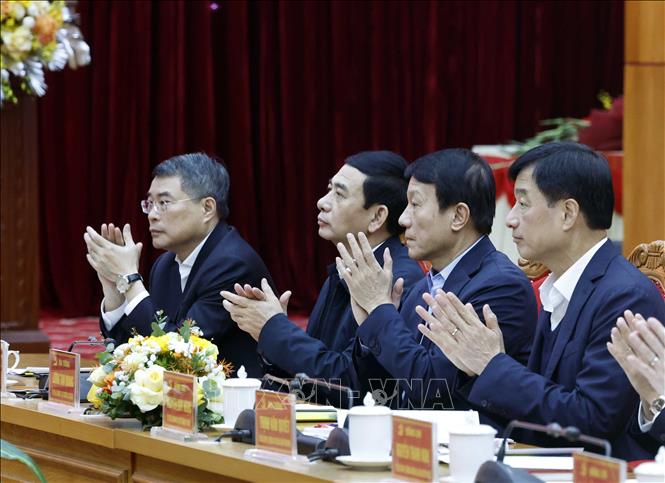
Also attending were Politburo members: Le Minh Hung, Head of the Central Organization Committee; General Phan Van Giang, Minister of National Defense; General Luong Tam Quang, Minister of Public Security; Nguyen Duy Ngoc, Secretary of the Hanoi Party Committee; Trinh Van Quyet, Head of the Central Propaganda and Mass Mobilization Committee; Nguyen Thanh Nghi, Head of the Central Policy and Strategy Committee; Central Party Committee members, Alternate Central Party Committee members; Government leaders, National Assembly leaders; leaders of central committees, ministries, branches; leaders of Cao Bang province.
Cao Bang is a mountainous province, bordering the Northeast of the Fatherland, with a particularly important position in terms of national defense - security, foreign affairs; and also the cradle of the Vietnamese revolution, where President Ho Chi Minh chose as the first fulcrum when returning to the Fatherland to lead the revolution.
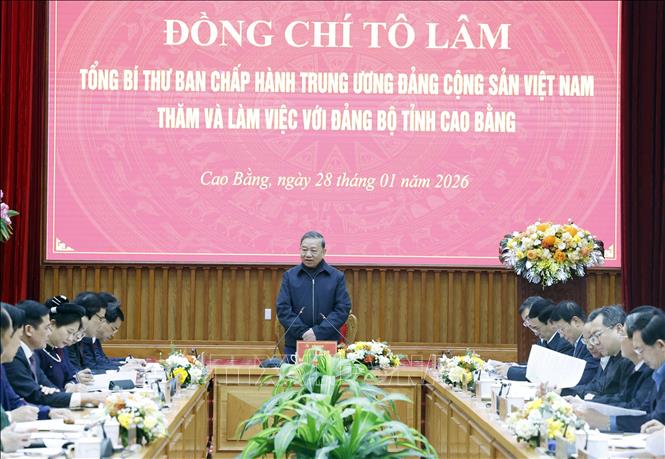
Reporting at the working session, Secretary of Cao Bang Provincial Party Committee Phan Thang An said that the province has focused on implementing socio-economic development tasks, taking care of people's lives, ensuring national defense and security; and at the same time preparing activities to celebrate the 85th anniversary of Uncle Ho's return to the country to lead the revolution and the 65th anniversary of Uncle Ho's visit to Cao Bang.
Speaking to direct, General Secretary To Lam emphasized that history has given Cao Bang a very special position, both as a "front" on the border of the Fatherland and as the source of strategic thinking of the Vietnamese revolution.
However, that position also places a great responsibility in maintaining border stability, strengthening national defense and security and finding a suitable development path in the new period.
The General Secretary pointed out that Cao Bang is a mountainous, border province, with a low development point, difficult natural conditions, and limited infrastructure.
Therefore, the province cannot develop according to the mindset of spreading out or mechanically copying models from other localities, but must know how to turn difficulties into motivation, turn the border position into a strategic advantage, and turn historical and cultural values into development resources.
Acknowledging the province's efforts in the past time, the General Secretary said that the old thinking and ways of doing things are no longer enough for Cao Bang to develop faster, shortening the gap with the national average.
Therefore, the province needs to innovate the growth model, promote digital transformation, improve the investment and business environment, and innovate leadership and management styles.
The General Secretary agreed with the orientation of restructuring the province's development model in the direction of "effectiveness - productivity - happiness", taking the quality of life of the people as the central measure.
Development is not only assessed by the growth rate but also by the improvement in people's lives, more sustainable livelihoods, and essential services reaching remote and border areas.
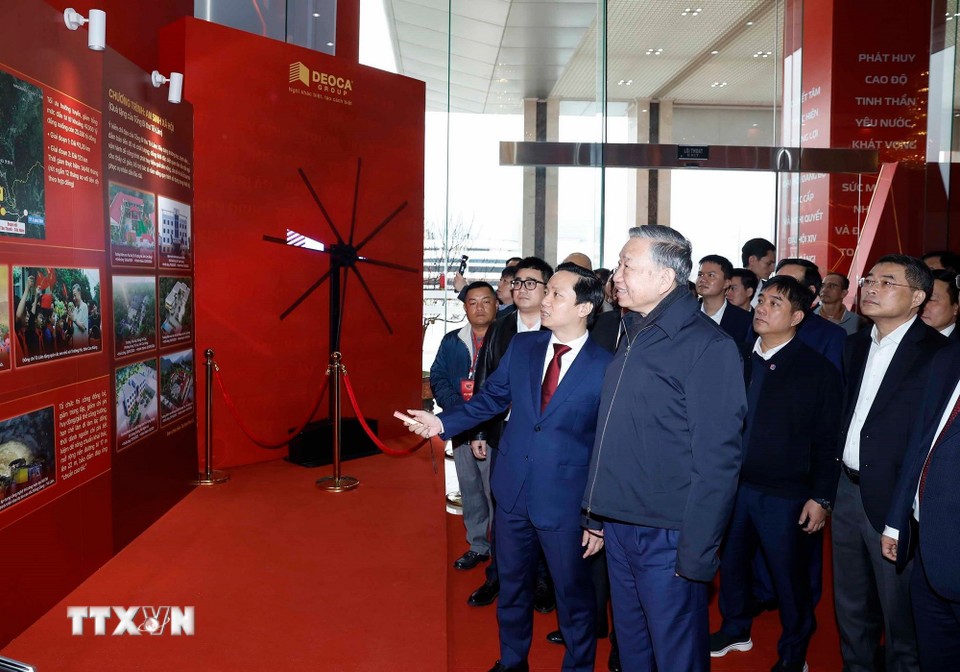
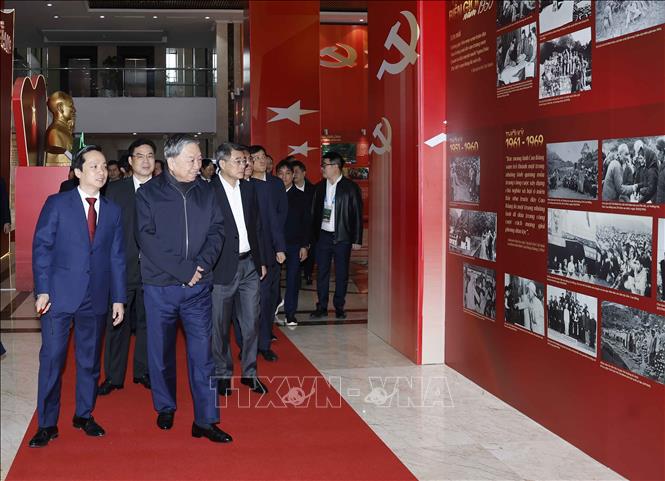
Regarding the border gate economy, the General Secretary noted that it should not stop at customs clearance activities but needs to develop value-added services, logistics, and digitalization of processes.
Tourism needs to be identified as a key economic sector, developed in depth, avoiding crude commercialization, damaging local resources and image.
Along with that, the province needs to build a streamlined and effective government apparatus; develop human resources associated with advantageous sectors; build a contingent of cadres who dare to think, dare to do, and dare to take responsibility.
National defense - security and foreign affairs work must be ensured firmly, not to be passive or surprised, and to maintain national border sovereignty.
Highly appreciating the orientations and breakthroughs that Cao Bang has chosen, the General Secretary believes that the province will turn its special advantages into a real driving force for development, improve people's lives, and contribute to the country's successful implementation of the Resolution of the 14th Party Congress.


