
When financial education is not just about theory
Gen Alpha - the generation born in 2010 onwards - grows up with smartphones. Children may be accustomed to "pressing and having", but lack the opportunity to feel the journey of creating and managing money.
Many parents today face a common problem: Teaching children to save and manage money, it is easy to say but difficult to do, especially when traditional forms such as piggy banks lack interaction, while financial applications for adults are too complicated for young children.

In the context of children growing up with smartphones and digital payments, VIB Junior Banking is developed with the desire to accompany parents and children in building modern and proactive financial habits from an early age, helping children not only learn about money through theory but also directly experience creating, accumulating and using money in daily life.
Instead of approaching in a controlled direction, VIB builds Junior Banking as a companion model, where parents play a leading role and children are the ones who directly experience and practice. Not only learning about money, children begin to get acquainted with small choices every day – from completing tasks to receive rewards, setting goals to save money for their favorite items to the first time paying with a card in their name.
Formula 1-2-3: Financial solution set for the whole family
The difference of VIB Junior Banking lies in the way the product is built as an interconnected ecosystem instead of discrete features.
The 1-2-3 structure includes: Maxtopia - digital financial space for children integrated on VIB's Max application; Family card set including two specialized Family Link cards for parents and Junior Smart Card for children from 6 - 15 years old or Ivy Card for eldest children who are students; Along with three core skills: Understanding money transfer, Taking care of accumulation and Wise spending.
In this model, the family is seen as a central financial unit, where parents are the leaders and children are the practitioners. Instead of separating adult and child finance into two independent worlds, VIB Junior Banking creates a connection between parents' financial behavior and children's financial learning experience.
Mother spends - Child accumulates: Turning everyday consumption into a financial learning experience
One of the notable points of VIB Junior Banking is the mechanism to directly connect parents' spending with their children's accumulation journey through the family card set.
Accordingly, each transaction from the Family Link card of parents - especially in spending groups such as education or healthcare - will be converted into bonus points with a total refund of up to 12 million VND/year. At the same time, children will experience for the first time the feeling of proactive self-management of spending with Junior Smart Card or use bonus points converted into shopping vouchers in the MAXShop warehouse. In particular, Junior Smart Card is upgraded with automatic profitability for every one dong on the payment account (Max Account) up to 6%, exclusively for Max customers.
Familiar expenses such as tuition, book purchases or health check-ups are now not only limited to payment, but also become part of children's way of learning about the value of money and accumulation.
Game-making of Gen Alpha's financial learning journey
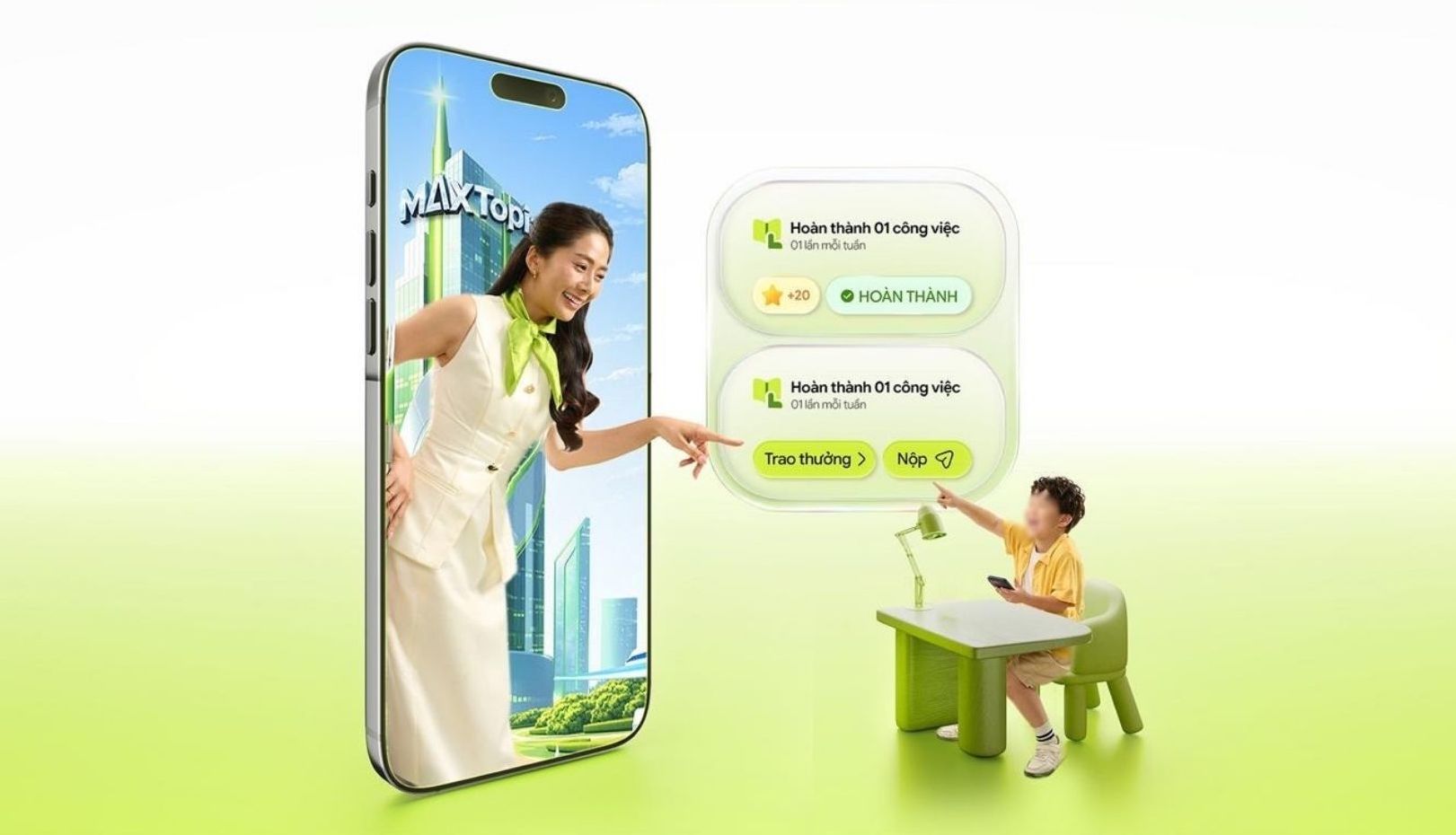
Unlike traditional financial education models, Maxtopia is designed according to a gamification mechanism, turning learning into an interactive experience suitable for Gen Alpha. Here, children can complete tasks assigned by their parents, take quizzes or learn through flipcards to receive rewards, and use accumulated points to exchange for gifts or spend with Junior Smart Cards.
This is not just a financial simulation application, but a digital space where children can directly experience financial behaviors in real life. The noteworthy point is that children are not randomly scored. Each reward is associated with practical efforts, from completing tasks to achieving accumulation goals. This helps children gradually form the mindset that money is associated with labor value and priority choice.
Future Saving: Online Heo Dat for the new generation
One of the disadvantages of traditional forms of savings such as putting money in piggy banks is that children do not see a clear change in the amount of money accumulated over time. VIB solves this with the Future Saving – Online Piggy bank feature in Maxtopia.
Through this feature, parents can help children set early-life savings goals - from favorite items to longer-term plans - and track the visual growth progress every day on electronic savings books. Instead of just "saving money", children can see their goals grow through small accumulations, thereby creating more motivation to maintain savings habits.
Notably, parents can assign tasks to their children in Maxtopia and reward money directly into savings accounts. When due, if they are 15 years old, children can manage their savings themselves - a transition from financial education to financial mastery.
A representative of VIB said that financial management skills are gradually becoming one of the foundational competencies of the young generation. With Junior Banking, VIB not only provides financial products but also participates more deeply in the journey of building financial capacity for customers from an early age. Instead of letting children access finance passively, Junior Banking creates an environment for children to directly experience making money, accumulating money and making spending decisions every day.


