
Mr. Aakash Doshi - Head of Gold Strategy at State Street Investment Management - said that 2025 recorded the strongest annual increase in gold since 1979.
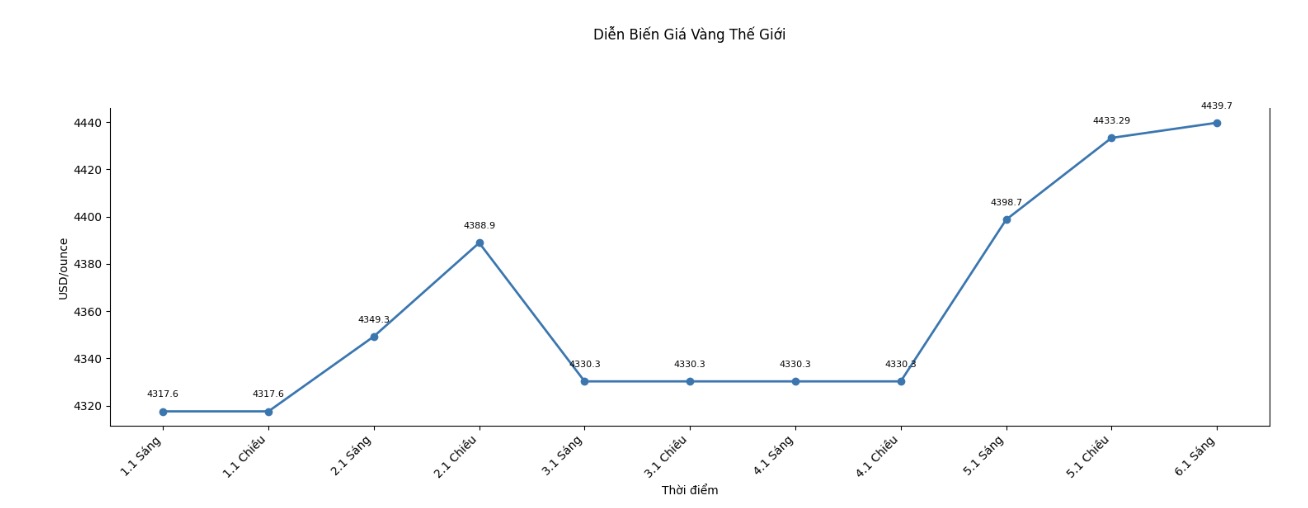
Although still maintaining an optimistic view of precious metals, he believes that the baseline scenario for 2026 is that gold prices rise at a high one-digit to low two-digit level, with the goal of fluctuating around 4,500-4,600 USD/ounce.
More importantly, Mr. Doshi emphasized that the next major direction of gold prices still leans towards increasing.
I think it is more likely that the next 20-25% fluctuation will head towards the 5,000 USD/ounce mark, instead of turning back to 3,000 USD/ounce" - Mr. Doshi said, while saying that the risk of price decline is being limited by a strong structural support zone around 3,600-3,700 USD/ounce.
Public debt, yields and the new defensive role of gold
One of the biggest drivers driving gold prices today is the unprecedented expansion of global debt. Total global debt has reached nearly 340,000 billion USD, of which government debt accounts for more than 30%.
In the context of persistent inflation and high long-term bond yields, Mr. Doshi believes that gold is increasingly playing a role in hedging against futures risks and currency devaluation.
According to traditional views, increasing bond yields are often detrimental to gold because they increase the opportunity cost of unprofitable assets. However, Mr. Doshi noted that investors need to distinguish the reasons for yield increases.
If yields increase due to strong economic growth, gold may be under pressure. Conversely, if yields are pushed up by inflation and excessive fiscal spending, this may become a supporting factor for gold.
The second scenario is contributing to making the yield curve steeper, thereby strengthening the attractiveness of gold in the investment portfolio.
In addition, Mr. Doshi believes that gold is also benefiting from the prolonged positive correlation between stocks and bonds. After decades of bonds playing a defensive role for stocks, this relationship has been broken since the post-pandemic inflation shock.
Prospects for 2026
If the correlation between stocks and bonds does not return to the reverse state as before, gold will become increasingly important in the portfolio structure" - Mr. Doshi said, while also saying that more and more investors are questioning the sustainability of the traditional 60/40 asset allocation model.
ETF capital flows show that gold has not been held excessively
In the past three years, the demand for buying gold from central banks has been an important pillar supporting the market. However, since the second half of last year, investment demand has been the main driving force leading the global gold market.
Although the December data has not been completed, as of November 2025, data from the World Gold Council shows that more than 700 tons of gold have flowed into global gold ETF funds. The world's largest gold ETF fund – SPDR Gold Shares – alone has increased its holdings by 195.75 tons.
Mr. Doshi said that although the sharp increase in gold prices has pushed the value of ETF assets to a record level, in terms of the amount of gold held, these funds are still lower than the peak of 2020. This shows that the room for demand growth is still large.
Gold may be overbought in price, but it has never been over-held" - he said - "There are still many institutional investors who have not allocated any proportion to gold.
According to him, gold ETF funds currently account for less than 3% of total global ETF assets, significantly lower than the 5-10% usually recommended in the strategic portfolio, and also much lower than the more than 8% at the peak of 2011.
The biggest risk of gold in 2026
According to Mr. Doshi, the most notable risk scenario for gold is that the US economy will grow strongly again, causing the USD to appreciate and reducing expectations that the US Federal Reserve (Fed) will cut interest rates. In that context, capital flows into gold ETFs may slow down and gold prices may fall below $4,000/ounce.
Another risk comes from the expansion of demand in Asia. Gold prices maintaining above $4,000 could put pressure on consumer demand in China and India, although there are currently no clear signs of this decline.
The third, less likely, risk is a significant reversal of geopolitical fragmentation or the world returning to a more stable trade order.
Even in those negative scenarios, Mr. Doshi believes that it is unlikely that gold prices will fall sharply.


