
Inflation pressure and tight monetary policy
One of the main reasons for gold being sold off is concerns about high inflation, forcing central banks to continue to maintain tight monetary policy longer than expected.
The US Federal Reserve (Fed) has decided to keep interest rates unchanged and signaled that it can only cut restrictions this year. At the same time, the Fed raised its inflation forecast for 2026 to 2.7%, showing that price pressure is still persistent.
Similarly, the European Central Bank (ECB) also maintained interest rates and warned that conflict in the Middle East would push energy prices up, increasing the risk of inflation in the short term. This makes the high interest rate environment prolonged, reducing the attractiveness of gold – a non-interest-generating asset.
Geopolitical conflict pushes energy prices up
Tensions between Iran and Israel continue to escalate, leading to a sharp increase in oil prices and putting pressure on the entire global economy.
Rising energy prices not only increase inflation but also make it difficult for central banks to ease policies. This indirectly disadvantages gold as the opportunity cost of holding precious metals increases.
Not only gold, many industrial metals such as copper also fell sharply, reflecting concerns about global economic weakness.
Positive US economic data puts pressure on gold
Another important factor is that US economic data exceeded expectations, especially the Philadelphia Fed's manufacturing report.
The March production outlook index increased sharply to 18.1 points, much higher than forecast. Indicators of orders, shipping and prices all showed an expansion of economic activity.
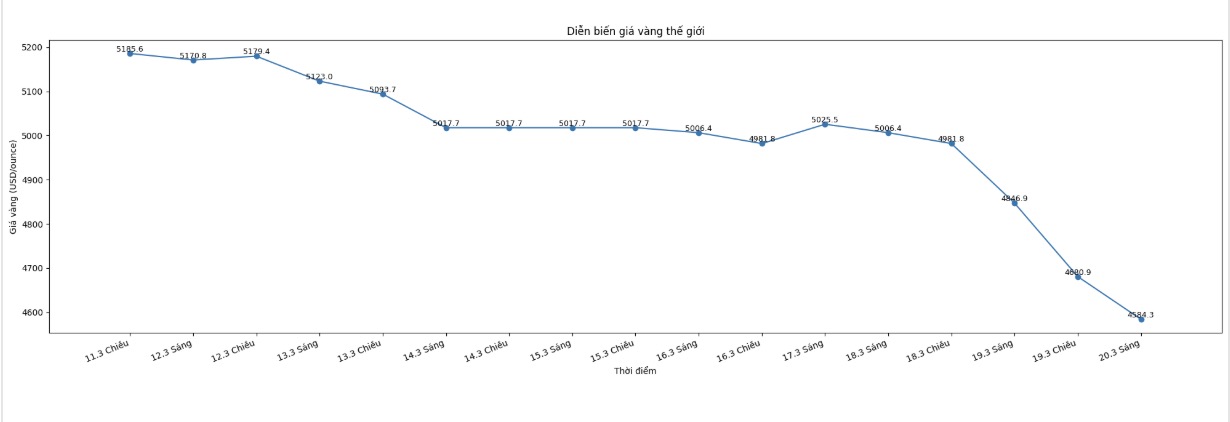
This positive data increased expectations that the US economy would remain solid, thereby reducing safe-haven demand for gold. Immediately after the report was released, gold prices quickly broke through the support level of 4,600 USD/ounce and continued to fall deeply.
Sharp decline after hitting a historic peak
In fact, the current decline occurred after gold and silver just set record highs at the end of January. To date, gold prices have fallen by more than 900 USD/ounce compared to the peak, while silver has also lost more than 50 USD/ounce.
Profit-taking pressure combined with unfavorable macroeconomic factors has caused the precious metals market to bear strong selling pressure on a large scale.
In the short term, the gold market is forecast to still face many risks as inflation has not cooled down and global monetary policy continues to be cautious.
If factors such as high interest rates, stable US economy and high energy prices continue to persist, gold may still be under adjustment pressure in the near future.


