Many projects promote efficiency
Implementing Resolution No. 02-NQ/TU and the direction of the City Party Committee, People's Council, and People's Committee of Hanoi City on overcoming waterlogging bottlenecks, the city is shifting from handling each point separately to synchronously deploying solutions according to the basin.
In a short time, many urgent projects and local flood control projects have been completed or basically completed, and timely put into operation in this year's rainy season.
The projects are concentrated in areas that are frequently flooded, with many solutions such as increasing the capacity of pumping stations, supplementing makeshift pumping stations, building culverts and drainage ditches, renovating drainage systems in urban areas and supplementing regulating tanks.
Talking to a reporter from Lao Dong Newspaper, Mr. Nguyen Duc Hung - Director of Hanoi City Technical Infrastructure Management Center - said that the projects have added a total pumping capacity of about 33.08m3/s. In which, 4 pumping stations are added in the Thang Long Avenue area; 19 regulating lakes are installed with pumping systems, exploiting an additional 1.4 million m3 of capacity participating in regulation.
The city also completed the installation of more than 10.5km of drainage culverts and 2 underground regulating tanks at Hang Da market, under the Bac Duong railway underpass, with a total capacity of about 4,300m3.
In addition, 7 projects invested by the City Infrastructure and Agricultural Construction Investment Project Management Board have basically completed the main items serving drainage.
Projects to renovate the downstream Kim Nguu route connecting the To Lich River with Yen So Pumping Station, renovate the Thuy Phuong canal, build Thuy Phuong, Phu Do, Yen Nghia 1 and 2, and Dong Bong 2 regulating lakes have added about 83ha of regulating lakes, an increase of about 3.4 million m3 of regulating capacity.
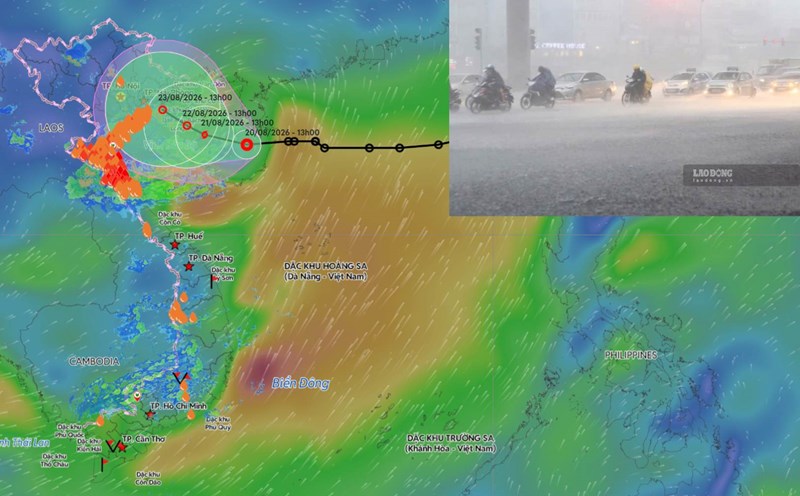
According to Mr. Nguyen Duc Hung, the effectiveness of the projects is clearly shown through the early rains of the season. In the rain on July 28, the rainfall in Phu Thuong reached 195.1mm, Hai Ba Trung 150.8mm, Gia Lam 137mm, Phuc Loi 113.6mm, Bo De 102.9mm and Ba Dinh 102.2mm. In such heavy rain conditions, through monitoring in the invested areas, 34/71 points in the list have been basically controlled.
Proactively create water storage capacity
Hanoi City is implementing many solutions to increase the ability to store, regulate and drain water. The local flood control project has completed the Quang Trung - Quan Su drainage axis, renovated and dredged Ba Mau Lake and installed pumping stations at Bay Mau, Linh Quang, Van Chuong, and Trung Tu Lakes.
Many underground regulating tanks are also being built in the inner city area. Among them, the tank on Nguyen Khuyen street has a capacity of 2,000m3; the tank in front of Hang Da market is 2,500m3; the tank on Thien Duc street, the underpass area of Bac Duong railway is 1,800m3.
According to the Hanoi Department of Construction, putting the projects into synchronous operation initially contributes to overcoming the flooding situation in many areas.
Notably, before the rains, Hanoi City directed to lower the water level at rivers, ditches and regulating lakes to create storage capacity. Regulating lakes, pumping stations, sluice gates, rivers, ditches and sewer lines are operated interconnected according to each basin.
Representatives of the Hanoi Department of Construction said that this method helps promote the overall efficiency of the system instead of letting projects operate individually. After each rain, the operating results are evaluated to adjust the plan and handle existing bottlenecks.
Hanoi Drainage Company also organizes duty shifts in areas at risk of flooding according to the "6 clear" motto: clear people, clear tasks, clear responsibilities, clear areas, clear time and clear information and reporting regimes.
Initial results show that the emergency flood prevention project group has contributed to improving drainage capacity, increasing air conditioning capacity and interconnected operation capacity along the basin. Many flooding points that once affected traffic and people's lives have been controlled or significantly reduced flooding time.