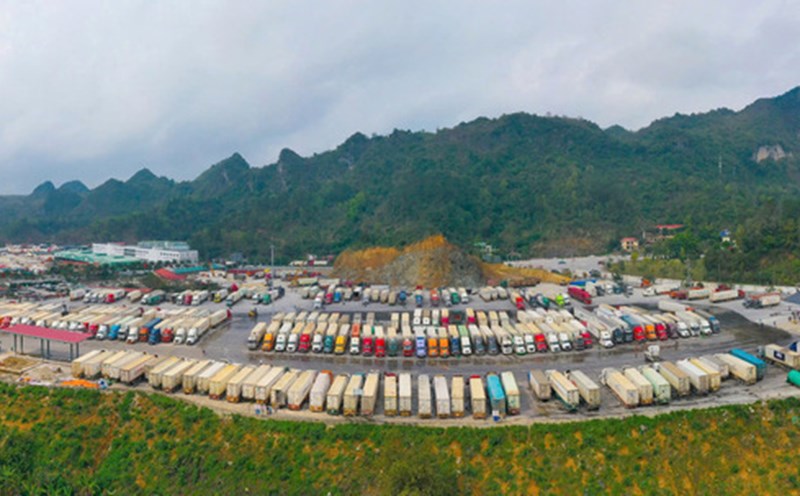
This is considered a breakthrough in border management, contributing to improving competitiveness, promoting trade and border economic cooperation between the two countries. The Mong Cai (Vietnam) - Dongxing (China) border gate pair plays a particularly important role in trade in the northern border area, a strategic connection point between Vietnam and the Hunan region (China).
In the context of strong digital integration and transformation, building a smart border gate model here is an urgent requirement in both practice and strategy. Statistics show that the traffic of people and goods through border gates has increased rapidly, an average of 18,000-20,000 people and nearly 800 vehicles per day, sometimes doubling during peak times, causing infrastructure overload, congestion, and cost incursion.
Meanwhile, the requirements of ensuring border security, preventing smuggling and epidemics are increasingly complex, requiring a modern control system that applies real-time monitoring technology, big data, and AI to identify risks early. The construction of smart border gates will be a driving force for regional economic development, attracting logistics and e-commerce businesses, creating jobs, increasing budget revenue, and enhancing competitiveness with other border gates in the Vietnam - China and ASEAN - China regions.
Deploying the development of the Project, in July 2025, Quang Ninh province issued a decision to complete the Steering Committee for the construction of smart border gates headed by the Chairman of the Provincial People's Committee; the Economic Zone Management Board is the standing agency.
On that basis, the Quang Ninh Economic Zone Management Board has coordinated with relevant units to develop a pilot project for smart border gates at Mong Cai - Dong Hung international border gate, send a report to the Prime Minister and urgently collect opinions from 11 ministries and branches to complete the project's content, ensuring consistency, feasibility and compliance with the general orientation of digital transformation in border management.
Up to now, the Project is being completed to submit to the Provincial People's Committee to report to the Prime Minister for approval.
According to the Project, Mong Cai - Dong Hung Smart Border Gate is built with a roadmap of 2 phases. Phase 1 (2025-2026): At the Bac Luan I bridge area, deploy a smart immigration control model for border residents, expected to be completed in 2025. In the Bac Luan II bridge area, build smart border gate technical infrastructure, install specialized lanes and equipment to operate IGV unmanned autonomous vehicles, operate 24/7; build an Smart Operation Center (IOC) according to the framework plan, to be completed by the end of 2026.
Phase 2 (2027-2030): Expanding the scope and scale of Bac Luan I border gate, increasing the number of automatic control flows to serve both border residents and tourists. In Bac Luan II, continue to expand the smart border gate model for both people and goods. It is expected to apply the IGV or mono-rail automatic freight transport model (sky-rail) depending on actual needs. At the same time, invest in Bac Luan II Logistics Park, E-commerce Center - import-export exhibition, smart logistics warehouse and other auxiliary infrastructure, creating a modern border gate - logistics - trade complex, connecting Vietnam and China.
In particular, the border gate management system will be completely digitized, applying technology to identify faces, scan fingerprints, QR codes, electronic passports... in sync with the National Population and Immigration Database. The control of people, goods and vehicles will be automated, the time for procedures will be shortened, costs will be reduced, direct contact will be limited, contributing to the prevention and control of smuggling, trade fraud and ensuring border security.