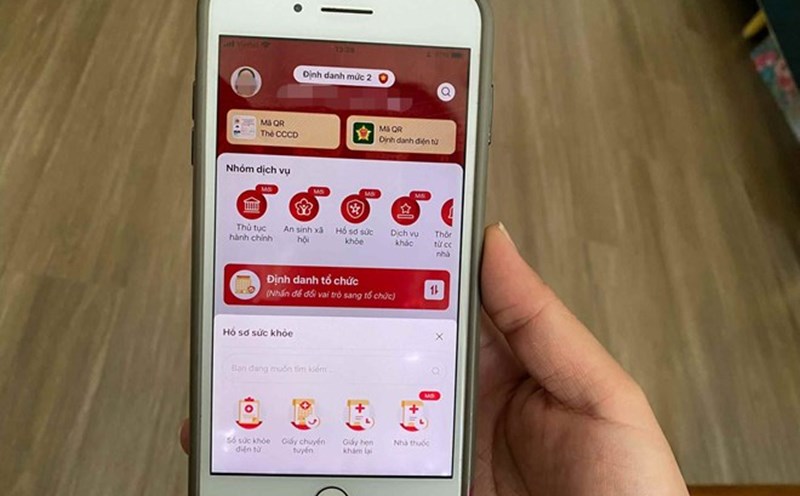
Patients do not need to bring paper records.
After a visit to a grassroots hospital and being diagnosed with a liver tumor, Mr. Nguyen Van Sy (63 years old, Dong Nai) decided to go to Binh Dan Hospital (HCMC) for re-examination. Although it was the first time he came for examination, Mr. Sy only needed to present his citizen identification card, the hospital's electronic system scanned the barcode and all personal information, health insurance and related medical examination and treatment data were fully displayed on the system.
I am not familiar with technology, in the past, every time I went for examination, I had to bring many papers. But this time, just needing a citizen identification card, the doctor has grasped all the information, reread it for me, no need to carry many papers as before. This is very convenient, especially for the elderly," Mr. Sy shared.
Over the past 5 years, Binh Dan Hospital has persistently implemented and gradually completed the electronic medical record system, transforming all medical orders of specialties into a digital platform. Thanks to that, the medical examination and treatment process has been shortened, information is more accurate and continuous. At the same time, it significantly reduces administrative workload, helping medical staff have more time to focus on professional work and patient care.
To date, most hospitals in Ho Chi Minh City have implemented electronic medical records and gradually connected and exploited digital health data. This contributes to modernizing medical examination and treatment procedures, towards the goal of building a smart and safe healthcare system.
Talking to Lao Dong Newspaper about the deployment of integrated electronic health records on VNeID, BS.CKII Vo Duc Hieu - Deputy Director of Ho Chi Minh City Oncology Hospital - said that this is a very important component in digital health transformation, not only helping patients reduce paperwork dependence when going for medical examination and treatment and carrying out administrative procedures, but also a key solution to improve the quality of patient service. Currently, the hospital is focusing all efforts on the roadmap to build a digital health data ecosystem.
According to the Deputy Director of Ho Chi Minh City Oncology Hospital, "using data instead of papers" is an important step forward of digital medicine, not simply changing the form of storage, but completely changing the operating method of the hospital towards being more professional, safer and more humane. However, for "data instead of papers" to be truly effective, the data must be guaranteed to be "correct - sufficient - timely", the system operates stably and meets information security requirements, protecting the privacy of patients.
To make the electronic health record not just a "install-for-use application" but a "companion" of patients, we need the drastic involvement of not only the health sector but also of all sectors and the whole society," Dr. Hieu shared.
Promoting the use of data instead of paperwork
According to new regulations of the Ministry of Health, when medical examination and treatment data has been fully updated on the Electronic Health Record integrated in the VNeID application, patients do not need to bring paper records. Medical facilities can directly look up medical history, test results, prescriptions and treatment processes, thereby shortening the receipt time and improving the quality of medical examination and treatment.
An expert from the Vietnam Medical Informatics Association said that electronic health records have been piloted in many medical facilities, but the effectiveness is not uniform. The reason is that medical data has not been synchronously connected between levels, many facilities use different software, and even manually manage records. Although many central and provincial hospitals have applied VNeID data as an official information source, some lower-level facilities still face difficulties and require paper records.
On January 6, 2026, the Ministry of Health issued Decision No. 31/QD-BYT, officially announcing and guiding the exploitation and use of electronic health record data integrated on the VNeID application, replacing paper records in resolving administrative procedures.
According to the decision, electronic health record data that has been interconnected, integrated and fully displayed on VNeID has a legal value equivalent to paper documents in administrative procedure dossiers. Medical examination and treatment facilities and state agencies are not allowed to require people to return paper copies if corresponding information is already available on the application.
The Ministry of Health emphasizes that the exploitation, use and sharing of electronic health records must strictly comply with regulations on information security, confidentiality and personal privacy according to the Law on Medical Examination and Treatment in 2023, the Law on Protection of Personal Data in 2025 and related documents. At the same time, the system must meet technical requirements for connecting, managing and sharing digital data between agencies.
The electronic health record on VNeID includes important information groups such as: Personal administrative information; history of allergies, diseases, vaccination; information for each examination and treatment session; and a summary of medical records. Each examination session clearly shows the receiving facility, time of examination - hospitalization - discharge, reasons for examination, diagnosis, treatment results, clinical, paraclinical indicators, drugs used, surgery, procedures performed. Summary of medical records reflecting disease progression, treatment methods, prescriptions, re-examination schedule and information of the treating doctor.
The decision also stipulates that patients or legal representatives have the right to access and download detailed records of each medical examination and treatment session in the form of PDF files on the VNeID application, ensuring full rights according to legal regulations.
According to Dr. Ha Anh Duc, Vice Chairman of the National Medical Council, Director of the Department of Medical Examination and Treatment Management (Ministry of Health), Decision 31/QD-BYT does not provide completely new content but clarifies the scope of existing health information groups allowed to be used instead of paper copies, while ensuring the right of patients to access and exploit data.
Dr. Ha Anh Duc emphasized that this is an important institutionalization step of the principle of "using data instead of papers" in the health sector, contributing to reducing the burden of dossiers, promoting intercommunication and unified reuse of health data nationwide.