
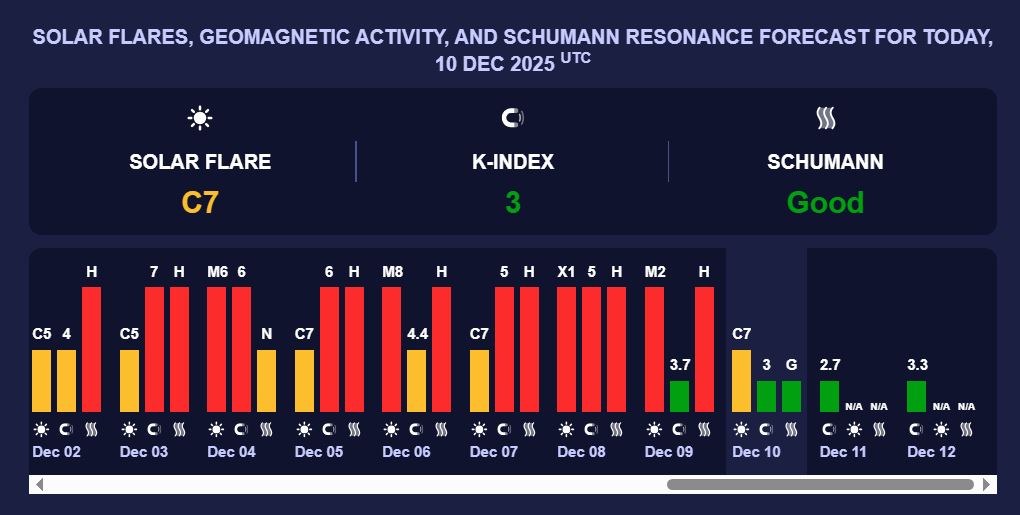
Data from the Meteoagent space weather monitoring portal and the British Geological Survey shows that this event arose from a CME launch associated with M-class fireworks, which made landfall on Earth in the morning and afternoon of December 9.
According to the forecast of the National Weather Service (NOAA), the CME case related to M8.1 fireworks is likely to trigger a Category 3 storm, which is a strength level on the G1-5 scale. This level is enough to interfere with radio waves, affect satellites and even threaten the power grid in some areas.
NOAA warns that the storm could cause: HF Radio Disruption, especially in the aviation and maritime sectors. GPS infection, reducing positioning accuracy. Satellite impact, increased risk of equipment failure and reduced life expectancy due to increased atmospheric friction. energy waves on the power grid, causing local disruption.
Previously, on December 8, a strong R3 solar radiation caused widespread disconnection in Australia and Southeast Asia, lasting nearly 1 hour, showing that the Sun's activity is in a very active phase.
Geostorm is a strong disruption of the Earth's magnetic field when the flow of electric charge from the Sun - especially in CME cases - hits the atmospheric layer. When the magnetic field is compressed and deformed, the released energy can strongly impact electronic devices and communications, positioning systems and satellites, and large-scale power grids.
Human health can also be affected by natural storms, especially people with cardiovascular disease and blood pressure. Many people who are sensitive to storms can experience headaches, fatigue, stress, difficulty sleeping, and even arrhythmia.
Strong Category G3-G4 geophysical storms occur several times a year depending on the Sun's cycle, while G5 is rare but can cause widespread disruption.
The 2003 event - known as Halloween Storms - affected the grid, aviation and a series of satellites and auroras seen as far away as Texas and Florida (USA).
To reduce the impact of geothermal storms, experts recommend drinking plenty of water, prioritizing herbal tea; limiting coffee and alcohol. Eat light, increase green vegetables and seasonal foods. Do light exercise, walk outdoors when possible. Keep your sleep stable, avoid stress. Reduced physical activity, especially for people with cardiovascular disease.
NOAA forecasts that further CME attacks could continue to hit Earth in the next 1-2 days, maintaining a high risk of Category earthquakes. Geometeorological storm warnings will be continuously updated if the situation turns to stronger level.
During the period when the Sun reaches its peak of the 11-year cycle, red-level geostorm types like this are expected to appear more frequently, posing a greater risk to modern technology systems that rely heavily on satellites and electromagnetic signals.


