
Loss of rhythm before human resource market movements
Nguyen Khanh Chi (22 years old, from Thanh Hoa) graduated from the Faculty of Journalism, majoring in Printing Journalism at the Academy of Journalism and Communication in June 2025. Deciding to leave the capital to return to her hometown, Chi is currently collaborating for Thanh Hoa Newspaper and Radio and Television.
Khanh Chi believes that she has accumulated enough basic knowledge and basic working skills to participate in the professional labor market.
Studying and interning time helps me understand the nature of work, in which I am aware of the requirement to accept the pressure of time and be ready to face a large amount of work, said Chi.
Having participated in the labor market for 6 months and doing things contrary to the major she studied, Khanh Chi realized that discipline and perseverance helped her complete her work well. With my work, I always have to follow information or complete long reports under time pressure and quality requirements. I have to be self-conscious, serious and not easily distracted, this is also something I have to remind myself to do every day, Chi shared.
Before that, Khanh Chi spent the last two months of her internship studying and working, learning more about filming and editing videos. Therefore, when working, Khanh Chi easily adapts to the production process of the television industry.

However, in the young labor market, there are not many individuals who proactively study, nurture skills and experience like Khanh Chi.
The reality of the labor market in recent years shows a worrying paradox: while businesses continuously report a shortage of skilled workers, many young students and workers have difficulty finding suitable jobs. This gap does not only come from supply - demand quantity, but mainly comes from the vague nature of human resource trends and skill requirements of the modern labor market.
A large number of new graduates lack the ability to analyze the labor market, have not yet identified the growing professions, which skills will become "tickets to the door" in the digital age. As a result, the choice of major and career path is still emotional, chasing the majority or short-term expectations, instead of based on long-term analysis of human resource needs.
Bui Tung Anh was a student majoring in Game Design and Development at the Academy of Posts and Telecommunications. Graduating in an major is considered "fashionable", easy to find job opportunities, but Tung Anh is confused when entering the labor market.
I myself am well equipped, but the lack of a clear development roadmap makes me fall into a state of passive work, afraid of change, and lack of proactiveness in learning to adapt when the market shifts. In the context of technology, artificial intelligence and automation strongly affecting the job market, this lack of preparation quickly left me behind, Tung Anh admitted.
Lack of long-term vision
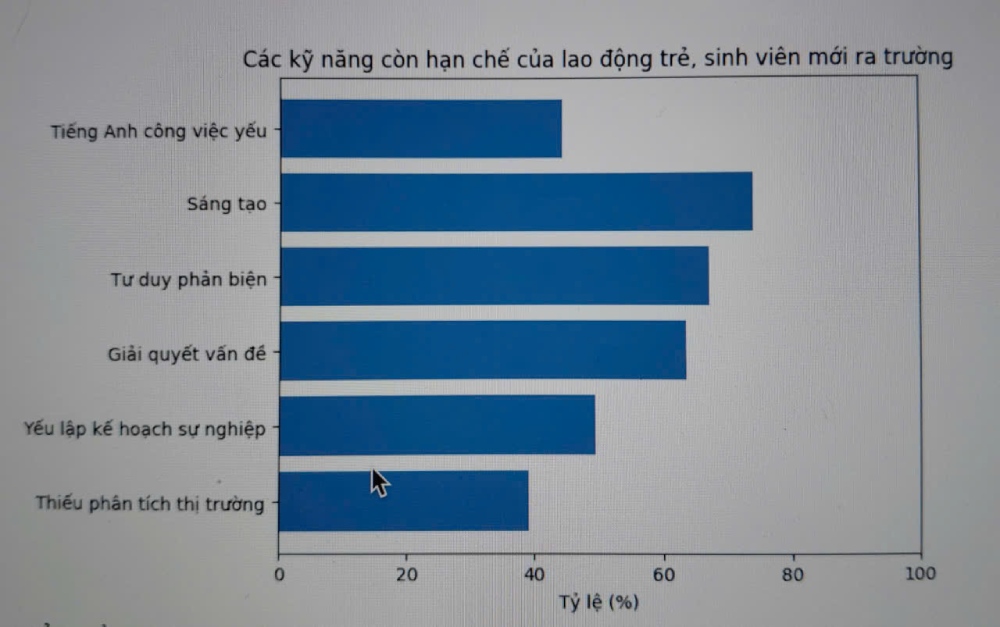
The Hanoi Employment Service Center has just announced the bulletin " Job picture for students in Hanoi". The survey conducted on 3,000 students showed that students lacked the ability to analyze the market with 39.17% confusion about human resource trends, so it was difficult to make the right decision. This group is also weak in career planning when 49.64% do not have a clear roadmap and lack a long-term vision.
Students' problem-solving ability is 63.8% with the majority of surveyed people self-assessing this ability from only average to below. Regarding critical thinking: 67.56% are not confident, and tend to accept one-sided information. Creativity: 74.32% self-assess at an average level or lower, lacking an environment to encourage new ideas.
Notably, foreign languages for work have not met the requirements, with 44.57% self-assessing their work English as weak/very weak. This is a big barrier when wanting to work in an international environment.
From this reality, many experts believe that to overcome the vague situation about human resource trends, it is necessary to change the approach to education and career orientation. Students must have earlier access to information about the labor market, future job trends and specific skills requirements for each major. At the same time, equipping analytical skills, career planning, digital skills and foreign languages should be considered a mandatory requirement, not just a "support" in the training program.
If this gap in awareness and skills is not narrowed, the risk of "overworking but lacking high-quality human resources" will continue to persist, becoming a major bottleneck for the goal of rapid and sustainable development of the economy in the coming period.


