The University of Southampton is a leading prestigious school in the UK with high achievements in research and application of multi-disciplinary science and technology with extensive experimental and applied capabilities in many fields such as artificial intelligence (AI), micro-electronics technology, aerospace, robots and quantum technology. The school is a member of the Russell Group - an association of leading public universities in the UK, known as the "Ivy League" of the UK, with a strong academic foundation, especially in the fields of STEM (Science, Technology, Engineering and Mathematics).
Over the past 70 years of its establishment and development, the University of Southampton has always been at the forefront of strategic technology research in the UK, focusing on the application and transfer of technology, creating practical products and solutions, contributing to the development of industry and society. The University of Southampton always maintains strong cooperative relationships with leading technology corporations, international research organizations and industrial partners. The school's international cooperation process has been promoted more strongly than ever during the term of Professor Andrew Atherton - Vice President of International Affairs of the University of Southampton. He is responsible for leading international cooperation strategies, building and maintaining global partnerships in research and education.
It is no coincidence that a highly ranked university in the UK with a long history of achievements pays special attention to CT Group - Vietnam. With the Tripple Helix cooperation model - a model of blending education, research and businesses, the University of Southampton continuously seeks opportunities for research development, knowledge exchange as well as cooperation with businesses.
Our experience in Southampton shows that when universities join hands with businesses with a high technology spirit, we will create new discoveries, new knowledge to help improve the world, create better opportunities and living conditions for people and society - Professor Andrew Atherton - Vice President in charge of international affairs of the University of Southampton shared.
With an ecosystem of 9 core technologies, suitable and intertwined business fields and academic research in new technology fields, it has created a potential strategic cooperation opportunity between CT Group and the University of Southampton.
According to Professor Andrew Atherton, Vietnam is one of the most interesting and dynamic countries in the world today. One of the reasons for that dynamism is that pioneering businesses and organizations like CT Group have led the national economic development, taking the lead in creating sustainable economic growth, contributing to improving the lives of Vietnamese people.
Southampton's strengths range from microelectronics, AI, cybersecurity, UAVs, clean energy, quantum technology to cell-gen technology and robotics, creating a rare comprehensive research ecosystem. When combined with the ability to deploy the core technology ecosystem from Semiconductor Technology, UAV Drone Technology, LAE Low-Range Space Economy, quantum Technology, Gen and Cell, New Energy... of CT Group, with a very high level of overlap, it will form a strong complements structure, when one side possesses the depth of academics and experience of international standards, the other side is capable of applying technology to large-scale practical applications. This added advantage creates a foundation for the joint development of core technologies of strategic significance, in line with Vietnam's innovation needs and global technology trends.
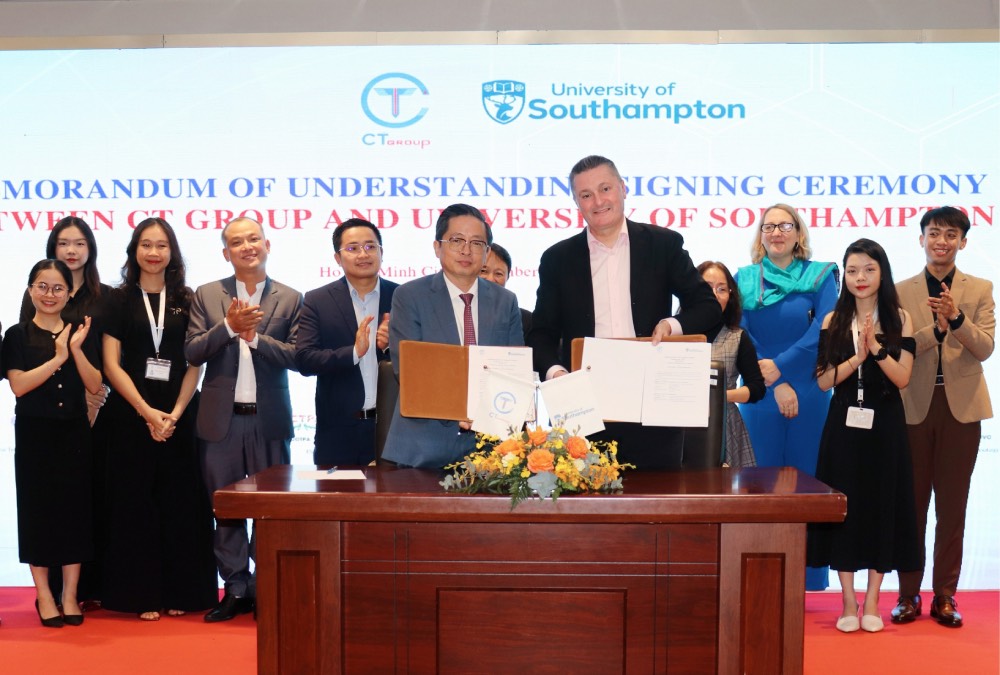
CT Group and Southampton University officially established a strategic cooperation relationship for the period of 2025 - 2028, through the signing of a memorandum of understanding on cooperation held on December 9, 2025, in Ho Chi Minh City, marking an important development step in the effort to connect Vietnamese technology enterprises with one of the leading universities in the UK in science and technology.
Cooperation between the two sides will aim at technology transfer and development of highly applicable scientific and technical platforms between the two countries. Instead of limiting it to the framework of basic training, the two sides will expand in-depth cooperation when developing human resource programs according to international standards, focusing on integrated research programs, ranging from UAV, AI, semiconductors, quantum technology to biotechnology... creating positive social impacts through sustainable projects, solving environmental and climate problems and developing technology solutions that benefit society. In particular, the joint development and application of LAE (Low altitude Economy) space economic technology will become one of the new growth drivers for European economies as well as create sustainable development for the Mekong Delta.