
Information from functional agencies, in the first quarter of 2026, import and export (I&E) activities through Cao Bang province recorded a significant decrease.
Total import and export turnover is estimated at 131.43 million USD, only about 8% of the set plan.
In the structure, export turnover reached 51.99 million USD (6% of the plan), imports reached 19.9 million USD (4% of the plan). Goods activities under supervision type reached 59.54 million USD, equivalent to 19% of the plan.
According to the assessment of functional agencies, import and export activities in the province have decreased comprehensively in terms of scale, number of declarations, turnover and efficiency.
The main reason identified is that import and export activities are heavily dependent on the Chinese market, while the structure of exported goods is still monotonous and low added value. In addition, transportation and logistics infrastructure are still bottlenecks.
At the beginning of the year, the production and business activities of enterprises showed signs of stagnation. Some agricultural products have reached consumption targets from 2025, while China has strengthened control over many imported agricultural products.
Notably, in the Ta Lung International Border Gate area, some businesses have shifted export direction to border gates in Lang Son province to reduce transportation costs and shorten travel time.
In addition, some businesses investing in projects and tax-exempt stores are cautious in disbursement due to concerns about business efficiency, causing the progress of many projects to be delayed.
Enterprises trading in warehouses in economic zones also continue to be negatively affected by the import and export situation, and operations have not achieved the expected efficiency.
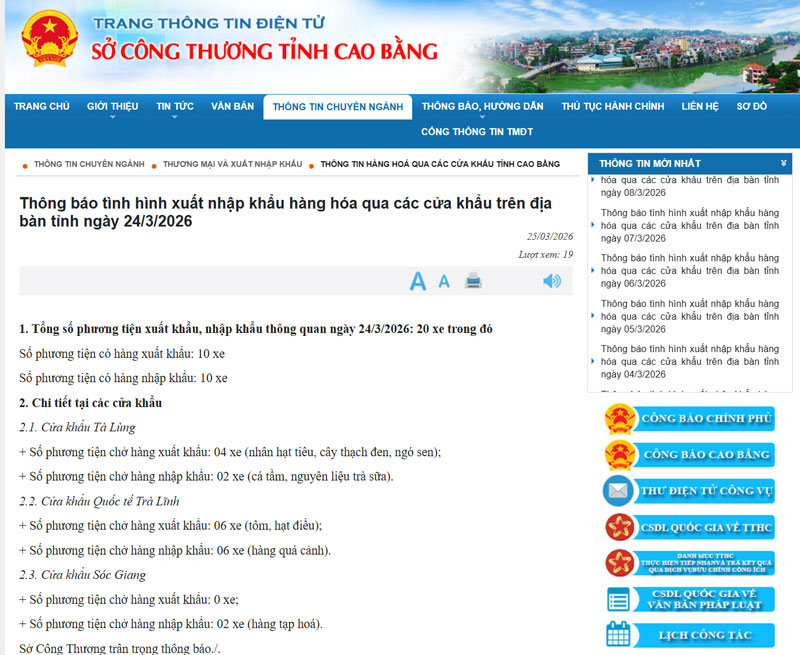
According to the latest data from the Department of Industry and Trade of Cao Bang province, on March 24, the total number of vehicles cleared for import and export was only 20 vehicles. The number of vehicles passing through border gates remained at a very low level, counted on the fingers of one hand.
Faced with the above situation, Cao Bang province has implemented many solutions to remove difficulties and promote import and export activities.
On March 23, the Department of Industry and Trade organized an inter-sectoral meeting to agree on a plan to advise the Provincial People's Committee on mechanisms to facilitate goods transportation through border gates during the day.
At the same time, the Provincial People's Council approved Resolution No. 01/2026/NQ-HĐND on collection, payment and management of border gate infrastructure fees.
Accordingly, the adjusted collection level is reduced by an average of about 20% compared to before, and fees are abolished for some imported goods such as cars, self-driving cars, specialized vehicles and equivalent machinery.
Talking to PV, a representative of the Cao Bang Provincial Border Gate Economic Zone Management Board said that the unit is coordinating with relevant departments and branches to develop a project to restructure import and export activities, and at the same time deploy a digital border gate model.
It is expected that in the coming time, the province will work with Chinese partners to attract more goods sources and gradually restore import and export activities in the area.


