
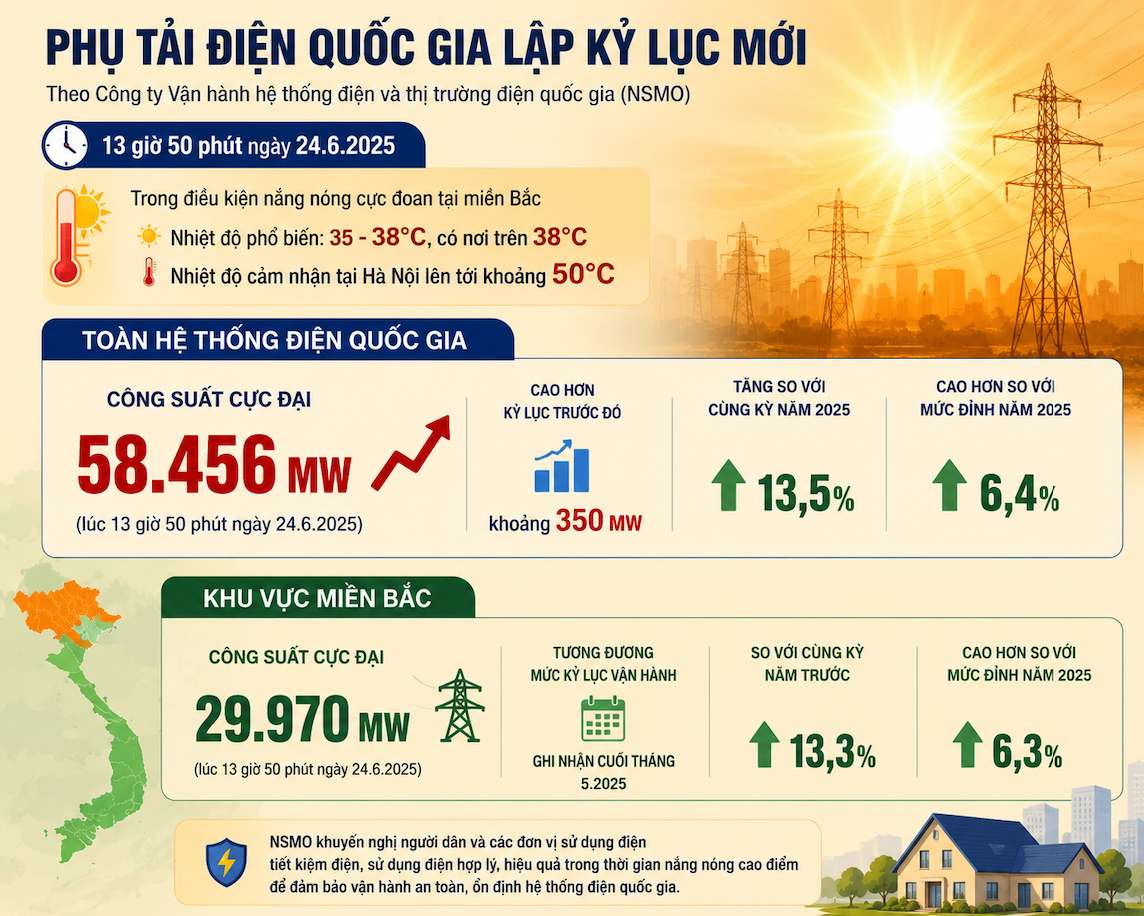
According to the National Power System and Electricity Market Operation Company (NSMO), at 1:50 PM on June 24, in extreme hot weather conditions in the North with common temperatures of 35-38 degrees Celsius, in some places above 38 degrees Celsius, the perceived temperature in Hanoi reached about 50 degrees Celsius, the maximum capacity of the national power system reached about 58,456 MW. This level is about 350 MW higher than the previous record, an increase of 13.5% compared to the same period in 2025 and 6.4% higher than the peak in 2025.
In the Northern region, the maximum capacity reached 29,970 MW, equivalent to the operating record record recorded at the end of May 2026. Compared to the same period last year, the regional load increased by 13.3% and 6.3% higher than the peak in 2025.
To meet the increasing load demand, NSMO said that all available power sources have been mobilized to the maximum level. Large coal, gas turbine and hydropower plants all operate at the highest available capacity. In particular, the system must also mobilize S2 O Mon unit using FO oil and units of Ninh Binh Thermal Power Plant to increase supply to the Northern region.
However, the system still faces many challenges when the available capacity of thermal power sources decreases by about 1,800 MW and may reach 2,000 MW if the heatwave continues to last.
According to Mr. Ngo Son Hai - Deputy General Director of Vietnam Electricity Group (EVN), with the current growth rate of electricity demand, the national power system needs to add about 4,000-5,000 MW of new capacity each year.
In that context, electricity saving plays a particularly important role in reducing investment pressure for the electricity industry. For example, to supplement 1,000 MW from offshore wind power or LNG power projects, after completing procedures, it also takes 3-4 years to put them into operation. Meanwhile, if about 2% of consumption capacity is saved, it is equivalent to reducing investment demand by about 1,000 MW. This shows that electricity saving is a faster, more effective and much less costly solution," said Mr. Ngo Son Hai.
EVN representatives said that currently, the electricity system operator must mobilize power sources in order from low cost to high cost to meet load demand. When electricity demand increases, the system is forced to mobilize additional power sources with higher costs. Therefore, saving electricity will contribute to limiting the mobilization of expensive power sources, thereby reducing the overall operating costs of the entire system.
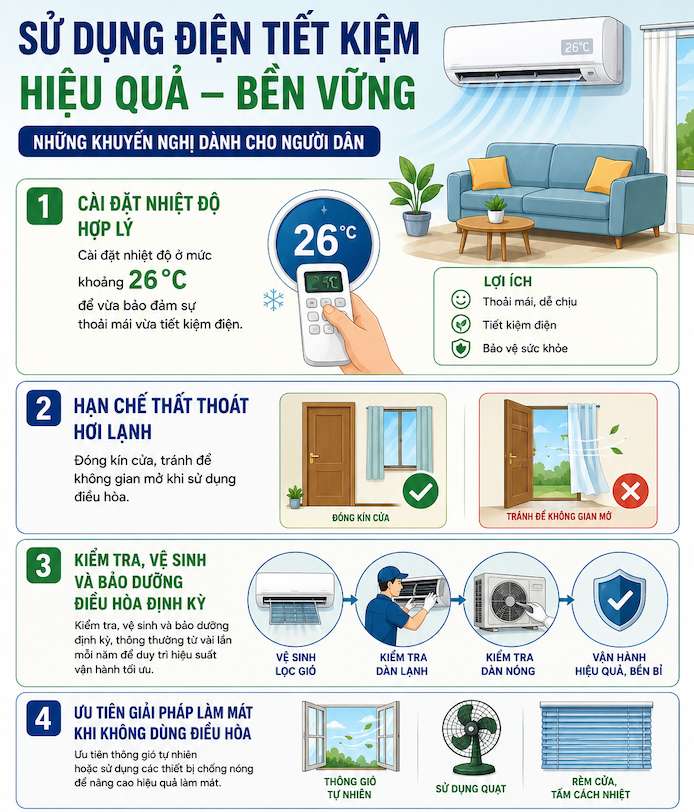
Regarding specific recommendations for people, Mr. Ngo Son Hai said that in the hot season, air conditioners are the most energy-consuming devices in many households. People should set the temperature to about 26 degrees Celsius to both ensure comfort and save electricity. At the same time, it is necessary to limit cold air loss by closing the doors tightly, avoiding leaving open space when using air conditioners. The air conditioning system also needs to be checked, cleaned and maintained periodically, usually several times a year, to maintain optimal operating efficiency.
For spaces that do not use air conditioning, natural ventilation solutions can be prioritized or heat-resistant devices can be used to improve cooling efficiency. In addition, people and businesses should limit the simultaneous use of many high-capacity electrical appliances, especially during peak hours of the power system.
Currently, in the summer, peak hours usually last from about 6 pm to 10 pm - 11 pm. This does not mean that people are not allowed to use electricity during this time, but should consider switching unnecessary devices to other time slots to reduce pressure on the system.
For investing in electrical equipment, people and businesses should prioritize choosing products with high energy efficiency. We currently have many online tools to support calculating electricity consumption, evaluating energy efficiency and conducting energy audits. These tools help users assess the economic efficiency of investing in new equipment.
Reality shows that in many cases, initial investment costs can be recovered after only a few years thanks to the saved electricity. These contents can all be specifically assessed and analyzed by professional consulting units," said an EVN representative.


